

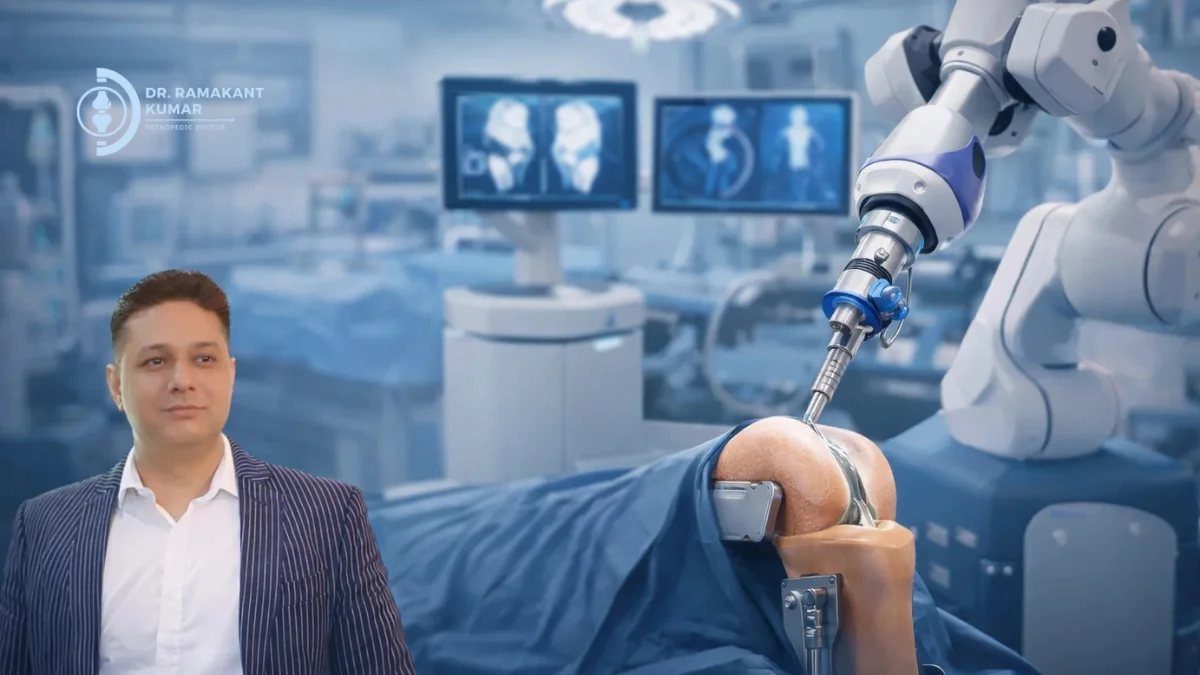
Robotic knee replacement is transforming how we treat severe knee pain and arthritis. Whether you’re considering total or partial knee replacement, robotic-assisted surgery offers greater precision, faster recovery, and improved joint alignment, especially for patients who haven’t found relief with medications or physiotherapy.
I am Dr. Ramakant Kumar, and I’ve created this guide to help you understand what robotic knee replacement surgery involves, the difference between total and partial procedures, and who can benefit most. This knowledge can help you make the right decision for your knee health and long-term mobility.
Contents
- 1 What Is Robotic Knee Replacement Surgery?
- 2 Who Should Consider Robotic Knee Replacement?
- 3 Robotic Total Knee Replacement in Patna: When the Entire Joint Needs Treatment
- 4 Robotic Partial Knee Replacement in Patna: Preserve What Is Healthy
- 5 Total vs Partial Robotic Knee Replacement: Which One Is Right for You?
- 6 Step-by-Step: How Robotic Knee Replacement Surgery Is Performed
- 7 Recovery Timeline: What Patients Can Realistically Expect
- 8 Benefits of Robotic Knee Replacement Compared to Conventional Surgery
- 9 Safety, Risks, and Honest Limitations
- 10 Why Surgeon Experience Matters More Than the Robot
- 11 Cost of Robotic Knee Replacement in Patna
- 12 FAQs About Robotic Knee Replacement Surgery
- 13 Conclusion
What Is Robotic Knee Replacement Surgery?
Robotic knee replacement surgery is an advanced technique that uses computer-assisted tools to help orthopedic surgeons plan and perform the procedure with greater accuracy. It’s important to understand that the surgery is not performed by a robot. I remain in full control of every step. The robotic system simply provides a real-time 3D view of your knee and helps me execute the surgical plan with sub-millimeter precision.
This technology allows for personalized bone cuts, optimal implant positioning, and better joint alignment based on your anatomy. The end result is a more natural-feeling knee, reduced risk of implant misplacement, and a smoother recovery process. Compared to conventional methods, robotic knee replacement offers higher accuracy, especially in complex cases or when bone structure is irregular.
Some patients ask me, “Does the robot decide everything?” The answer is no. Robotic assistance improves the precision of the work we already do, but the decisions, from diagnosis to final implant selection, are made by the surgeon.
If you’re searching for robotic knee replacement surgery in Patna, you’re likely looking for a treatment that is safer, more accurate, and offers better long-term results. And that’s exactly where this method stands out.
Who Should Consider Robotic Knee Replacement?
Not every patient with knee pain needs surgery. But if your symptoms are affecting daily activities and conservative treatments like painkillers, physiotherapy, or joint injections have failed to help, it may be time to consider a surgical solution.
You may be an ideal candidate for robotic knee replacement if:
- You have moderate to severe osteoarthritis
- Pain, swelling, or stiffness limits your ability to walk, sit, or climb stairs
- Your knee joint feels unstable or misaligned
- Imaging shows significant cartilage loss or deformity
- You have trouble performing daily routines or going to work
Robotic-assisted knee replacement is especially beneficial for:
- Younger, active patients who want precise joint preservation
- Individuals with knee deformities like bow-legs or knock-knees
- Patients who need either total or partial replacement with minimal tissue damage
In some early-stage cases, surgery might not be immediately necessary. A detailed clinical evaluation, physical exam, and imaging help determine whether you need to wait, start non-surgical management, or proceed with a robotic procedure.
Must Read: Is Your Back Pain Actually Due to Gas? Signs, Locations, and Easy Relief Methods
Robotic Total Knee Replacement in Patna: When the Entire Joint Needs Treatment
When arthritis or joint damage affects all three compartments of the knee, robotic total knee replacement is usually the best approach. In this procedure, we remove the damaged cartilage and bone from the thigh bone (femur), shin bone (tibia), and sometimes the kneecap (patella), and replace them with a metal and plastic implant.
Robotic technology adds precision to every step, especially during bone resurfacing and implant alignment. The system creates a 3D map of your knee before the first cut, helping us plan the surgery based on your leg shape, ligament balance, and lifestyle goals.
You may require robotic total knee replacement if:
- You have pain throughout the entire knee
- X-rays show bone-on-bone arthritis across all compartments
- Your knee is stiff or deformed (bow-leg or knock-knee)
- You experience pain even at night or while resting
Key benefits of robotic total knee replacement include:
- More accurate joint alignment
- Improved implant longevity and stability
- Better long-term pain relief
- Increased confidence while walking or using stairs
This procedure can be life-changing when done at the right time with the right planning.
Robotic Partial Knee Replacement in Patna: Preserve What Is Healthy
Not every patient with knee arthritis needs a full joint replacement. In many cases, damage is limited to just one part of the knee, most commonly the inner (medial) compartment. For such patients, a robotic partial knee replacement offers a less invasive, more natural alternative.
In this procedure, only the affected part of the knee is resurfaced, preserving your healthy bone, cartilage, and all major ligaments. This helps maintain more natural movement and reduces the trauma to your surrounding tissues.
As a surgeon, I find robotic technology particularly helpful in partial knee replacements because these procedures demand even higher precision. Millimeter-level accuracy matters when you’re preserving part of the joint, and robotic systems help minimize any risk of misalignment or over-correction.
You may be an ideal candidate for robotic partial knee replacement if:
- Arthritis is confined to one compartment (inner, outer, or front)
- Your knee remains stable and the ligaments are intact
- You want a quicker recovery and better functional range
- You are not yet ready for a total knee replacement
When selected properly, partial replacement allows you to get back to walking, cycling, or even mild jogging sooner, with less pain and a more natural feel in the joint.
Total vs Partial Robotic Knee Replacement: Which One Is Right for You?
Many patients come to me asking, “Can I go for partial instead of total replacement?” The honest answer is, it depends entirely on your knee structure, the extent of arthritis, and long-term outcome expectations.
Here’s a quick comparison I often share during consultations:
| Factor | Robotic Total Knee Replacement | Robotic Partial Knee Replacement |
| Area Replaced | All 3 compartments | One damaged compartment only |
| Best For | Advanced arthritis, deformity | Localized arthritis, stable ligaments |
| Natural Knee Preservation | Moderate | High |
| Recovery Speed | Slower | Faster |
| Post-op Knee Feel | Artificial but stable | More natural feel |
| Implant Longevity | 15–20 years (average) | Similar, if selected correctly |
Ultimately, the choice between total vs partial robotic knee replacement must be based on:
- Clinical evaluation
- Weight-bearing X-rays or MRI
- Your age, activity level, and long-term mobility goals
Robotic planning helps me analyze your knee in high detail, but the decision is always personalized. If I feel your joint can be preserved safely, I always recommend partial over total, but only if it gives you lasting relief.
Step-by-Step: How Robotic Knee Replacement Surgery Is Performed
Understanding how the procedure works can ease anxiety and help you prepare better.
Here’s how we typically perform robotic knee replacement surgery in Patna:
- Pre-surgery Planning & Imaging: We take CT scans or X-rays to build a 3D digital model of your knee. This allows me to evaluate your bone structure, ligament alignment, and damage level.
- Custom Surgical Plan: Based on the digital model, I design a personalized surgical plan, choosing the implant size, alignment angles, and bone cut precision before even entering the operating room.
- Robotic-assisted Bone Preparation: During surgery, the robotic arm guides my instruments and ensures the cuts are made exactly as planned, minimizing damage to surrounding tissue.
- Precise Implant Placement: The robotic system provides live feedback, helping me place the implant in the best possible position to match your natural alignment and movement.
- Balancing and Final Checks: Before closing, I check ligament tension and joint motion in real time, adjusting as needed to ensure perfect balance and comfort.
This entire process is built around safety, accuracy, and consistency. It helps reduce human error, shortens surgical time, and leads to more predictable recovery outcomes.
Recovery Timeline: What Patients Can Realistically Expect
The recovery timeline after robotic knee replacement depends on whether you’ve undergone total or partial replacement, but overall, patients recover faster and with more confidence compared to conventional methods.
First 48 Hours
You will begin standing and walking with support, usually the same day or next. Pain is managed through a structured protocol, and robotic surgery often results in less swelling and tissue damage.
First 2 Weeks
You’ll work with physiotherapists to regain range of motion and knee strength. Most patients return home within 3–5 days and start walking with a walker or cane. The focus is on reducing stiffness and building early confidence.
Weeks 4 to 6
By this stage, you should be walking independently, climbing stairs, and resuming light household work. Patients who undergo robotic partial knee replacement often reach this point earlier.
3 Months and Beyond
You can expect to return to normal activities such as office work, longer walks, and even travel. Recovery is smoother due to accurate implant positioning and better joint balance.
Remember, physiotherapy and home exercises are critical for full recovery. Your commitment matters as much as the surgery itself.
Benefits of Robotic Knee Replacement Compared to Conventional Surgery
A common question I hear from patients is whether robotic knee replacement truly offers better results or is simply a modern trend. Based on what I’ve seen in my practice, the benefits are clear:
- Higher accuracy in implant alignment, reducing wear and increasing implant life.
- Less soft tissue trauma, which means less post-operative pain and faster healing.
- Better joint balance, leading to more natural movement and fewer complications.
- Fewer chances of revision surgery, especially in active patients.
- Improved patient satisfaction, particularly in how the new joint feels during walking or bending.
For patients in Patna looking for a more precise and reliable knee surgery outcome, robotic knee replacement offers clear advantages.
Safety, Risks, and Honest Limitations
Like any surgery, robotic knee replacement has risks, bleeding, infection, blood clots, or implant-related complications. However, the robotic planning system helps reduce some of these risks by allowing better control over each surgical step.
Still, it’s important to remember that technology does not replace surgical experience. Robotic systems enhance results only when used correctly, and that’s where experience and planning play a critical role.
Why Surgeon Experience Matters More Than the Robot
Robotic systems are tools, powerful ones, but tools alone don’t guarantee great outcomes. As a surgeon, I am responsible for:
- Evaluating your knee condition thoroughly
- Selecting the right implant type and size
- Making real-time decisions during surgery
- Planning your rehabilitation after discharge
If you’re searching for the best orthopedic doctor in Patna for robotic knee replacement, I recommend you look beyond equipment. Choose someone who explains things clearly, guides you honestly, and has the surgical volume and results to back their recommendations.
Cost of Robotic Knee Replacement in Patna
The cost of robotic knee replacement in Patna varies based on:
- Whether it’s total or partial replacement
- Implant brand and type (imported or Indian)
- Hospital stay, physiotherapy, and diagnostics
While robotic procedures may seem costlier than conventional methods, they offer better alignment, lower complication rates, and longer implant survival, which can reduce revision surgeries later. The long-term value is often higher than the upfront cost.
I always discuss cost transparently with patients, including alternatives if needed.
Must Read: Why Frozen Shoulder Pain Peaks in Winter and How to Prevent It
FAQs About Robotic Knee Replacement Surgery
Is robotic knee replacement safe?
Yes, it is safe and often more precise than traditional surgery when done by an experienced surgeon.
How long will the implant last?
Most robotic implants last 15–20 years, and accurate placement may improve longevity even further.
Can both knees be replaced together?
Yes, in suitable candidates, both knees can be replaced in one sitting after proper evaluation.
Is partial knee replacement permanent?
Yes, if arthritis is limited and implant placement is precise, partial replacements can last 10–15+ years.
When can I climb stairs or drive again?
Climbing stairs is usually possible by 3–4 weeks. Driving depends on your leg strength and response time, generally after 6 weeks.
Conclusion
Robotic knee replacement goes beyond advanced technology, it’s about providing highly personalized treatment with greater precision, improved safety, and more reliable surgical results. Whether you need a total or partial procedure, your success depends on careful evaluation, patient education, and step-by-step surgical planning.
If you’re considering robotic total knee replacement or robotic partial knee replacement in Patna, I encourage you to schedule a consultation. I’ll take the time to explain every detail, address your concerns, and help you choose the best option for your long-term knee health. 📞 Call or WhatsApp: 7070312214
Surgery is not the end, it is the beginning of a more active, pain-free life.