Shoulder pain can be frustrating because it often starts like a minor strain, but in some patients, the real problem is deeper inside the joint. You may feel pain while lifting your arm, discomfort during gym workouts, weakness during throwing, or a repeated clicking sensation that does not seem normal. When these symptoms continue, one possible reason is a tear in the upper part of the shoulder labrum, called a Superior Labrum Anterior and Posterior tear, or a SLAP tear.
This area is important because it helps with shoulder stability and is closely connected to the biceps tendon. That is why patients with a SLAP injury often complain of pain during pulling, lifting, overhead work, sports activity, or even simple daily movements done at the wrong angle.
If you are searching for SLAP repair in Patna, the first thing I want you to understand is this: every SLAP tear does not need surgery, and every MRI finding is not equally important. The real key is proper diagnosis. Before discussing treatment, we need to understand what a SLAP tear is, what symptoms it causes, and whether it is truly the reason behind your shoulder problem.
Contents
- 1 What is a SLAP tear?
- 2 Symptoms of a SLAP tear patients commonly notice
- 3 What usually causes a SLAP tear?
- 4 How do we diagnose a SLAP tear properly?
- 5 When is SLAP repair actually needed?
- 6 How is SLAP repair surgery done?
- 7 Recovery after SLAP repair
- 8 When should you consult a shoulder specialist in Patna?
- 9 Conclusion
What is a SLAP tear?
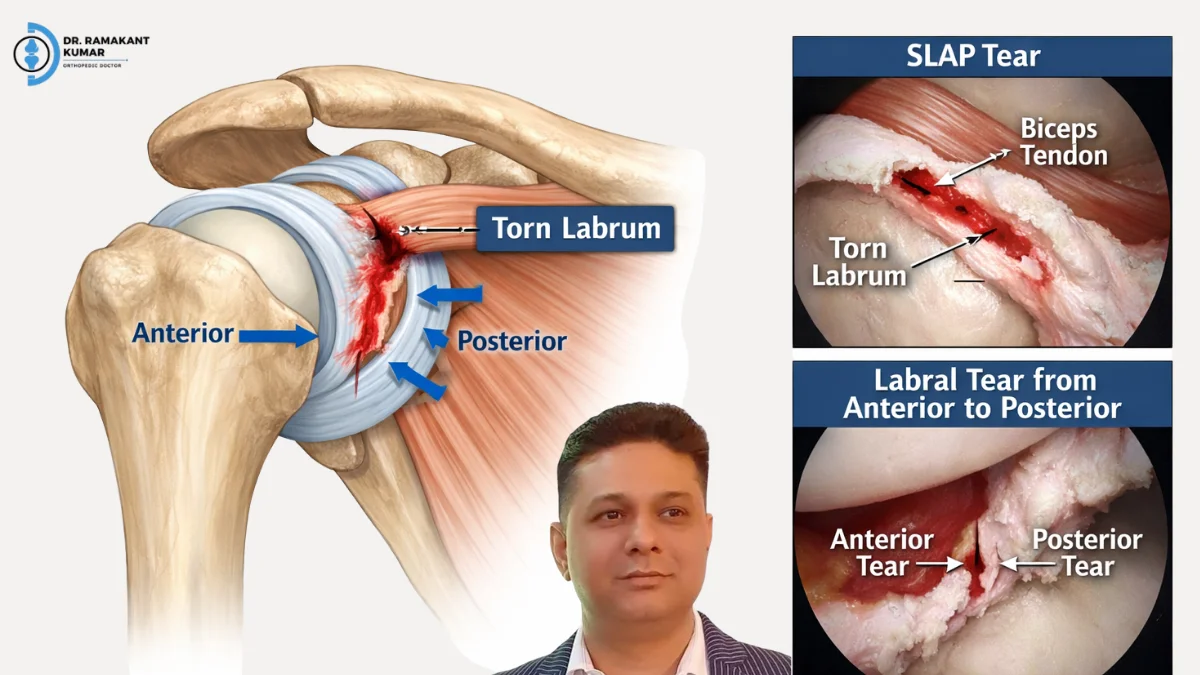
The shoulder joint has a soft but strong rim of tissue around the socket called the labrum. Its job is to support stability and help the ball of the shoulder stay centered during movement. A SLAP tear develops in the upper rim of cartilage that lines the shoulder socket.
The term Superior Labrum Anterior and Posterior simply means:
- Superior: the upper part of the labrum
- Anterior and Posterior: the tear may extend in front of and behind the attachment point
- this is also the area where the biceps tendon attaches
This is why a SLAP lesion is not just a small surface injury. When the upper labrum is torn, patients may feel pain with forceful shoulder use, especially when the arm is raised, rotated, or loaded.
In simple words, a SLAP tear can affect:
- shoulder stability
- smooth movement inside the joint
- strength during lifting or overhead activity
- comfort during sports, gym work, and repetitive arm use
Symptoms of a SLAP tear patients commonly notice
A SLAP tear does not always cause dramatic pain at rest. In many patients, the symptoms appear mainly when the shoulder is used in a demanding way.
Common symptoms include:
- deep pain inside the shoulder
- clicking, popping, or catching during movement
- pain while lifting the arm overhead
- weakness during gym training, throwing, or pulling
- discomfort while sleeping on the affected side
- a feeling that the shoulder is not moving smoothly
- reduced confidence in the arm during sports or active work
One important detail I always explain to patients is that these symptoms can look very similar to rotator cuff pain, impingement, biceps irritation, or even general shoulder strain. That is exactly why a shoulder injury should not be judged only by symptoms or only by an MRI report.
What usually causes a SLAP tear?
In practice, I usually see SLAP tears develop in two main ways.
1. Sudden injury
This includes situations like:
- falling on an outstretched hand
- direct injury to the shoulder
- a sudden pull on the arm
- sports trauma
- shoulder dislocation
- road traffic injury
2. Repeated overhead strain
This is common in patients who do repeated or forceful shoulder movement over time, such as:
- cricket
- badminton
- volleyball
- weight training
- manual overhead work
- repeated lifting above shoulder level
In some adults, age-related wear may also affect the upper labrum. That is why not every labral change seen on imaging needs repair.
Read More: Shoulder Arthroscopy Guide: Glenoid, Labrum, Rotator Cuff & AC Joint Repair in Patna
How do we diagnose a SLAP tear properly?
A proper diagnosis starts with the patient’s story. I want to know exactly how the pain began, which movement triggers it, whether there was a fall or sports injury, and what activities are now difficult.
Then comes a careful shoulder examination. During this stage, we assess:
- range of motion
- strength
- painful movement patterns
- shoulder stability
- signs suggesting biceps or rotator cuff involvement
- whether the pain may actually be coming from another shoulder problem
After that, imaging may be advised when needed. MRI helps us assess the labrum and surrounding soft tissues, but this is where many patients get confused. A scan can support the diagnosis, but it should not make the decision by itself.
The most important point is this:
we do not treat MRI words, we treat the patient.
A tear written in the report becomes meaningful only when it matches:
- your symptoms
- your examination findings
- your activity limitation
- the overall shoulder pattern
That is the stage where we can start deciding whether the problem is likely to improve with non-surgical treatment or whether SLAP repair may eventually be needed.
When is SLAP repair actually needed?
One of the most common misunderstandings I see is this: if the MRI says SLAP tear, patients assume surgery is the next step. That is not always true. Not every Superior Labrum Anterior and Posterior injury needs immediate repair.
We usually start by seeing whether the shoulder can improve without surgery through:
- activity modification
- pain-control medicines when needed
- shoulder physiotherapy
- strengthening of the rotator cuff and surrounding muscles
- gradual return to overhead movement only after pain improves
If the pain settles and function improves, surgery may not be necessary. That is why I always tell patients not to panic after reading an MRI report. The scan should support the diagnosis, not dictate it on its own.
We think more seriously about SLAP repair in Patna when a patient has:
- persistent deep shoulder pain despite proper non-surgical treatment
- repeated clicking or catching that affects function
- weakness during lifting or overhead use
- difficulty returning to gym, sports, or work
- symptoms that match the tear seen on imaging
- a clinically significant tear in a younger or active patient
The real decision is not just whether a tear exists. The real question is whether that tear is truly causing your symptoms and limiting your shoulder function.
How is SLAP repair surgery done?
When surgery is needed, SLAP repair is usually done through shoulder arthroscopy. This allows us to treat the problem through small incisions instead of a large open cut in most cases.
In simple terms, the procedure usually involves:
- inserting a small camera into the shoulder joint
- examining the labrum, biceps attachment, and nearby structures
- confirming the exact location and extent of the tear
- preparing the torn area for repair
- fixing the torn superior labrum back to the socket with anchors and sutures when required
This matters because shoulder pain may not always come from only one structure. Arthroscopy helps us see whether the SLAP lesion is the true pain generator or whether there are associated problems inside the joint as well.
From a patient’s point of view, the important things to understand are:
- the goal of surgery is to reattach the damaged labrum so the shoulder can function more securely and smoothly.
- the goal is to reduce pain and improve shoulder stability and function
- the procedure is usually done in a minimally invasive way
- recovery depends not just on surgery, but also on proper rehabilitation afterward
A good SLAP repair in Patna is not about simply fixing what appears torn on a report. It is about matching the right procedure to the right patient after a proper evaluation.
Recovery after SLAP repair
For most patients, recovery after shoulder labrum surgery is more important than the operation itself. A good repair can still give a disappointing result if the shoulder is not protected early and rehabilitated properly later.
After arthroscopic SLAP repair, the arm is usually kept in a sling for a few weeks so the repaired tissue can start healing without unnecessary strain. Major orthopedic guidance commonly places sling use in the range of about 2 to 6 weeks, depending on the injury pattern and the procedure performed.
In practical terms, recovery usually moves in phases:
- Early protection phase: pain control, sling use, wound care, and avoiding sudden shoulder movement
- Guided motion phase: gradual supervised movement once the repair is safe enough to mobilize
- Strengthening phase: progressive work on the rotator cuff, scapular muscles, and shoulder control
- Return to activity phase: step-by-step return to daily tasks, work, gym activity, and sports
This is why I tell patients that recovery is not just about waiting for time to pass. It is about following the right sequence. Trying to use the shoulder too aggressively in the early stage can overload the repair, while being too inactive for too long can lead to stiffness.
Patients often ask when they can return to normal life. Light routine activity may start earlier, but full recovery takes patience. Athletes often begin a graded return to sport after several months, and full unrestricted play may take around six months in many cases. Some overhead athletes, especially throwers, may need even longer and outcomes can be less predictable than patients expect.
Read More: Bone Pain in Children – When to Worry and When to See a Doctor
When should you consult a shoulder specialist in Patna?
You should not ignore shoulder symptoms for months if they are interfering with function. A proper evaluation becomes important when you notice:
- deep shoulder pain that is not settling
- repeated clicking, catching, or popping
- weakness during lifting or overhead use
- pain while throwing, gym training, or manual work
- reduced confidence in the shoulder during movement
- MRI evidence of a labral injury with ongoing symptoms
In these situations, the right next step is not guessing from the report. It is getting a clinical shoulder assessment so the symptoms, examination, and imaging can be matched properly. That is the real way to decide whether you need physiotherapy, medication, further workup, or a procedure such as SLAP repair in Patna.
If you are looking for the best orthopedic doctor in Patna for persistent shoulder pain, make sure the evaluation focuses on the actual pain source and not just on a scan label.
Conclusion
A Superior Labrum Anterior and Posterior tear can be easy to misunderstand because its symptoms often resemble other shoulder problems. The key is not just finding a tear on MRI, but confirming whether that tear is truly responsible for your pain, clicking, weakness, or loss of overhead function.
Not every patient needs surgery, but when symptoms persist and the clinical findings match the injury, a well-planned SLAP repair can help restore shoulder stability and function.
If your shoulder pain, clicking, or weakness is not improving, the right step is to get it evaluated early. Book an appointment with me, Dr. Ramakant Kumar, for a detailed shoulder assessment and a clear, personalized treatment plan.