
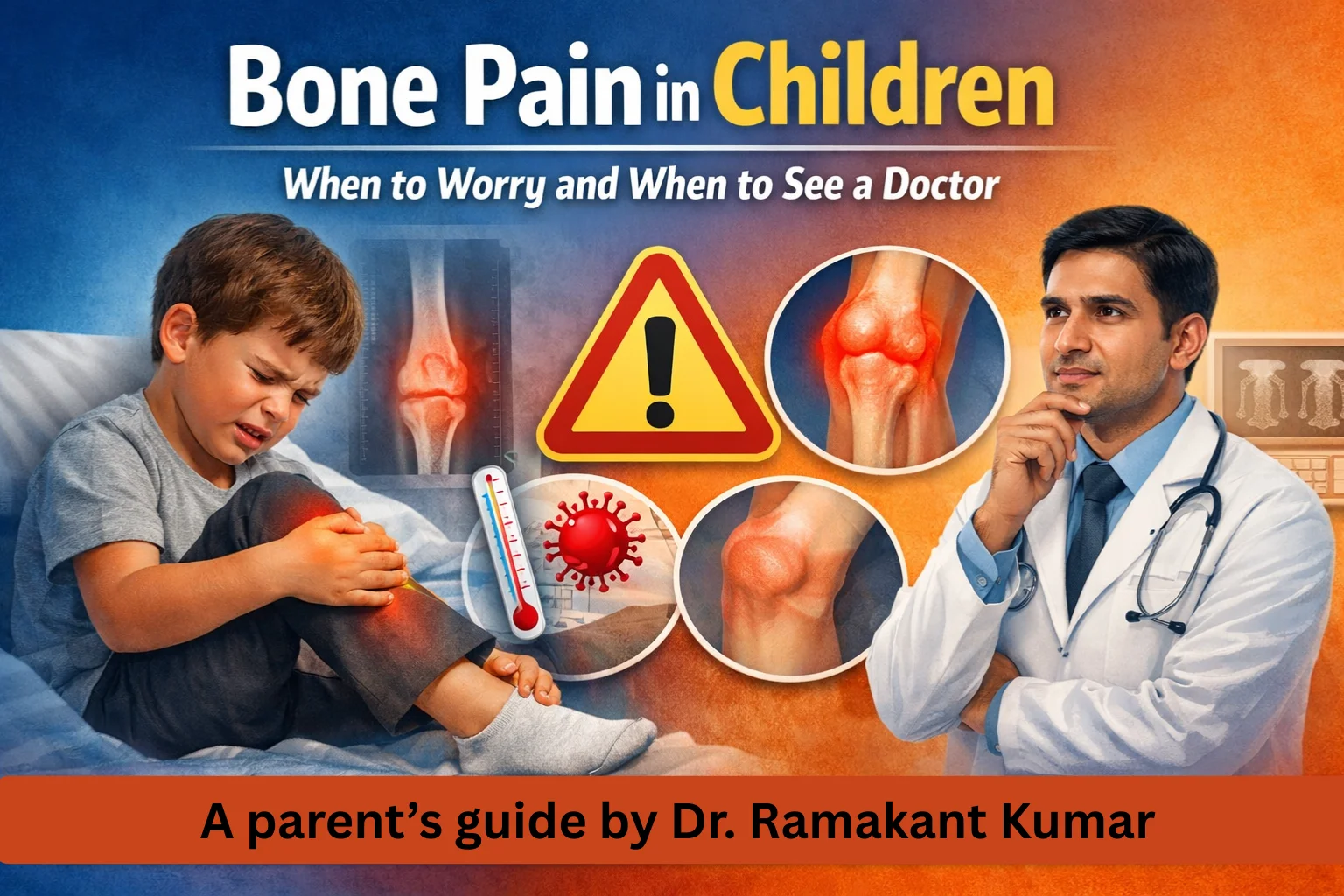
As a parent, you notice small changes quickly. A child who usually runs around freely may suddenly avoid stairs, ask to be carried, or complain that their legs hurt. In most families, the first thought is either “Maybe it is growing pains” or “Did they hurt themselves while playing?” Both are reasonable. But the truth is, bone pain in children and joint pain in children can have many causes. Some are simple and temporary, while a few need medical attention without delay.
In this guide, I will help you understand what bone pain feels like compared to joint or muscle pain, and exactly when joint pain in children is serious. I will also explain joint pain in children causes that we commonly see in Indian families, including overuse, post-viral pain, vitamin D and calcium related issues, inflammation, and infections. My goal is to help you take the right next step with clarity, not fear.
Contents
- 0.1 Bone Pain vs Joint Pain vs Muscle Pain: How You Can Tell at Home
- 0.2 When Is Joint Pain in Children Serious? 5 Red Flags that I Want You to Take Seriously
- 0.2.1 1) Your child refuses to walk or suddenly starts limping
- 0.2.2 2) Fever along with bone or joint pain
- 0.2.3 3) The joint looks swollen, hot, or movement is clearly restricted
- 0.2.4 4) Pain that repeatedly wakes your child at night or keeps getting worse
- 0.2.5 5) Whole-body symptoms like unusual tiredness, weight loss, paleness, or frequent bruising
- 0.3 Growing Pains: What They Look Like and What They Do Not
- 1 Joint Pain in Children Causes in India
- 1.1 1) Overuse and Mechanical Pain (The Most Common Pattern I See)
- 1.2 2) Post-Viral Body Aches and Reactive Joint Pain
- 1.3 3) Vitamin D and Calcium Related Bone Pain (Very Common in India)
- 1.4 4) Inflammatory Joint Problems (When Stiffness Matters More Than Pain)
- 1.5 5) Bone or Joint Infection (A Situation Where Time Matters)
- 1.6 6) Less Common but Important Patterns (Do Not Panic, Just Recognise the Signs)
- 1.7 What I Usually Check in Clinic (So You Know What to Expect)
- 2 Tests, Safe Home Care, FAQs, and the Right Next Step
- 3 FAQs Bone Pain in Children
- 4 Conclusion
Bone Pain vs Joint Pain vs Muscle Pain: How You Can Tell at Home
Parents often use the word “bone pain” for any pain in the arms or legs. But the source of pain matters, because bone pain in children is evaluated differently from joint pain or muscle pain.
Bone pain is usually deeper and more specific. A child can often point to a particular spot on the shin, thigh, arm, or near a bone and say it hurts even when they are not moving much. Bone pain may feel like a constant ache, and pressing on the area can make it sharply tender. Pain that stays in the same exact location again and again is something I take seriously, especially if it is getting worse.
Joint pain is more about movement and stiffness. The child may complain that bending the knee hurts, turning the ankle hurts, or moving the wrist is painful. You might notice the joint is puffy, warm, or the child is not using it normally. In younger children, joint pain often shows up as limping. One important point is that hip problems in children sometimes present as pain in the thigh or knee. So if your child keeps saying their knee hurts but the knee looks normal, the hip still needs to be checked properly.
Muscle pain is often more diffuse, like soreness. It can happen after intense play, sports training, or even after a viral fever. The child may say both legs feel heavy or aching, but when you examine them, the joints look normal and there is no specific bone point tenderness. Muscle pain usually improves with rest, hydration, and time.
If you are unsure which it is, do not get stuck trying to label it. Instead, focus on the pattern. The most useful questions are: Is your child walking normally? Is there fever? Is there swelling? Is the pain improving or worsening day by day?
When Is Joint Pain in Children Serious? 5 Red Flags that I Want You to Take Seriously
Most joint pain in children causes are not dangerous, but serious conditions often show clear warning signals. If you notice any of the following, I recommend medical evaluation without delay.
1) Your child refuses to walk or suddenly starts limping
When a child cannot bear weight, refuses to stand, or starts limping suddenly, I treat it as a red flag. A limp is not always an injury. It can be the earliest sign of a hip problem, joint infection, bone infection, or inflammation. If the child is holding the leg still, crying with movement, or avoiding putting the foot down, do not wait for several days hoping it will settle.
2) Fever along with bone or joint pain
Fever changes the whole picture. Bone pain in children with fever, or joint pain with fever, can indicate infection. Some parents assume it is just viral fever, and sometimes it is. But if the pain is severe, localised, or the child refuses to move a joint, we must rule out serious infections like septic arthritis or osteomyelitis early. These conditions can damage the joint or bone quickly if treatment is delayed.
3) The joint looks swollen, hot, or movement is clearly restricted
If you can see swelling, or feel warmth compared to the other side, or the child cannot bend or straighten the joint normally, this is not typical growing pain. It could be inflammation, injury, or infection. Even if there is no fever, swelling with restricted movement needs evaluation. A joint that is painful but looks completely normal is often less urgent, but a joint that is visibly changed deserves attention.
4) Pain that repeatedly wakes your child at night or keeps getting worse
Many parents associate night pain with growing pains. That is partly true, but the details matter. Growing pains usually come and go, often in both legs, and the child is fine in the morning. If pain wakes your child again and again, happens in the same spot, or is getting stronger week by week, I consider it a warning sign. Persistent night pain that is not settling deserves a proper assessment.
5) Whole-body symptoms like unusual tiredness, weight loss, paleness, or frequent bruising
This is uncommon, but important. If your child has ongoing bone pain along with unexplained fatigue, reduced appetite, weight loss, pale appearance, frequent bruising, or repeated fevers, do not ignore it. These signs can be linked to systemic illness. Most children will never face such causes, but the safest approach is to evaluate early when these clues appear.
If your child has one of these signs, you do not need to self-diagnose. Your job is only to recognise that this may not be routine pain and get timely medical help.
Growing Pains: What They Look Like and What They Do Not
Growing pains are real, and many families in India deal with them. But growing pains are frequently misused as a label for pain that actually needs evaluation, so let me explain it clearly.
Typical growing pains usually:
- Occur in the evening or at night, often after an active day
- Affect both legs more than one leg, commonly the calves, shins, or thighs
- Do not cause swelling, redness, or warmth in a joint
- Improve with gentle massage, warmth, and comfort
- Do not cause limping the next day, and the child usually wakes up fine in the morning
Now, what growing pains do not explain well:
- Pain in one exact spot again and again
- A swollen joint, or pain with clear restriction of movement
- Morning stiffness, especially stiffness that improves later in the day
- A limp, refusal to walk, or pain that is worsening over time
- Pain with fever, or pain with unusual tiredness and poor appetite
If your child fits the classic growing pain pattern and is completely normal during the day, it is usually safe to monitor. But if the pattern does not match, do not force the growing pains to explain.
At home, simple steps like a warm compress, gentle leg massage, good hydration, and rest help many children. If you are using pain medicine frequently for the same complaint, that is a sign it is time to get evaluated rather than continuing home management.
Joint Pain in Children Causes in India
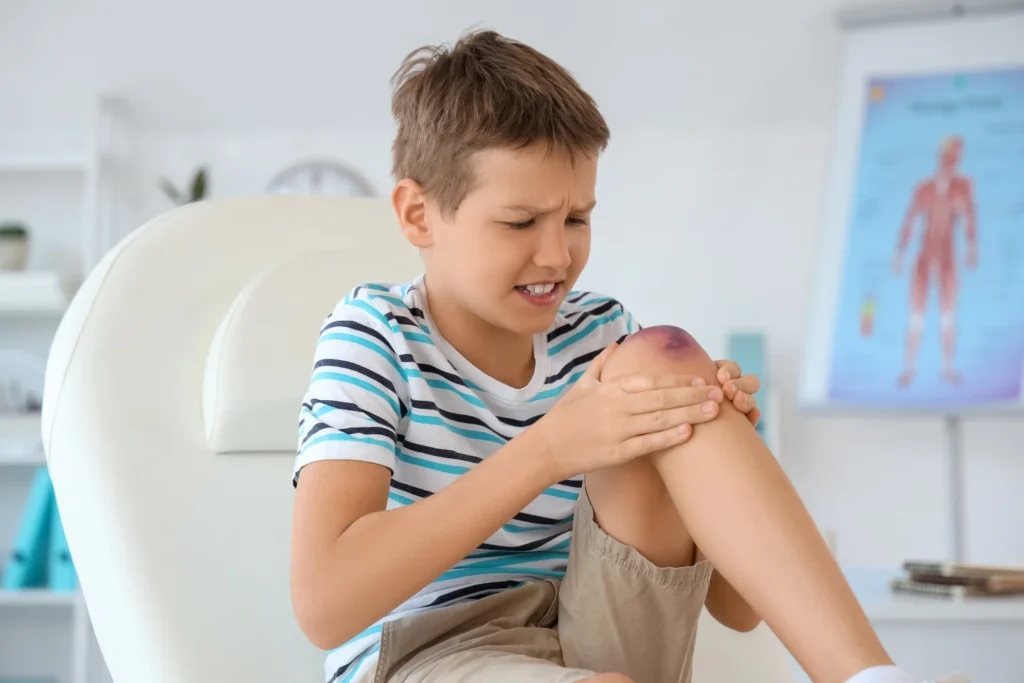
Now that you know how to separate bone pain from joint and muscle pain, let us talk about what is actually behind it. When parents search for joint pain in children, they usually want one thing: “Is this something minor, or do I need to worry?”
In India, I see a few patterns again and again. Some are linked to school routines, sports coaching, and rapid activity changes. Some follow viral fever seasons. And some relate to nutrition and sunlight exposure, especially vitamin D deficiency. I will explain these in a practical way, so you can match the cause to what you are seeing at home.
1) Overuse and Mechanical Pain (The Most Common Pattern I See)
A large number of children I examine have pain simply because their body is being used more than it is ready for.
This happens when:
- A child joins a cricket academy, football coaching, dance classes, or starts intense tuition schedules with little rest
- Activity suddenly increases after a break, like after exams or during holidays
- There is poor footwear, flat feet, or awkward running posture
- The child carries a heavy school bag daily, climbs stairs, and plays afterwards without recovery
How it usually looks:
- Pain comes after activity and improves with rest
- There is no fever
- There is no visible swelling or warmth in the joint
- The child may complain of knee pain, ankle pain, heel pain, or shin pain
- The pain often increases in the evening because the whole day load adds up
One key detail I ask parents is this: “Does pain reduce on Sunday or holidays?” If your child feels noticeably better on rest days or lighter-activity days, the pain is often linked to overuse rather than a serious condition.
What you can do first:
For mild pain with no red flags, a short rest period of 48 to 72 hours, hydration, and reducing high-impact activity can help. If pain keeps returning every week, it is better to correct the cause instead of just treating symptoms. Many children need simple steps like footwear correction, stretching, and training load adjustment, not long-term pain medicines.
2) Post-Viral Body Aches and Reactive Joint Pain
After a viral fever, many children complain of leg pain, knee pain, or general body aches. Parents often worry that it is bone pain, but the pattern is usually temporary.
How it usually looks:
- Pain starts during fever or within 1 to 2 weeks after it
- Pain may move around or be felt in both legs
- The child may feel tired and less active for a few days
- There is usually no persistent swelling of a joint
- The trend is improving, even if slowly
In Indian families, this is common during seasonal viral waves. The important part is the direction. If your child is getting better overall each day, pain is likely part of recovery.
When I worry:
- Pain is not improving after 7 to 10 days
- The child starts limping or refusing to bear weight
- There is persistent swelling or repeated fever spikes
- Pain is in one exact location repeatedly
That is when we stop assuming it is just post-viral.
3) Vitamin D and Calcium Related Bone Pain (Very Common in India)
Many parents are surprised when I say this, but vitamin D deficiency is one of the most frequent contributors to bone pain in children in India. It is not only about diet. Many children spend more time indoors than parents realize. Even in sunny cities, if a child is mostly inside school, tuition, and home, sunlight exposure can be low. Add picky eating, low milk intake, or poor protein intake, and bone discomfort becomes more likely.
How it usually looks:
- Generalised leg aches, especially in shins, thighs, or around knees
- Pain after activity, and sometimes dull aches even at rest
- Child gets tired easily or avoids sports
- Some children complain of back pain or foot pain
- In younger kids, you may see delayed walking, bowing of legs, or repeated falls, but these are not in every case
The key point is: do not start supplements blindly at high doses. Vitamin D needs the right dose for age and deficiency level. A doctor can decide whether testing is needed based on symptoms, diet, sun exposure, and exam findings.
If your child has repeated bone pain without swelling, especially if they are indoors most of the day and diet is limited, this factor deserves attention.
4) Inflammatory Joint Problems (When Stiffness Matters More Than Pain)
Some joint conditions are not because of injury or overuse, but because of inflammation. Parents often miss this because the child does not always say “I have stiffness.” They simply say “My knee hurts” or they avoid using the joint in the morning.
How it usually looks:
- Morning stiffness, meaning the child is slow to move or complains of pain after waking up
- Pain improves after moving around
- Joint swelling may be present, but sometimes it is mild
- The pain can come in episodes, returning again and again
- The child may avoid running, sitting cross-legged, or bending the knee fully
This is one reason why joint pain in children when it is serious is not only about night pain or fever. Morning stiffness is an important clue. If a child regularly struggles in the morning and becomes better by afternoon, I want to evaluate inflammation properly rather than calling it growing pains.
5) Bone or Joint Infection (A Situation Where Time Matters)
Infections are not the most common cause, but they are among the most urgent causes. A bone infection or joint infection can worsen quickly, and delay can lead to long-term joint damage.
How it often presents:
- Severe pain that is much stronger than typical strain pain
- Child refuses to walk, or holds the limb still
- Fever may be present, but sometimes it is low-grade or recent fever history is present
- Joint may look swollen, hot, or extremely tender
- The child looks unwell, not just in pain
This is not a condition to watch at home for many days. If your child has fever with severe bone pain in children, or severe joint pain with inability to bear weight, same-day evaluation is the safest decision.
6) Less Common but Important Patterns (Do Not Panic, Just Recognise the Signs)
Most families never face rare causes. But I still teach parents what to notice, because early recognition makes everything easier.
A pattern that needs evaluation is:
- Pain in one spot that keeps coming back
- Night pain that repeatedly wakes the child and does not behave like growing pains
- Pain plus unusual tiredness, pallor, unexplained bruising, weight loss, or frequent fever episodes
I am not listing these to scare you. I am listing them because they are the difference between routine pain and pain that deserves a deeper look.
What I Usually Check in Clinic (So You Know What to Expect)
When you bring a child with bone pain in children or joint pain, I do not just look at the painful area for 30 seconds and prescribe a calcium tablet. I start with the full story and a proper examination.
I usually ask:
- When did it start, and is it improving or worsening?
- Is pain worse in the morning, evening, or night?
- Is there fever, recent viral fever, sore throat, or skin infection?
- Can the child run, climb stairs, squat, or sit cross-legged comfortably?
- Any injury, even a minor fall?
- Diet, sunlight exposure, milk intake, and overall growth
Then I examine:
- Gait and posture, because limping tells me more than words
- Range of motion of joints, especially hips, knees, and ankles
- Tenderness mapping, to see if pain is in bone, muscle, or joint
- Joint warmth and swelling
- Sometimes spine and pelvis, because hip problems can show up as knee pain in children
Read More: Robotic Hip Replacement Now in Patna: Safe, More Precise for Hip Pain Relief
Tests, Safe Home Care, FAQs, and the Right Next Step
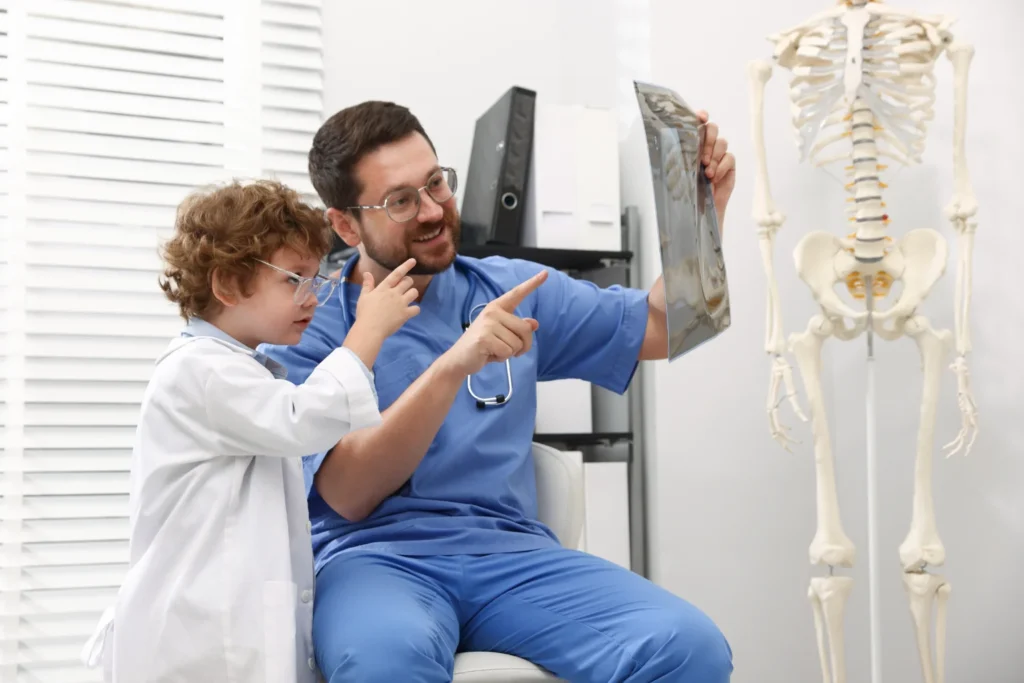
By now, you have a clearer picture of bone pain in children, how it differs from joint and muscle pain, and which joint pain in children causes are common in Indian families. In this final part, I will help you understand what happens next: when tests are actually needed, what you can safely do at home without missing something serious, and quick answers to the most searched questions.
When Are Tests Needed for Bone Pain or Joint Pain in Children?
Not every child needs blood tests or scans. In fact, unnecessary testing can increase anxiety and still not give a useful answer if the clinical pattern is mild and improving. The decision is based on the pain pattern, the exam, and the presence of warning signs.
I usually consider tests when:
- Pain is persistent and not improving after about 7 to 10 days
- Pain keeps returning in the same spot
- There is limping, refusal to bear weight, or reduced joint movement
- There is joint swelling, warmth, or visible puffiness
- There is fever, repeated fever episodes, or the child looks unwell
- Pain wakes the child repeatedly at night and is not behaving like classic growing pains
- There are whole-body signs like unusual fatigue, pallor, easy bruising, weight loss, or poor appetite
If your child has mild aches but is active, walking normally, and improving, we can often monitor without tests. If the pain pattern is concerning, testing is not done to “tick a box.” It is done to protect your child from delayed diagnosis.
Common Tests and What They Help Us Confirm
Blood tests
When joint pain in children is serious, blood tests help separate infection or inflammation from minor strain.
Depending on the case, tests may include:
- Markers that indicate inflammation or infection
- Blood counts that can show anaemia or infection-related changes
Parents frequently ask, “Can a blood test tell us exactly what is causing this?” At times it points us clearly toward infection or inflammation, and at other times it is most helpful for quickly ruling out urgent possibilities and guiding the next step.
X-ray
X-rays are useful when:
- Pain is localised to one area
- There is a history of injury
- Pain is persistent or worsening
- We suspect bone-related issues rather than muscle strain
A normal X-ray does not always mean everything is perfect, but it can rule out many important problems.
Ultrasound
Ultrasound is commonly used when:
- A joint looks swollen
- We suspect joint fluid or inflammation
It is painless and quick, especially helpful for knee, ankle, and sometimes hip evaluation.
MRI
MRI is not the first test for most children, but it is very valuable when:
- Symptoms are strong but X-ray is normal
- We suspect deep infection, inflammation, or specific bone problems
- Pain is persistent, localised, and not explained by simpler tests
MRI helps us see soft tissues, bone marrow, and early changes that may not appear on X-ray.
What You Can Safely Do at Home (If There Are No Warning Signs)
If your child has mild pain, no fever, no swelling, no limp, and is otherwise active and eating well, you can monitor at home for a short period. The goal is not to delay care, but to avoid panic and unnecessary medicines.
Here is a safe, practical approach I recommend:
Reduce load for 48 to 72 hours
- Pause running, jumping, long sports sessions, and intense coaching
- Allow gentle walking and normal daily activity if comfortable
Use local comfort measures
- Warm compress for 10 to 15 minutes in the evening can reduce soreness
- Gentle massage can help if the pain is muscular or fits growing pains
- Avoid strong massage over a clearly tender bone spot or a swollen joint
Hydration and sleep
Many children complain of leg pain more during dehydration or poor sleep. A consistent sleep routine and proper hydration can make a noticeable difference.
Track the pattern
Instead of guessing, write down:
- When pain starts (morning, after school, night)
- Where it hurts (same spot or shifting)
- Whether the child is limping
- Any fever, even mild
- Whether pain is improving day by day
If pain is clearly improving in a few days, that is reassuring. If it is stable or worsening, it is time to get evaluated.
What I do not recommend is using repeated pain medicine daily for a long period without diagnosis. If you need medicine again and again for the same problem, the child needs assessment.
When Should You Stop Monitoring and See a Doctor?
If any of the following happens, do not wait:
- Your child develops a limp or stops bearing weight
- Fever appears along with bone or joint pain
- A joint becomes swollen, warm, or movement becomes restricted
- Pain becomes severe or starts waking the child repeatedly at night
- Pain does not improve within 7 to 10 days, even after rest and reduced activity
These are common points where joint pain in children when it is serious becomes a real concern.
Read More: Best Robotic Knee Replacement in Patna – Total & Partial Knee Surgery Options
FAQs Bone Pain in Children
1) Bone pain in children at night: is it always growing pains?
Not always. Growing pains typically happen in the evening or night, often in both legs, and the child is fine by morning. If the pain is repeated in one spot, wakes your child often, causes limping the next day, or is associated with fever or swelling, it is not safe to assume it is growing pains.
2) Joint pain in children causes: what is most common in India?
In Indian families, the most common causes are overuse from sports or activity spikes, post-viral aches, minor injuries that were not noticed, and nutrition or sunlight-related bone discomfort, including vitamin D deficiency. Inflammation and infections are less common, but they are the ones we must not miss.
3) Joint pain in children, when is it serious?
I consider it serious when the child cannot walk normally, when there is fever with pain, when a joint is swollen or hot, when morning stiffness keeps happening, or when pain is worsening and waking the child frequently at night. Serious patterns are more about the behaviour of pain and the child’s function than the pain score alone.
4) My child has leg pain but no injury. What should I do first?
Start by checking walking and daily activity. If your child is walking normally and pain is mild, reduce intense activity for 2 to 3 days, use warm compress, focus on hydration and sleep, and track the pain pattern. If pain persists beyond a week, returns repeatedly, or any warning sign appears, get a medical evaluation.
5) Which doctor should we consult?
For mild pain without warning signs, many families start with a paediatrician. If there is limping, swelling, persistent pain, or concern for bone or joint problems, it is appropriate to consult an orthopaedic specialist who has experience with children.
If you are looking for a pediatric orthopedic doctor in Patna, you can book your appointment with me, Dr. Ramakant Kumar, directly from this website, so I can examine your child in detail, pinpoint whether the pain is coming from bone, joint, or muscle, and guide you on the right next step, whether that means simple home care, a few focused tests, or targeted treatment.
Conclusion
Most cases of bone pain in children are not dangerous, but they deserve smart attention. When you focus on the pattern, the presence of fever or swelling, and whether your child is walking normally, the next step becomes clearer.
If something feels off, especially if pain is worsening, persistent, or affecting your child’s movement, it is always safer to get evaluated early rather than waiting for weeks. If you have any additional questions related to your child’s bone or joint pain, you can share them in the comments, and we will try to guide you in the right direction.