

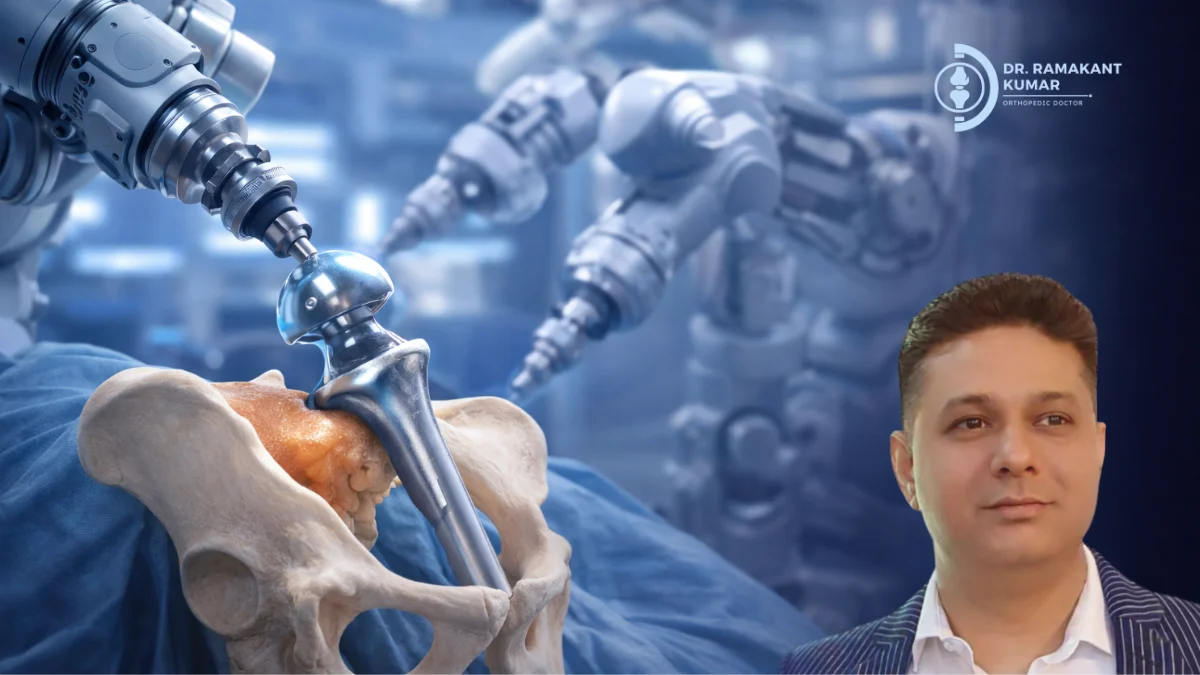
Hip pain can severely limit your daily activities—whether it’s difficulty walking, standing, or even turning in bed. Many patients in Patna and Bihar struggle for months or years, often hesitant about surgery due to concerns over recovery, accuracy, or long-term results. With advances in orthopedic care, the solution has evolved: robotic hip replacement offers a more precise and personalized way to treat severe hip damage and restore mobility.
I’m Dr. Ramakant Kumar, MBBS, (Gold Medalist), MS Ortho (AIIMS, New Delhi), DNB and in this guide, I’ll walk you through how robotic hip replacement surgery in Patna works, who it’s most suitable for, and why this advanced technique offers safer, more accurate results with a quicker recovery.
If you’re exploring options and searching for the best orthopedic doctor in Patna, this article will give you the clarity you need to make an informed, confident decision about your treatment.
Contents
- 1 What Is Robotic Hip Replacement Surgery?
- 2 Who Can Benefit from Robotic Hip Replacement?
- 3 Why Robotic Technology Matters in Hip Replacement
- 4 Step-by-Step: How Robotic Hip Replacement Is Performed
- 5 Robotic vs Traditional Hip Replacement: Key Differences
- 6 Recovery Timeline: What to Expect After Robotic Hip Replacement
- 7 Safety, Risks, and Importance of Surgical Experience
- 8 Cost of Robotic Hip Replacement in Patna: What You Should Know
- 9 Frequently Asked Questions
- 10 Conclusion
What Is Robotic Hip Replacement Surgery?
Robotic hip replacement is a technologically advanced form of joint replacement that uses computer-assisted tools to help the surgeon plan and perform the procedure with greater precision. Contrary to what some patients assume, the robot does not perform the surgery. I, as the surgeon, remain fully in control of every decision and surgical step.
Here’s how it works:
- Before surgery, a 3D model of your hip is created using a CT scan or high-resolution imaging.
- This allows us to plan the exact placement, size, and angle of the implant based on your unique anatomy.
- During the operation, a robotic arm helps guide the instruments in real time, ensuring accurate bone preparation and implant alignment.
- The system also checks leg length, joint stability, and movement range before finalizing the placement.
Compared to traditional hip replacement, robotic-assisted surgery improves alignment, reduces soft tissue damage, and results in a more natural-feeling joint. If you’re searching for hip replacement surgery in Patna, understanding this difference can help you make a better treatment decision.
Who Can Benefit from Robotic Hip Replacement?
Robotic hip replacement is not only for complex cases—it is ideal for any patient who wants long-lasting results with greater precision and a smoother recovery.
You may be a suitable candidate if you:
- Have hip osteoarthritis, avascular necrosis, post-traumatic arthritis, or rheumatoid arthritis
- Experience constant pain in your hip, groin, or thigh while walking, standing, or sitting cross-legged
- Find it difficult to perform daily tasks like using the toilet, climbing stairs, or getting in and out of vehicles
- Have already tried medications, injections, or physiotherapy without improvement
In my practice, I also recommend robotic surgery for:
- Younger, active individuals who need precise implant positioning for longevity
- Patients with previous surgeries or complex bone structure
- Anyone with concerns about leg-length imbalance or joint instability post-surgery
That said, not every patient with hip pain needs surgery right away. Early-stage arthritis can often be managed without surgery. That’s why a proper evaluation, imaging, and joint movement analysis are essential before deciding the next step.
Must Read: Best Robotic Knee Replacement in Patna – Total & Partial Knee Surgery Options
Robotic Hip Replacement Now in Patna: A Safer, More Precise Option for Hip Pain Relief
This section includes:
- Why robotic technology matters
- Step-by-step process of robotic hip replacement surgery
- Comparison between robotic and traditional hip replacement
Why Robotic Technology Matters in Hip Replacement
In any joint replacement surgery, precision is key—especially in the hip, where the implant must match your body’s natural movement, weight-bearing angle, and leg length. Small errors in alignment can lead to long-term issues like implant loosening, limping, or dislocation. That’s exactly where the robotic approach stands out as a more advanced and patient-specific option available right here in Patna.
Robotic assistance allows us to:
- Plan the procedure virtually before stepping into the operating room, using a detailed 3D model of your hip joint.
- Customize the implant placement to match your unique anatomy
- Reduce soft tissue damage by targeting only the area that needs work
- Ensure better leg-length balancing, reducing post-op limping risk
- Check real-time joint stability during surgery to avoid future complications
In simple terms, robotic technology allows me to operate with sub-millimeter accuracy, leading to better implant fit, fewer complications, and faster recovery.
Step-by-Step: How Robotic Hip Replacement Is Performed
If you’re considering robotic hip replacement surgery in Patna, knowing how the process works can ease many of your concerns. Here’s what typically happens:
- Preoperative CT Scan & Digital Planning: As part of the pre-surgical process, a detailed CT scan is used to build a 3D representation of your hip, allowing precise customization of the implant plan. This helps us assess your bone quality, hip socket shape, and joint alignment.
- Personalized Surgical Plan: Using this model, I design a surgical plan that includes the exact location, depth, and orientation of the implant. This plan is tailored to your body—not based on averages.
- Robotic-Assisted Surgery: During the procedure, the robotic system guides my surgical instruments and helps me follow the plan with a high degree of accuracy. The robot constantly checks alignment and provides real-time feedback.
- Live Adjustments & Final Implant Placement: Just before securing the implant, I verify joint stability, movement range, and leg length to ensure everything is properly aligned. Any minor adjustments are made immediately to ensure long-term stability and comfort.
- Closure & Recovery Start: Once the implant is secured, we close the incision and shift focus to early recovery, pain management, and physiotherapy.
Throughout the surgery, I am in full control. The robot enhances precision—it doesn’t replace clinical judgment.
Robotic vs Traditional Hip Replacement: Key Differences
If you’re comparing your options, this table will help you understand the clear benefits of robotic hip replacement:
| Feature | Robotic Hip Replacement | Traditional Hip Replacement |
| Surgical Planning | 3D CT-based, patient-specific | Manual templating, generalized planning |
| Implant Alignment | Sub-millimeter precision | Relies on visual estimation |
| Soft Tissue Impact | Minimal | Moderate to high |
| Leg Length Accuracy | High (digitally verified) | Variable, risk of mismatch |
| Recovery Experience | Smoother, less swelling | May involve longer discomfort |
| Post-op Outcomes | More predictable | Depends more on surgical skill alone |
For patients who value safety, faster healing, and long-term function, robotic surgery offers a clear edge. But remember, even the best technology must be used by an experienced surgeon to deliver the best outcome.
Recovery Timeline: What to Expect After Robotic Hip Replacement
Every patient’s recovery speed may differ, but robotic hip replacement often results in a smoother and more predictable healing process compared to conventional methods. Based on typical recovery patterns, this is how most patients progress after surgery:
First 48 Hours
You will be encouraged to stand and walk with assistance—usually on the same or next day. Pain is managed through medications, and swelling is usually less due to reduced soft tissue damage during surgery.
Week 1 to 2
Walking with a walker or stick becomes easier. Physiotherapy begins to improve joint movement and muscle control. Many patients return home comfortably within 3 to 5 days.
Week 3 to 6
By this stage, you should be walking more confidently, climbing stairs with support, and performing basic home activities. Those who undergo robotic hip replacement in Patna often feel more stable during this period due to improved implant alignment.
After 3 Months
Most patients regain near-normal movement and can resume driving, office work, or light travel. Physiotherapy continues for strengthening and coordination.
Safety, Risks, and Importance of Surgical Experience
Like any surgical procedure, robotic hip replacement carries certain risks, such as:
- Blood clots
- Infection
- Nerve irritation
- Implant-related complications (though rare)
That said, robotic assistance significantly lowers the chances of common technical errors like implant malalignment or leg-length discrepancies. The real key, however, is the surgeon’s experience. Technology alone cannot replace clinical judgment.
As a robotic hip replacement doctor in Patna, I use robotic planning to enhance—not replace—my surgical skill and patient-centered decision-making. Your outcome depends on both the precision of the system and the expertise of the hands using it.
If you are researching your options, always evaluate both: the technology available and the surgeon’s track record. Internal link: [Best orthopedic doctor in Patna]
Cost of Robotic Hip Replacement in Patna: What You Should Know
The cost of robotic hip replacement in Patna, Bihar depends on several factors:
- Type of implant used (imported vs Indian)
- Whether it is a total or partial replacement
- Your hospital stay duration and physiotherapy requirements
- Additional diagnostics and pre-surgical evaluations
While robotic procedures may have a slightly higher initial cost compared to conventional methods, they often result in:
- Fewer complications
- Faster return to work
- Better long-term implant performance
I always advise my patients to focus on value, not just price, when choosing their surgical approach. A well-done hip replacement can last 15–20 years with proper care.
Frequently Asked Questions
Yes, it is considered very safe when performed by an experienced surgeon. Robotic assistance improves surgical accuracy and reduces certain risks.
On average, hip implants can last 15–20 years or more. Accurate placement using robotic tools can enhance implant life by reducing early wear.
It depends on your condition, age, and recovery. Some patients regain the ability, especially with good physiotherapy and implant positioning.
Most patients return to desk jobs and driving within 6 to 8 weeks. Active jobs may require a longer recovery period.
Yes, but whether both can be done in one sitting depends on your health, age, and risk factors.
Also Read: Is Your Back Pain Actually Due to Gas? Signs, Locations, and Easy Relief Methods
Conclusion
Robotic hip replacement is not just about using advanced tools—it is about making every step of your surgery more accurate, personalized, and safe. Whether you are considering this option due to chronic hip arthritis, post-injury pain, or reduced mobility, robotic assistance gives us more control, and you more confidence.
If you are exploring robotic hip replacement surgery in Patna, I invite you to schedule a consultation. Together, we will review your reports, examine your joint health, and decide the best path forward—keeping both your safety and quality of life in mind. You can call or WhatsApp our team at +917070312214 to book your appointment or get your doubts clarified.
You no longer need to travel outside Bihar for advanced orthopedic care. With the right guidance and technology, you can move pain-free again.