Shoulder pain is not always just a simple strain that settles with rest. In many patients, the real issue lies deeper inside the joint, where the rotator cuff, labrum, glenoid, or AC joint may be injured. This is where shoulder arthroscopy becomes important. It allows us to look inside the shoulder through small incisions, identify the actual damage, and treat it with much less tissue disruption than traditional open surgery.
If you have been advised to consider Shoulder arthroscopy surgery in Patna for long-standing shoulder pain, this guide will help you understand what the surgery is, who needs it, and what problems it can fix.
Contents
- 1 What is shoulder arthroscopy?
- 2 When Shoulder Arthroscopy Is Needed and How Glenoid, Labrum, Rotator Cuff, and AC Joint Repair Are Done
- 2.1 When do we recommend shoulder arthroscopy?
- 2.2 How we evaluate a patient before shoulder arthroscopy surgery
- 2.3 How shoulder arthroscopy surgery is actually performed
- 2.4 Rotator cuff repair: what it means for the patient
- 2.5 Labrum repair: when instability is the real problem
- 2.6 Glenoid repair and stabilization: why the socket side matters
- 2.7 AC joint repair or arthroscopic treatment: when pain stays on top of the shoulder
- 2.8 Why arthroscopy is often preferred over a larger open procedure
- 3 Recovery After Shoulder Arthroscopy, Risks, and What Patients Should Know Before Surgery
- 3.1 What happens immediately after shoulder arthroscopy surgery?
- 3.2 How long is recovery after shoulder arthroscopy?
- 3.3 How long do patients need to wear a sling?
- 3.4 Why physiotherapy is such an important part of success
- 3.5 When can you return to work after shoulder arthroscopy?
- 3.6 What risks should patients know about?
- 3.7 What questions should you ask before deciding on surgery?
- 3.8 When should you seriously consider specialist consultation?
- 4 Conclusion
What is shoulder arthroscopy?
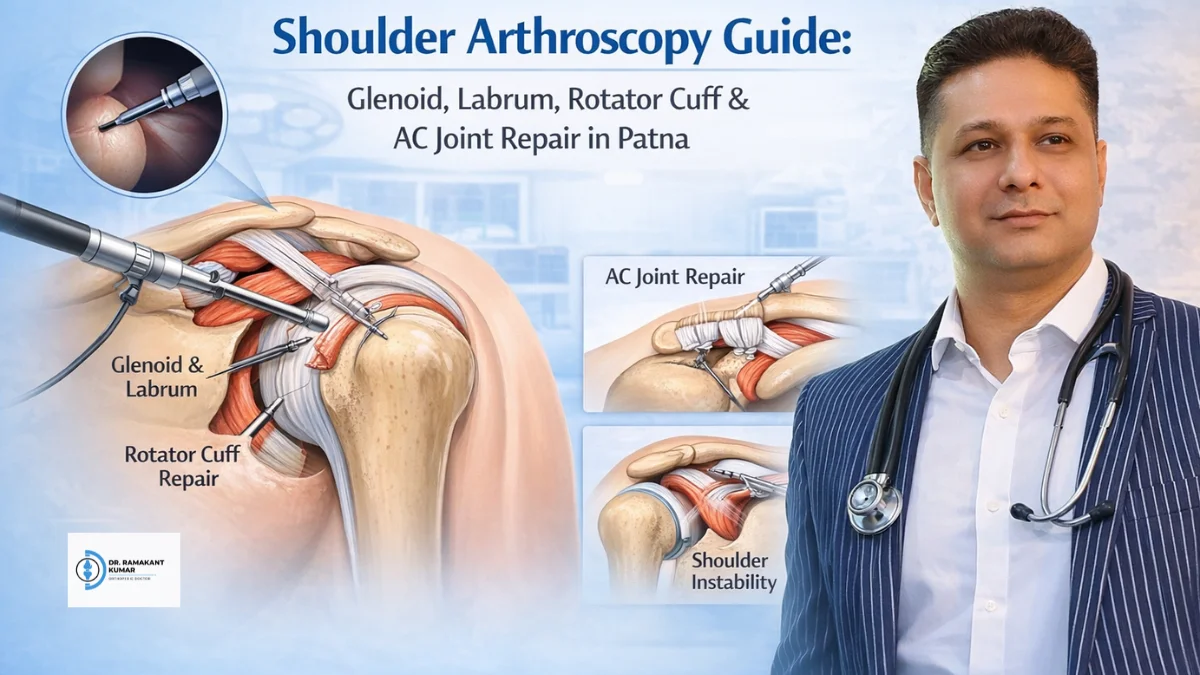
Shoulder arthroscopy is a minimally invasive shoulder procedure in which a tiny camera, called an arthroscope, is inserted into the shoulder joint through a small cut. This camera shows the inside of the joint on a screen in real time. Using a few additional small portals, we can pass fine instruments to repair damaged tissues.
In simple terms, it is a keyhole surgery for shoulder problems. Instead of making a large cut to open the shoulder, we work through small openings with better visibility of the joint structures. For many patients, this means less soft tissue damage, smaller scars, less post-operative discomfort, and a more structured recovery.
However, shoulder arthroscopy is not done just because it is modern. It is done when the diagnosis is clear and the problem is suitable for arthroscopic repair.
Why the shoulder gets injured so easily
The shoulder is one of the most mobile joints in the body. That freedom of movement helps you lift, rotate, throw, reach overhead, and perform daily tasks comfortably. But this same mobility also makes the shoulder vulnerable to instability, tendon tears, and repetitive stress injuries.
To understand shoulder arthroscopy surgery properly, you first need to know the main structures involved.
Rotator cuff
The rotator cuff is a group of tendons and muscles that help keep the shoulder stable while allowing smooth movement. When one of these tendons tears, patients often complain of pain while lifting the arm, weakness, night pain, or difficulty doing routine activities like combing hair or reaching a shelf.
Labrum
The labrum is a ring of cartilage around the socket of the shoulder. It helps improve stability by deepening the socket slightly. A torn labrum may lead to clicking, a slipping sensation, deep shoulder pain, or repeated instability, especially after sports injuries or falls.
Glenoid
The glenoid is the socket part of the shoulder joint. It is naturally shallow, which allows wide movement but also increases the chance of dislocation. If the glenoid rim or surrounding structures are damaged, the shoulder may keep feeling loose or unstable.
AC joint
The AC joint, or acromioclavicular joint, is located at the top of the shoulder where the collarbone meets part of the shoulder blade. This joint is commonly injured in falls, direct shoulder impact, gym injuries, and contact sports. Pain at the top of the shoulder, especially while reaching across the chest, often points toward AC joint involvement.
Which shoulder problems can be treated with arthroscopy?
Not every shoulder complaint needs surgery. But arthroscopy is commonly used when scans, examination, and symptoms all point toward a structural problem that is not improving properly.
Rotator cuff tear
A rotator cuff tear may happen due to wear and tear over time or after sudden injury. Small tears may initially behave like tendonitis, but larger tears usually cause more persistent weakness and pain. Many patients tell me they can no longer comfortably lift the arm above shoulder level or sleep on the affected side.
Labrum tear
Labral injuries are common in younger active individuals, athletes, and people who have suffered shoulder dislocation. In some cases, the shoulder may not fully dislocate again, but it keeps feeling unreliable, painful, or unstable during movement.
Glenoid-related instability
When the shoulder dislocates, the damage is not always limited to soft tissues. Sometimes the socket side also gets involved. Glenoid injury can play a major role in recurrent instability. If this is missed, the patient may continue to experience slipping episodes even after basic treatment.
AC joint pathology
The AC joint may become painful from trauma, arthritis, overuse, or weight training. Some patients develop persistent pain at the top of the shoulder that does not settle with medicines, activity modification, or physiotherapy. In selected cases, arthroscopic treatment can help reduce pain and improve shoulder function.
When should you start thinking beyond medicines and physiotherapy?
This is the stage where many patients get confused. Shoulder pain is common, so people often keep trying painkillers, home remedies, massage, or exercise videos without understanding the actual cause. That delay can sometimes make the condition harder to treat.
You should consider proper orthopedic evaluation if you have:
- shoulder pain lasting several weeks
- weakness while lifting or rotating the arm
- repeated shoulder slipping or dislocation
- pain at night that disturbs sleep
- clicking, catching, or locking sensation
- top-of-shoulder pain after a fall or gym injury
- poor improvement despite rest and physiotherapy
When Shoulder Arthroscopy Is Needed and How Glenoid, Labrum, Rotator Cuff, and AC Joint Repair Are Done
In many patients, shoulder pain improves with rest, medicines, structured physiotherapy, and activity changes. But when the problem is caused by a true tear, recurrent instability, or a damaged joint structure, non-surgical treatment may reduce symptoms only temporarily. This is the stage where shoulder arthroscopy surgery becomes a more meaningful option.
If you are considering Shoulder arthroscopy surgery in Patna, the most important step is not rushing into surgery. The right step is confirming exactly what is damaged, how severe it is, and whether that damage matches your symptoms and examination findings.
When do we recommend shoulder arthroscopy?
I do not advise arthroscopic shoulder surgery just because an MRI mentions a tear. We recommend it only when your history, physical examination, imaging, and day-to-day limitations all point toward a problem that is unlikely to recover properly without repair.
Shoulder arthroscopy may be advised when:
- pain continues despite proper non-surgical treatment
- you have a confirmed rotator cuff tear with weakness
- the shoulder keeps slipping, partially dislocating, or fully dislocating
- a labrum injury is causing instability, pain, or repeated clicking
- AC joint pain remains significant despite medicines and physiotherapy
- overhead work, sports, gym activity, or daily function is affected
- sleeping on the involved side has become difficult for a long time
In other words, the goal is not just to treat a scan report. The goal is to treat a structural shoulder problem that is limiting your life.
How we evaluate a patient before shoulder arthroscopy surgery
Before planning surgery, we need clarity. Shoulder pain can come from the joint, tendons, bursae, cervical spine, or even referred pain. That is why good evaluation matters more than simply reading the MRI impression line.
A proper assessment usually includes:
1. Detailed symptom history
We look at how the pain started, what movement makes it worse, whether there was a fall or sports injury, and whether the shoulder feels weak, unstable, or stuck. Night pain, inability to throw, and pain at the top of the shoulder all give different clues.
2. Clinical examination
This is where we test motion, strength, instability, impingement, AC joint tenderness, and specific signs related to labrum or rotator cuff injury. In many cases, the examination already tells us which structure is likely involved.
3. Imaging
X-rays help assess alignment, arthritis, AC joint changes, and bone-related issues. MRI helps show soft tissue damage such as rotator cuff tears, labral tears, inflammation, and associated injury patterns. In selected instability cases, CT may also be useful to understand glenoid bone loss more clearly.
Read More: Robotic Hip Replacement Now in Patna: Safe, More Precise for Hip Pain Relief
How shoulder arthroscopy surgery is actually performed
Many patients imagine this as a major open operation, but arthroscopy works differently. It is a minimally invasive shoulder surgery performed through small portals around the joint.
The exact steps may vary from patient to patient, but the overall process is usually like this:
Anesthesia and positioning
The procedure is typically done under general anesthesia, often with an additional regional block to improve pain control after surgery. The patient is then positioned carefully so the joint can be accessed safely and the repair can be done precisely.
Small arthroscopic portals
A tiny camera is introduced through one portal, and other fine instruments are inserted through additional small openings. These portals allow us to inspect the shoulder systematically rather than relying only on surface-level findings.
Joint inspection
We examine the labrum, glenoid side, rotator cuff, cartilage surfaces, biceps attachment, and surrounding tissues. This step is important because some patients have more than one problem inside the same shoulder.
Repair based on the damaged structure
Once the exact pathology is confirmed, the repair is carried out using specialized arthroscopic instruments, suture techniques, and anchors where needed.
Rotator cuff repair: what it means for the patient
The rotator cuff is one of the most common reasons patients need shoulder arthroscopy surgery. A tear may involve one tendon or more, and it may be partial thickness or full thickness.
In arthroscopic rotator cuff repair, the torn tendon is mobilized, the bone surface is prepared, and the tendon is reattached to its original footprint using suture anchors. These anchors help secure the tendon while healing takes place over time.
This procedure is especially helpful when you have:
- persistent pain despite treatment
- weakness while lifting the arm
- pain during overhead use
- night pain that keeps returning
- functional limitation in work or routine activity
A simple but important point is this: surgery repairs the tendon, but healing depends heavily on how well you protect the repair and follow rehabilitation afterward.
Labrum repair: when instability is the real problem
A labral tear often causes deeper shoulder pain than a simple muscular strain. Patients may say the shoulder “moves strangely”, “clicks inside”, or feels as if it may slip during certain motions.
In arthroscopic labrum repair, the torn labrum is repositioned and fixed back to the socket using anchors and sutures. This improves stability and helps restore the normal restraint mechanism of the shoulder.
This is commonly required in cases such as:
- recurrent shoulder dislocation
- Bankart lesion after instability episode
- labral injury in athletes
- painful clicking with instability symptoms
- shoulder giving way during activity
For patients with repeated dislocation, labrum repair is not only about reducing pain. It is also about preventing future instability episodes that can create more damage over time.
Glenoid repair and stabilization: why the socket side matters
Some patients focus only on the tendon or the dislocation itself, but the glenoid side of the joint can be equally important. When the glenoid rim or surrounding stabilizing structures are compromised, the shoulder can remain mechanically vulnerable.
Arthroscopic glenoid-related repair is planned when instability patterns, soft tissue damage, or associated socket-side injury suggest that stabilization is needed. In selected patients, this may involve restoring the soft tissue attachment and improving joint stability arthroscopically.
This matters especially in patients who:
- have had repeated dislocations
- feel the shoulder slip during routine use
- have pain with rotational movement after previous instability
- are young and active and want better functional stability
A poorly stabilized shoulder can continue to fail even if the patient tries to strengthen it, because the underlying mechanical problem remains unresolved.
AC joint repair or arthroscopic treatment: when pain stays on top of the shoulder
AC joint pain is often very localized. Patients usually point with one finger to the top of the shoulder. The pain may worsen while carrying weight, doing push movements, reaching across the body, or after a direct fall onto the shoulder.
Depending on the diagnosis, arthroscopic AC joint treatment may involve addressing inflamed or degenerative tissue, decompressing the painful area, or managing associated damage around the joint. In trauma-related cases with instability, further stabilization may also be considered depending on severity and timing.
We usually think of this option when:
- pain remains focused over the AC joint for a long period
- injections or physiotherapy have not given lasting relief
- gym activity or lifting continues to trigger pain
- imaging and examination both support AC joint pathology
Why arthroscopy is often preferred over a larger open procedure
For properly selected patients, arthroscopy offers real practical advantages, not just cosmetic ones.
These include:
- smaller incisions
- less disruption of surrounding soft tissue
- better visualization inside the joint
- ability to assess multiple structures in the same sitting
- less post-operative stiffness risk in many cases
- a more structured recovery pathway
That said, the best procedure is not the smallest one. The best procedure is the one that correctly addresses your exact shoulder problem.
Recovery After Shoulder Arthroscopy, Risks, and What Patients Should Know Before Surgery
Once a patient understands the diagnosis and the type of repair needed, the next question is usually very practical: How long will recovery take, and when will I be able to use my shoulder normally again? This is where proper guidance matters. Shoulder arthroscopy surgery is minimally invasive, but recovery is still structured and discipline-based, especially after rotator cuff repair, labrum repair, glenoid stabilization, or AC joint treatment.
If you are planning Shoulder arthroscopy surgery in Patna, you should not think only about the operation day. You should also understand the healing phase, sling period, physiotherapy plan, and activity restrictions that follow.
What happens immediately after shoulder arthroscopy surgery?
After surgery, your shoulder is usually supported in a sling. The exact type of sling and the length of use depend on what was repaired. A small diagnostic arthroscopy or minor trimming procedure may allow earlier movement, but a repaired tendon or labrum needs protection during the early healing phase.
In the first few days, patients commonly notice:
- mild to moderate pain and soreness
- shoulder heaviness due to the sling
- swelling around the portal sites
- difficulty lifting the arm on their own
- disturbed sleep, especially in the first week
This part is expected. It does not mean the surgery has failed. The shoulder has been repaired internally, and the tissues now need time to settle and begin healing.
How long is recovery after shoulder arthroscopy?
Recovery is not the same for every patient. It depends on what was done inside the shoulder.
A patient with simple arthroscopic cleaning may recover much earlier than someone who underwent rotator cuff repair or labrum stabilization. Age, tissue quality, pre-operative stiffness, diabetes, smoking, and how sincerely rehabilitation is followed also make a difference.
A broad recovery pattern often looks like this:
First 1 to 2 weeks
This phase is focused on pain control, wound care, sling support, and protected movement. Sleeping may still be uncomfortable, and I usually advise patients to avoid sudden shoulder motion, lifting, pushing, or unsupported arm use.
Weeks 2 to 6
This is when guided physiotherapy becomes more important. For many repairs, passive or assisted movement begins first. The patient should not assume that moving early and aggressively will speed recovery. In fact, overdoing motion too early may place the repair under unnecessary stress.
Weeks 6 to 12
By this stage, shoulder mobility usually begins improving more noticeably. Depending on the repair, we gradually move toward active movement and then controlled strengthening. Everyday tasks become easier, but the shoulder is still not ready for heavy loading.
Around 3 to 6 months
This is the period when many patients start returning to heavier work, gym-based rehabilitation, and sport-specific progressions, depending on the procedure. A repaired rotator cuff or instability repair still needs judgment here. Feeling better is not the same as complete healing.
How long do patients need to wear a sling?
This depends strongly on the type of arthroscopic shoulder repair.
After a significant rotator cuff repair or labrum repair, the sling may be needed for several weeks to protect the repaired tissue. After smaller procedures, the period may be shorter. The sling is not just for comfort. It helps reduce accidental strain on healing structures.
Some patients make the mistake of removing the sling too early because pain starts reducing. That can create avoidable trouble. Less pain does not mean the repaired tendon or labrum has fully healed to bone.
Read More: Best Robotic Knee Replacement in Patna – Total & Partial Knee Surgery Options
Why physiotherapy is such an important part of success
Shoulder arthroscopy surgery does not end in the operating room. Rehabilitation is one of the biggest factors deciding the final result. Even a technically well-done surgery can give a poor functional outcome if physiotherapy is neglected, rushed, or done incorrectly.
The sequence usually matters:
- protection first
- motion restoration in the right stage
- muscle activation later
- strength progression after healing is more secure
- return to work or sports only when the shoulder is functionally ready
Patients often ask me whether home exercise alone is enough. The honest answer is that some parts of rehabilitation can be done at home, but guided physiotherapy is often extremely valuable, especially after rotator cuff repair, labrum repair, or glenoid stabilization.
When can you return to work after shoulder arthroscopy?
This depends on the kind of work you do.
A patient with desk-based work may return earlier than someone whose job requires lifting, drilling, overhead use, pushing, pulling, or manual labor. Similarly, an athlete or gym user needs a more careful progression than someone doing light routine tasks.
In general terms:
- office or desk work may resume earlier if pain is controlled
- driving usually takes longer and depends on sling use and control
- overhead work and heavy labor require much more healing time
- sports return depends on strength, stability, range of motion, and procedure type
The biggest mistake here is comparing your recovery to someone else’s. Two patients may both have had “shoulder arthroscopy”, but one may have had a small debridement while the other underwent a full arthroscopic rotator cuff repair.
What risks should patients know about?
Every surgery has risks, and shoulder arthroscopy is no exception. The right way to discuss them is honestly, without unnecessary fear.
Possible risks include:
- infection
- stiffness
- persistent pain
- swelling
- bleeding
- nerve irritation
- delayed healing
- re-tear or failure of repair in selected cases
- recurrence of instability in some patients
Most patients do well when the diagnosis is correct, the indication is appropriate, the repair is performed carefully, and rehabilitation is followed properly. The chance of problems is generally lower when surgery is planned and executed by an experienced orthopedic doctor with arthroscopy expertise.
What questions should you ask before deciding on surgery?
Patients should never feel rushed into arthroscopic shoulder surgery. You should understand your diagnosis clearly.
Important questions include:
- What exactly is torn or damaged in my shoulder?
- Is it rotator cuff, labrum, glenoid-related instability, or AC joint disease?
- Have we tried the right non-surgical treatment for long enough?
- What type of arthroscopic repair is planned?
- How long will I need a sling?
- When will physiotherapy begin?
- When can I return to office work, driving, gym, or sports?
- What happens if I delay surgery further?
These questions help align your expectations with the real recovery pathway.
When should you seriously consider specialist consultation?
Do not keep ignoring symptoms if your shoulder continues to trouble you. You should seek orthopedic consultation if you have:
- shoulder pain lasting more than a few weeks
- arm weakness during lifting
- repeated shoulder dislocation or slipping sensation
- night pain that is affecting sleep
- top-of-shoulder pain after trauma
- clicking with instability
- poor improvement after medicines and physiotherapy
In such cases, a proper evaluation can help determine whether you need medicines, rehabilitation, injections, or Shoulder arthroscopy surgery in Patna.
Conclusion
Shoulder arthroscopy has changed the way we treat many important shoulder problems. Whether the issue is a rotator cuff tear, labrum injury, glenoid-related instability, or persistent AC joint pain, arthroscopic treatment can offer a more precise and tissue-friendly way to repair the damage when non-surgical methods are no longer enough.
The key is not just finding a modern procedure. The key is getting the correct diagnosis, understanding what exactly needs repair, and following a proper recovery plan afterward. If your shoulder pain, weakness, or instability is affecting your daily life, it is worth getting assessed by the best orthopedic doctor in Patna so the problem is addressed before it becomes more complicated.
If you have any additional questions about shoulder arthroscopy, recovery time, or whether surgery is really needed in your case, you can discuss it during a proper orthopedic consultation.
Read More: Bone Pain in Children – When to Worry and When to See a Doctor