

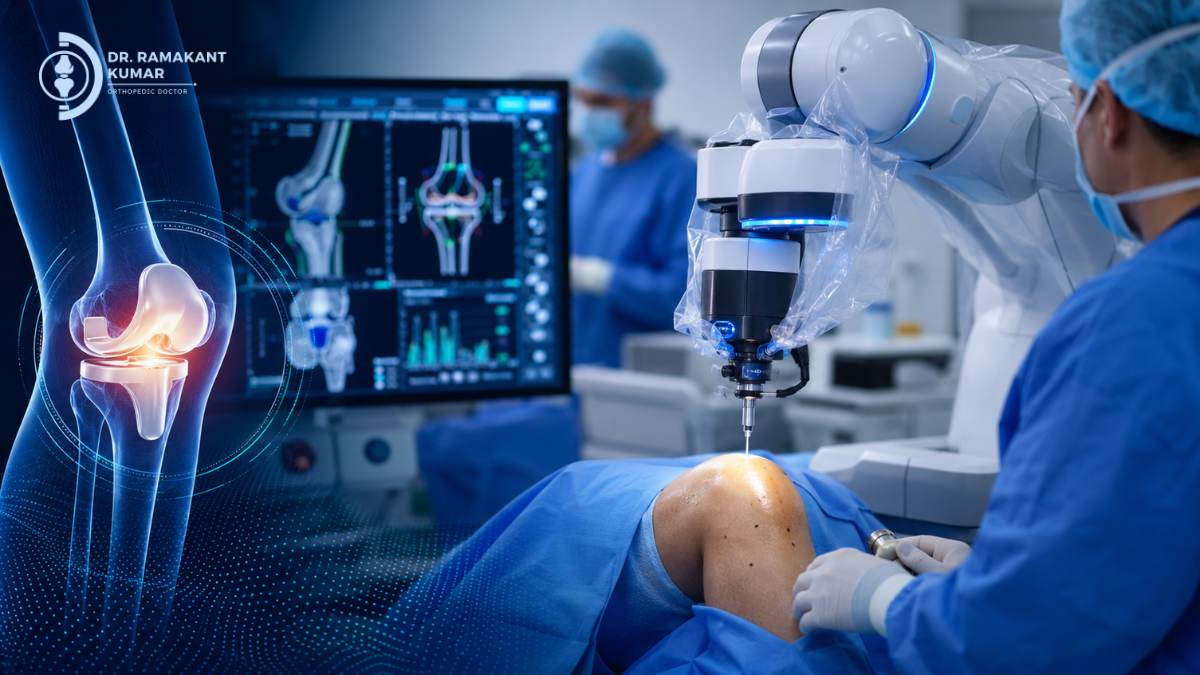
Are you considering knee replacement and wondering whether robotic surgery is really worth it? For selected patients, yes, robotic knee surgery can be better because it helps with accuracy, alignment, implant positioning, and soft tissue balance.
Still, robotic surgery should be recommended only when it adds real value to the patient’s knee condition, not simply because the technology is available. The right choice depends on your X-ray, knee deformity, pain level, medical fitness, implant quality, surgeon’s experience, hospital setup, and recovery plan.
When Robotic Knee Surgery May Be Better
Robotic knee surgery may offer more value in cases where arthritis has changed the knee shape, alignment, or movement pattern. This is often seen in patients with long-standing arthritis, bow-leg deformity, knock-knee alignment, stiffness, old injury, or uneven cartilage loss. In these cases, the knee is not only painful; its structure has changed over time.
The main benefit of robotic-assisted knee replacement is precision. It helps the surgeon plan the implant position, bone cuts, leg alignment, and soft tissue balance more accurately. The American Academy of Orthopaedic Surgeons explains that robotic-assisted joint replacement uses 3D planning before surgery and real-time computer navigation during surgery to support more precise implant placement.
This matters because knee replacement is not just about replacing the damaged joint surface. The artificial joint must be properly sized, correctly positioned, and balanced with the surrounding ligaments. If the knee is too tight, too loose, or poorly aligned, the patient may feel stiffness, instability, pain while walking, or difficulty bending the knee.
Robotic knee surgery may be considered when you have:
- Severe arthritis with visible knee deformity
- Bow-leg or knock-knee alignment
- Stiff knee with poor bending or straightening
- Uneven cartilage loss on one side
- Partial knee replacement requirement
- Complex knee shape due to old injury
A 2024 review on MAKO robot-assisted total knee replacement reported better short-term clinical efficacy, better alignment planning, and good safety compared with conventional manual total knee replacement. This supports the role of robotic technology in selected cases, but it should not be treated as a guarantee for every patient.
Related Article: Robotic Knee Replacement Recovery Time, Walking, Pain Relief, and Exercise Tips
Advantages and Disadvantages of Robotic Knee Replacement
| Advantages | Disadvantages |
| Helps the surgeon plan implant size, bone cuts, and alignment more accurately. | Usually costs more than conventional knee replacement because of technology, equipment, planning, and hospital setup. |
| May be useful in bow-leg, knock-knee, stiff, or complex arthritis cases. | Not necessary for every patient, especially when the knee condition is straightforward. |
| Supports better soft tissue balancing, so the knee is not too tight or too loose. | Not available in every hospital or city. |
| Can help in selected partial knee replacement cases where only the damaged part is replaced. | Insurance may not fully cover robotic-related charges, depending on the policy. |
| May improve surgical planning in patients with uneven cartilage loss or unusual knee anatomy. | It does not remove normal surgical risks such as infection, swelling, stiffness, blood clot, delayed wound healing, or anesthesia-related problems. |
| Gives the surgeon more patient-specific information during planning and execution. | Physiotherapy is still required after surgery. Robotic technology cannot replace rehabilitation. |
The cost point is important for patients. Robotic knee replacement is often more expensive than manual surgery because it uses advanced systems, specialized equipment, software planning, and robotic assistance during the operation. A 2025 cost-effectiveness analysis found robotic total knee arthroplasty had higher additional costs than manual total knee arthroplasty, while its value depended on outcomes and healthcare setting.
This is why patients should not choose robotic surgery only because it sounds advanced. The better approach is to ask whether the extra precision will make a real difference in your knee condition. If the answer is yes, robotic surgery may be worth considering. If the case is simple, the extra cost may not always add meaningful benefit.
Is Robotic Knee Replacement Covered by Insurance?

Robotic knee replacement may be covered by insurance if knee replacement is medically necessary, but coverage depends on your policy. Some insurance companies may approve the surgery but may not fully cover robotic system charges, implant limits, room rent differences, consumables, or advanced technology costs.
Before admission, do not rely only on verbal assurance. Ask for a written estimate and insurance pre-authorization. The estimate should clearly mention hospital charges, implant cost, robotic assistance charges, medicines, investigations, room category, and possible extra costs if the hospital stay increases.
You should ask these questions before surgery:
- Is robotic-assisted knee replacement covered under my policy?
- Are robotic charges included or excluded?
- Is there any implant cost limit?
- What amount may need to be paid personally?
- Is cashless approval possible before admission?
- Are consumables and physiotherapy included?
This discussion should happen before the surgery date, not at the billing counter. Clear insurance planning helps patients avoid confusion and financial stress during discharge.
Related Article: Robotic Hip Replacement Now in Patna: Safe, More Precise for Hip Pain Relief
Who Should Consider Robotic Knee Surgery?
Robotic knee surgery may be suitable for patients whose arthritis has started affecting daily life despite medicines, physiotherapy, injections, exercise, and weight control. If you cannot walk comfortably, climb stairs, stand for work, or sleep peacefully because of knee pain, you should get a proper orthopedic evaluation.
It may be considered for patients with severe arthritis confirmed on X-ray, visible deformity, stiff knees, uneven joint damage, or partial knee damage. It may also help when the surgeon feels that patient-specific planning can improve implant positioning and alignment.
However, robotic surgery may not be right for patients who expect instant pain-free recovery or want to avoid physiotherapy. Patients with uncontrolled diabetes, active infection, poor skin condition, severe obesity, or serious heart and lung problems need careful medical assessment before any knee replacement.
As I explain to patients, your goal should not be to choose the most advanced-sounding procedure. Your goal should be to choose the safest and most suitable treatment for your knee.
Robotic Knee Replacement in Patna Bihar: What Patients Should Ask
Patients looking for robotic knee replacement in Patna Bihar should not decide only by package price, hospital name, or online claims. The first step should be a detailed clinical examination, standing X-rays, arthritis grading, deformity assessment, and a clear discussion about whether robotic assistance will actually help.
Before choosing surgery, ask your orthopedic surgeon:
- Do I need partial or total knee replacement?
- Is robotic assistance useful for my knee condition?
- What implant will be used?
- What is the complete cost breakup?
- Is insurance or cashless approval possible?
- How long will physiotherapy continue?
- What risks apply to my age, weight, diabetes, or heart condition?
A consultation with the best orthopedic doctor in Patna can help you compare robotic and manual knee replacement based on your actual X-ray, pain level, deformity, walking difficulty, and recovery expectations.
Related Article: Best Robotic Knee Replacement in Patna – Total & Partial Knee Surgery Options
Final Verdict
Robotic surgery can be better for knee surgery when precision adds real value, especially in patients with deformity, stiffness, uneven joint damage, or complex knee anatomy. But it is not mandatory for every knee replacement patient.
The best outcome depends on the right diagnosis, surgeon experience, safe hospital setup, implant selection, infection prevention, and disciplined physiotherapy. Choose robotic knee surgery when it offers a clear medical advantage in your case, not just because it sounds modern.