

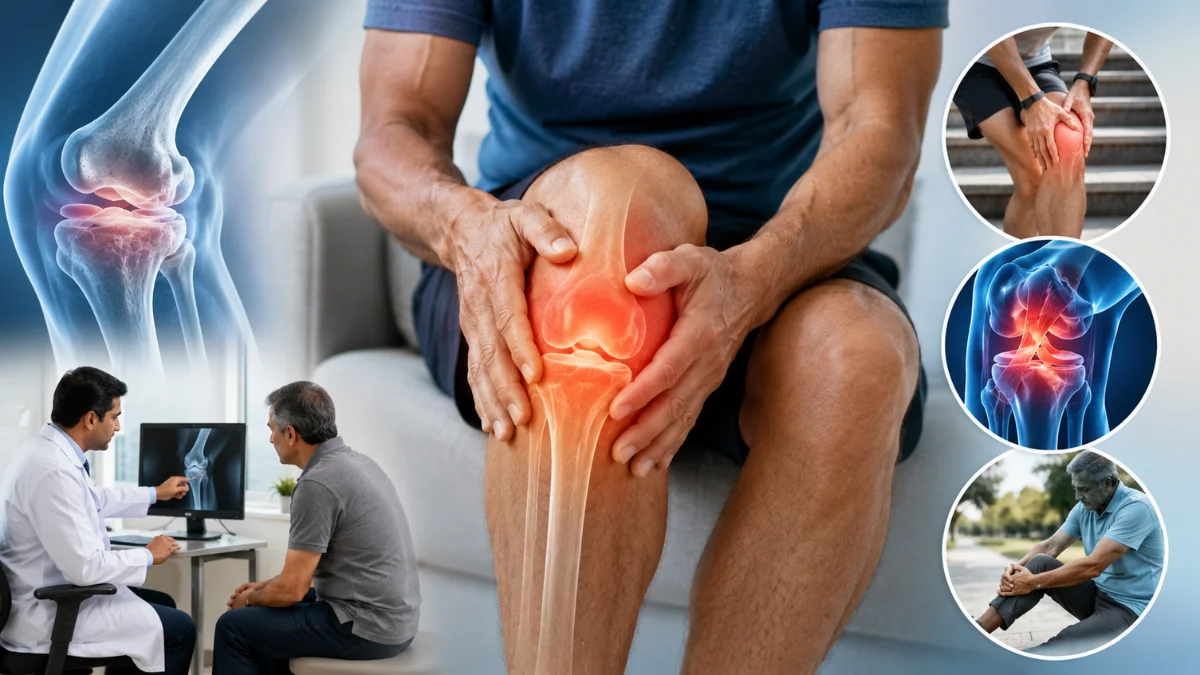
Knee pain after 40 is common, but it should not be treated as “normal aging” without understanding the cause. Many people start with mild discomfort while climbing stairs, walking for long, sitting cross-legged, or getting up from a chair. Some ignore it because the pain comes and goes. Others keep taking painkillers without knowing whether the problem is arthritis, ligament injury, meniscus tear, cartilage damage, or something else.
At the Advanced Bone & Joint Clinic, one thing we commonly notice is that patients often delay consultation because they assume every knee pain after 40 is arthritis. In reality, knee pain causes can be different from person to person. The right knee pain treatment depends on proper diagnosis, not guesswork.
Why Knee Pain Becomes More Common After 40
The knee is a weight-bearing joint. It supports your body while walking, standing, climbing stairs, squatting, and getting up from a sitting position. After 40, small changes in cartilage, muscles, ligaments, body weight, and old injuries can increase stress on the knee.
Common reasons include gradual cartilage wear, weak thigh muscles, reduced flexibility, repeated stair climbing, long standing, previous sports injuries, old ligament injury in the knee, meniscus degeneration, and increased body weight. Even a small twist or slip can cause pain if the knee is already weak or overloaded.
That is why knee pain after 40 should be taken seriously when it is repeated, increasing, or affecting daily movement.
Is It Knee Arthritis?
Knee arthritis symptoms usually develop slowly. In the beginning, pain may appear only after long walking, climbing stairs, or standing for too long. Later, stiffness, swelling, grinding sound, and reduced walking distance may start affecting daily life.
Common signs of knee arthritis include:
- Pain while walking or climbing stairs
- Morning stiffness or stiffness after sitting
- Swelling around the knee
- Grinding, cracking, or rubbing sensation
- Difficulty bending or straightening the knee
- Pain while getting up from the floor
- Reduced walking distance
- Bowing or deformity in advanced cases
Arthritis pain is often confused with weakness or calcium deficiency, but knee arthritis is mainly a joint surface problem. An X-ray is often helpful to understand the stage of joint damage.
Could It Be a Ligament Injury?
A ligament injury in the knee usually starts after a twist, fall, accident, sports movement, or sudden change in direction. It is not limited to young athletes. After 40, even a minor slip or twist can injure the knee if the joint is already weak.
Signs that suggest ligament injury include sudden pain, swelling within a few hours, difficulty walking confidently, knee giving way, instability while turning, and fear of putting full weight on the leg.
If the knee feels loose or unstable, it should not be ignored. Instability can affect walking balance and may increase the risk of further damage inside the joint.
Could It Be a Meniscus Tear?
The meniscus is a cushion inside the knee that absorbs shock and protects the joint. After 40, the meniscus may become weaker due to age-related changes. A small twist while squatting, sitting cross-legged, or getting up from the floor can sometimes cause a tear.
Meniscus tear symptoms include pain on one side of the knee, swelling after activity, locking, catching, difficulty fully straightening the knee, pain while squatting, and a feeling that something is stuck inside the joint.
Some meniscus problems improve with rest, medicines, physiotherapy, and activity changes. But repeated locking, swelling, or movement restriction needs orthopedic evaluation.
Arthritis vs Ligament Injury vs Meniscus Tear
| Feature | Knee Arthritis | Ligament Injury | Meniscus Tear |
| How the pain usually begins | Develops gradually over months or years | Starts suddenly after a twist, fall, or injury | May begin after a twisting movement or develop slowly with wear |
| Pain location | Usually affects the entire knee joint | Often felt around the injured ligament | Commonly felt along the inner or outer side of the knee |
| Swelling pattern | Mild or develops gradually | Often appears within a few hours of injury | May increase after walking or physical activity |
| Knee stability | Generally stable in early stages | Knee may feel loose or give way | Usually stable, but locking or catching may occur |
| Difficulty moving the knee | Movement becomes stiff over time | Movement may be painful because of injury | Bending or straightening the knee may feel restricted |
| Most helpful imaging test | X-ray is usually the first investigation | MRI is commonly considered if ligament damage is suspected | MRI may be advised when a meniscus tear is suspected |
This comparison helps, but it cannot replace a proper examination. Many patients may have more than one problem at the same time, such as arthritis with meniscus degeneration.
Other Knee Pain Causes After 40
Knee pain after 40 is not always arthritis or injury. Other causes include tendon inflammation, bursitis, gout, inflammatory arthritis, kneecap tracking problems, old fracture-related damage, hip problems, or spine-related pain.
Redness, fever, sudden severe swelling, inability to bear weight, or pain after a major fall should be checked urgently.
When Does Knee Pain Need X-Ray or MRI?
Not every knee pain needs an MRI. The test depends on symptoms, age, injury history, and clinical examination.
An X-ray is commonly advised when arthritis is suspected, especially in long-standing knee pain, stiffness, deformity, or pain while walking.
MRI may be advised when ligament injury, meniscus tear, cartilage damage, or internal soft tissue injury is suspected. MRI is more useful when the knee locks, gives way, remains swollen, or pain begins after twisting.
You should consult an orthopedic doctor for knee pain if pain lasts more than 2 to 3 weeks, swelling keeps returning, walking distance reduces, stairs become difficult, or the knee feels unstable.
Common Myths About Knee Pain After 40
Many patients delay treatment because of common myths.
Myth 1: Every knee pain after 40 is arthritis.
Truth: It may be arthritis, ligament injury, meniscus tear, tendon problem, gout, or referred pain.
Myth 2: Calcium tablets can cure knee pain.
Truth: Calcium helps bone health when needed, but it does not treat every knee joint problem.
Myth 3: MRI is required for every knee pain.
Truth: Many cases need only clinical examination and X-ray first.
Myth 4: Knee pain means surgery is certain.
Truth: Most early cases can be managed without surgery.
Myth 5: Rest is always the best treatment.
Truth: Too much rest can weaken muscles. The right exercises often help when advised properly.
Knee Pain Treatment After 40
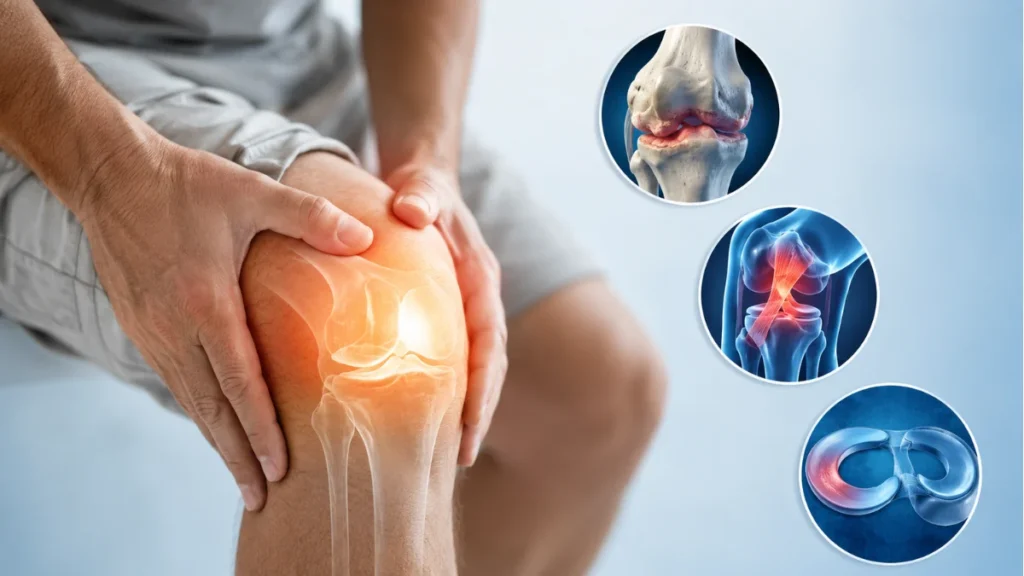
Knee pain treatment depends on the exact cause. Early arthritis, mild meniscus degeneration, muscle weakness, and soft tissue strain can often be managed without surgery.
Treatment may include medicines, physiotherapy, strengthening exercises, weight management, activity modification, knee support, and avoiding repeated squatting or sudden twisting movements. In some cases, injections may be considered after proper diagnosis.
The goal is not only pain relief. The goal is to reduce stress on the joint, improve movement, and prevent worsening where possible.
When Can Knee Pain Be Managed Without Surgery?
Many people fear that visiting an orthopedic clinic means they will be advised to have surgery. This is not true. Non-surgical treatment may work well when arthritis is mild or moderate, walking is still manageable, pain is not constant, the knee is not severely deformed, and symptoms are improving with treatment.
Early diagnosis gives patients a better chance to control pain, strengthen muscles, and slow down further damage.
When Is Knee Arthroscopy Needed?
Knee arthroscopy is a minimally invasive procedure used to diagnose and treat selected problems inside the knee joint. It is not required for every knee pain patient, and it is usually not the first treatment for simple knee arthritis symptoms.
Knee arthroscopy may be considered when there is a meniscus tear causing repeated locking, catching, swelling, or difficulty straightening the knee. It may also be useful in selected ligament injuries, loose bodies inside the joint, cartilage-related problems, or knee pain that does not improve despite proper non-surgical treatment.
For patients above 40, the decision is made carefully. If pain is mainly due to advanced arthritis, arthroscopy may not give the same benefit as it does in a mechanical problem like locking from a meniscus tear. That is why clinical examination, X-ray, and sometimes MRI are important before deciding the right treatment.
Since Dr. Ramakant Kumar performs arthroscopy, patients with suspected meniscus tear symptoms, ligament injury in knee, or repeated knee locking can be evaluated to understand whether arthroscopy is suitable or whether non-surgical care, physiotherapy, or another treatment option is better.
When Is Knee Replacement or Robotic Knee Replacement Considered?
Knee replacement is usually considered when arthritis is advanced and the joint surface is badly damaged. It is not the first option for every patient with knee pain.
Knee replacement surgery in Patna may be discussed when pain continues despite proper treatment, walking distance becomes very limited, stairs are difficult, deformity is visible, or daily life is badly affected.
Robotic knee replacement in Patna may be considered for selected patients with advanced arthritis. Robotic assistance can help in surgical planning and implant positioning, but the decision depends on X-ray findings, symptoms, age, activity level, and overall health.
Patients searching for a joint replacement surgeon in Patna should first get a proper evaluation to know whether surgery is required or whether non-surgical treatment is still possible.
Expert Opinion from Dr. Ramakant Kumar
According to Dr. Ramakant Kumar, knee pain after 40 should be evaluated when it starts affecting walking, stairs, sleep, or routine activities. Many patients assume the pain is arthritis, but the actual cause may be ligament injury, meniscus tear, cartilage damage, old trauma, or muscle weakness.
As the best orthopedic doctor in Patna for many patients seeking knee and joint care, Dr. Ramakant Kumar focuses on identifying the real cause before planning treatment. Surgery is not advised unless the condition truly requires it.
Patient Success Story
A 52-year-old patient visited Advanced Bone & Joint Clinic with repeated knee pain, swelling, and difficulty climbing stairs. The patient had been taking painkillers for months, assuming it was normal age-related pain.
After evaluation, the condition was found to be early knee arthritis with muscle weakness, not advanced joint damage. With medicines, physiotherapy, knee-strengthening exercises, and lifestyle correction, the patient noticed better walking comfort and reduced swelling within a few weeks.
This case shows why timely diagnosis matters. Knee pain after 40 does not always mean knee replacement, but delay can make the condition worse.
When to Consult an Orthopedic Doctor in Patna
If you have knee pain after 40 with swelling, stiffness, difficulty walking, pain while climbing stairs, locking, instability, or reduced movement, it is better to get checked early.
At Advanced Bone & Joint Clinic, each knee pain case is checked properly to find the actual cause, whether it is arthritis, ligament damage, meniscus injury, or any other bone and joint problem. If knee pain is affecting your daily life, you can consult one of the best orthopedic surgeons in Patna for proper diagnosis and treatment guidance. Book an appointment with Dr. Ramakant Kumar today!
FAQs
1. Can knee arthritis start after 40?
Yes. Knee arthritis can begin after 40, especially in people with excess weight, old injuries, weak muscles, or repeated stress on the knee joint.
2. How do I know if knee pain is arthritis or ligament injury?
Arthritis usually develops slowly with stiffness and walking pain. Ligament injury often starts suddenly after a twist, fall, or accident and may cause instability.
3. What are common meniscus tear symptoms?
Meniscus tear symptoms include pain on one side of the knee, swelling after activity, locking, catching, and difficulty fully straightening the knee.
4. When does knee pain need an MRI?
MRI may be needed when ligament injury, meniscus tear, cartilage damage, locking, instability, or repeated swelling is suspected.
5. Can knee pain after 40 be treated without surgery?
Yes. Many cases can be treated without surgery through medicines, physiotherapy, exercises, weight control, and activity correction if diagnosed early.
6. When is knee replacement needed?
Knee replacement may be considered when arthritis is advanced, pain is severe, walking is limited, deformity is present, and non-surgical treatment no longer gives relief.
7. Is walking good for knee pain?
Walking may help in mild cases, but it depends on the cause and severity. If walking increases pain, swelling, or instability, an orthopedic evaluation is recommended.