

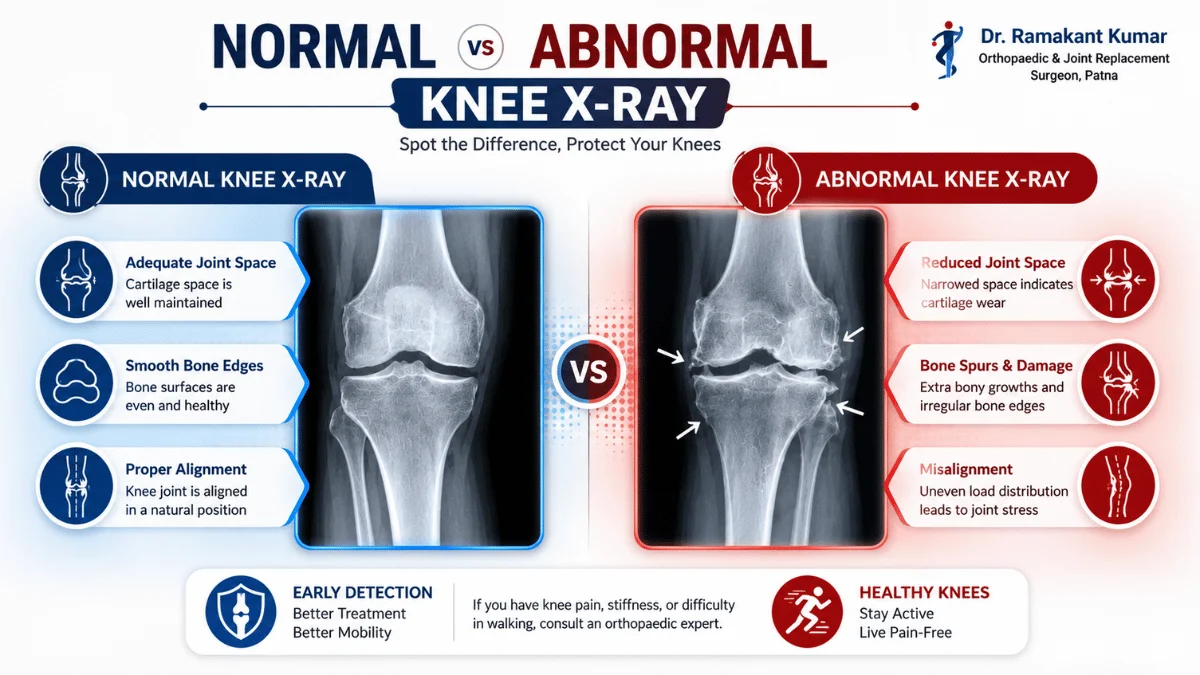
Many people first reach an orthopedic clinic when knee pain begins disturbing walking, stairs, sleep, or daily movement. After an X-ray is done, many patients receive a report containing terms such as “joint space narrowing,” “osteophytes,” “degenerative changes,” or “bone-on-bone arthritis” without fully understanding what they mean.
A knee X-ray can provide valuable information about arthritis, fractures, deformity, alignment problems, and overall joint health. However, understanding whether the findings are normal or abnormal requires more than simply reading the report.
In this guide, Advanced Bone & Joint Clinic explains what doctors look for in a knee X-ray, how arthritis and joint damage appear on imaging, and when X-ray findings may indicate the need for further treatment or orthopedic consultation.
Contents
- 1. What a Knee X-Ray Can Show
- 2. When a Knee X-Ray May Not Be Enough
- 3. Normal Knee X-Ray: What Doctors Usually Look For
- 4. Abnormal Knee X-Ray: Signs That Need Attention
- 5. Knee Arthritis X-Ray: How Arthritis Appears
- 6. Knee Joint Space Narrowing: What It Means
- 7. Bone-on-Bone Knee X-Ray: Does It Always Mean Surgery?
- 8. Knee Replacement X-Ray: What Doctors Check After Surgery
- 9. Why X-Ray Findings Must Be Matched With Symptoms
- 10. Treatment Options Based on Knee X-Ray Findings
- 11. When to Consult an Orthopedic Doctor
- 12. Request Appointment
- 13. FAQs
- 13.1. What does a knee X-ray report show?
- 13.2. Can a normal knee X-ray still cause pain?
- 13.3. What does knee joint space narrowing mean?
- 13.4. What does bone-on-bone mean in a knee X-ray?
- 13.5. When is knee replacement considered after an X-ray?
- 13.6. Should I get an MRI after a knee X-ray?
- 13.7. Can a knee X-ray show whether I need knee replacement surgery?
What a Knee X-Ray Can Show
A knee X-ray is useful because it gives a clear view of the bony structure of the knee joint. It can show whether the joint space is maintained, reduced, or almost lost. It can also reveal bone spurs, fractures, deformity, bone hardening, loose fragments, or changes around an old implant.
For patients with knee pain, a knee X-ray report may help identify arthritis, injury-related damage, bow-leg or knock-knee alignment, and signs of advanced joint wear. In patients who already had knee replacement, X-rays help check whether the implant is well placed and stable.
However, an X-ray does not show everything. Ligaments, meniscus, early cartilage damage, muscles, tendons, and nerve-related pain are not always visible clearly on X-ray. For this reason, a patient can continue to feel knee discomfort even when the X-ray does not show clear bone or joint damage. In such cases, further evaluation or MRI may be needed.
When a Knee X-Ray May Not Be Enough
Although X-rays are often the first imaging test for knee pain, they do not reveal every cause of symptoms. A patient may experience locking, instability, clicking, swelling, or pain despite having a relatively normal X-ray.
This can happen because structures such as ligaments, meniscus cartilage, tendons, muscles, and certain soft-tissue injuries are not clearly visible on standard X-rays. In selected cases, MRI, ultrasound, or additional investigations may be recommended to identify the actual source of pain.
For this reason, treatment decisions should always be based on both the patient’s symptoms and imaging findings rather than the X-ray report alone.
Normal Knee X-Ray: What Doctors Usually Look For
In a normal knee X-ray, the space between the thigh bone and shin bone is usually well maintained. This gap is important because it indirectly represents the area where cartilage protects the joint. The bone edges should look smooth, the kneecap should sit in a proper position, and there should be no fracture line, major deformity, or abnormal bone growth.
A normal X-ray also shows balanced alignment between the bones. The joint should not look tilted to one side, and the weight-bearing area should not appear compressed. If the patient has no major swelling, no serious injury history, and normal knee movement, these findings are usually reassuring.
Still, a normal X-ray does not always mean the knee is completely healthy. Pain that appears during running, bending the knee, climbing steps, or sudden turning may come from soft-tissue problems such as a meniscus injury, ligament strain, weak supporting muscles, or early internal knee damage. This is why clinical examination remains important even when the X-ray does not show major damage.
Abnormal Knee X-Ray: Signs That Need Attention
An abnormal knee X-Ray usually means the doctor has noticed changes in the bones, joint space, alignment, or implant area. The most common abnormal finding in long-term knee pain is reduced joint space. This often happens when the protective cartilage has worn down due to arthritis.
A report may also point to extra bony growth, rough joint margins, dense stress-related bone changes, small hollow areas below the joint surface, floating bone pieces, visible crack lines, or changes in knee alignment. Some patients may also have bow-leg or knock-knee alignment, where body weight falls more on one side of the knee and worsens joint damage over time.
If your knee x ray report mentions arthritis, joint space reduction, osteophytes, sclerosis, deformity, or bone-on-bone changes, it should be reviewed with an orthopedic specialist. The report gives important clues, but it should not be used alone to decide treatment.
Knee Arthritis X-Ray: How Arthritis Appears
A knee arthritis X-Ray does not show cartilage directly. Instead, doctors judge cartilage loss by looking at the gap between the bones. As this gap starts reducing, it often suggests that the cartilage layer inside the knee is no longer providing enough cushioning between the bones. If the gap is almost gone, the bones may start rubbing against each other.
Arthritis can also create bone spurs around the joint. These extra bony projections form as the knee tries to adjust to long-term stress. In advanced cases, the bone near the joint may look denser or harder because of repeated friction.
Arthritis may affect one side of the knee more than the other. This can cause the leg to bend inward or outward gradually. That is why standing X-rays are often useful. They show how the knee behaves under body weight, which may be different from a lying-down X-ray.
Read more: Knee Pain After 40: Is It Arthritis, Ligament Injury, or Something More Serious?
Knee Joint Space Narrowing: What It Means
Knee joint space narrowing is one of the most important findings in arthritis. The joint space is the gap between the thigh bone and shin bone. A healthy knee has enough space because cartilage protects the bone surfaces. When cartilage wears down, this space becomes smaller.
Narrowing may happen on the inner side, outer side, or behind the kneecap. Inner-side narrowing is common in many arthritis patients and can lead to bow-leg deformity over time. If narrowing is mild, non-surgical treatment may still help. If narrowing is severe and daily life is affected, advanced treatment options may need to be discussed.
This finding becomes more meaningful when it matches symptoms like pain while walking, stiffness after rest, difficulty climbing stairs, swelling, or reduced knee movement.
Bone-on-Bone Knee X-Ray: Does It Always Mean Surgery?
A bone-on-bone knee X-Ray usually means the joint space is severely reduced and the cartilage has worn down significantly. Patients with this finding may have pain while walking, difficulty standing for long, night pain, stiffness, swelling, or visible deformity.
Still, surgery is not advised only because an X-ray looks severe. At Advanced Bone & Joint Clinic, the report is reviewed together with the patient’s symptoms, walking comfort, daily activity limits, general health, previous treatments, and fitness for any procedure. Some patients with advanced X-ray changes may manage with medicines, exercises, weight control, injections, or walking support for some time.
Knee replacement may be discussed when X-ray damage is severe and the patient’s daily life is clearly affected despite proper non-surgical care. The goal is not to rush surgery, but to choose the right treatment at the right time.
Knee Replacement X-Ray: What Doctors Check After Surgery
A knee replacement X-Ray is done to check the position and stability of the implant after surgery. The doctor looks at implant alignment, bone support around the implant, joint balance, and any sign of loosening, wear, fracture, or change in implant position.
If a patient has pain after knee replacement, swelling, instability, stiffness, or difficulty walking, the X-ray helps identify whether the implant is stable or if further evaluation is needed. Follow-up X-rays are also useful because some implant-related issues develop slowly over time.
Why X-Ray Findings Must Be Matched With Symptoms
A knee X-ray is helpful, but treatment should not be decided from the report alone. Some patients have major arthritis changes but can still manage daily life. Others may have severe pain even with mild X-ray findings because the pain may be coming from a meniscus tear, ligament injury, inflammation, hip problem, spine issue, or nerve irritation.
Many patients become worried after reading terms like “arthritis,” “degenerative changes,” or “joint space narrowing” in their report. However, these findings should always be interpreted in the context of the patient’s age, activity level, pain severity, walking ability, and overall quality of life.
This is why clinical examination matters. Before suggesting the next step, the knee is assessed for range of motion, swelling, painful areas, alignment changes, walking difficulty, and joint support.
Treatment Options Based on Knee X-Ray Findings
Treatment depends on the stage of damage and the patient’s symptoms.In early arthritis, symptoms can often be controlled with guided exercises, physiotherapy, weight management, suitable medicines, and changes in daily activity habits. Moderate arthritis may need structured strengthening, activity modification, walking support, or injections in selected cases.
If the X-ray shows advanced arthritis, severe joint space loss, deformity, or bone-on-bone changes, knee replacement may be discussed only when pain and walking difficulty are affecting daily life. Injury-related findings like fracture or dislocation need urgent orthopedic attention.
At Advanced Bone & Joint Clinic, the treatment plan is shaped by the patient’s symptoms, examination findings, imaging results, lifestyle needs, and overall health, rather than by report terms alone. The aim is to reduce pain, improve movement, protect joint function where possible, and guide patients honestly when surgery may or may not be needed.
When to Consult an Orthopedic Doctor
You should consult an orthopedic specialist if knee pain lasts for weeks, swelling keeps returning, walking becomes difficult, stairs are painful, or your report mentions arthritis, joint space narrowing, deformity, fracture, or implant-related changes.
You should also consider consultation if your symptoms are worsening despite treatment, your knee has started changing shape, or you have difficulty performing activities that were previously comfortable. Early evaluation often helps patients understand their options before the condition becomes more disabling.
At Advanced Bone & Joint Clinic in Patna, knee X-ray findings are studied together with the patient’s pain history, movement, walking difficulty, and clinical examination. If you are looking for the best orthopedic doctor in Patna for knee pain, arthritis, or knee replacement guidance, proper evaluation can help you understand the right treatment option.
Request Appointment
If your knee X-ray report mentions arthritis, joint space narrowing, bone spurs, deformity, or bone-on-bone changes, a proper orthopedic evaluation can help determine what these findings actually mean for your daily life. At Advanced Bone & Joint Clinic, Patna, patients receive individualized assessment based on symptoms, examination findings, and imaging results.
If you are looking for one of the best orthopedic doctors in Patna for knee pain, arthritis, or knee replacement guidance, schedule a consultation and bring your X-rays and previous reports for review.
FAQs
What does a knee X-ray report show?
A knee X-ray report can show bone alignment, joint space, fracture, arthritis changes, deformity, bone spurs, and implant position after knee replacement. It does not clearly show all ligament, meniscus, or soft-tissue injuries.
Can a normal knee X-ray still cause pain?
Yes. A normal X-ray does not rule out every knee problem. Meniscus injury, ligament strain, muscle imbalance, inflammation, early cartilage damage, or referred pain from the hip or spine may still cause symptoms.
What does knee joint space narrowing mean?
Knee joint space narrowing usually means the cartilage cushion inside the joint has reduced. It is commonly seen in arthritis and becomes more important when it matches pain, stiffness, swelling, or walking difficulty.
What does bone-on-bone mean in a knee X-ray?
Bone-on-bone means the joint space is almost completely lost and the bones may be rubbing due to severe cartilage damage. It often indicates advanced arthritis, but treatment depends on symptoms and overall condition.
When is knee replacement considered after an X-ray?
Knee replacement may be considered when X-ray damage is severe and the patient has significant pain, stiffness, deformity, walking difficulty, and poor response to non-surgical treatment.
Should I get an MRI after a knee X-ray?
MRI may be advised if the doctor suspects ligament injury, meniscus tear, early cartilage damage, swelling source, or soft-tissue injury that is not clearly visible on X-ray.
Can a knee X-ray show whether I need knee replacement surgery?
Not by itself. A knee X-ray can show the extent of arthritis and joint damage, but the decision for knee replacement depends on several factors including pain severity, walking ability, stiffness, deformity, daily activity limitations, overall health, and response to non-surgical treatment.