

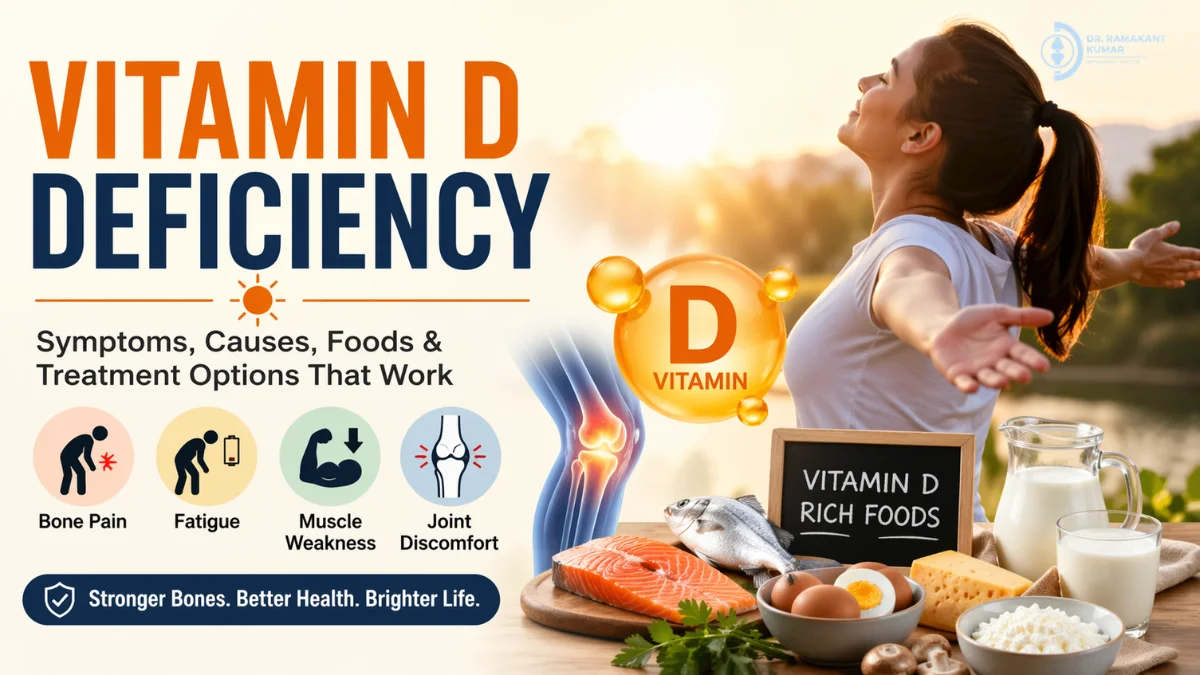
In my orthopedic practice, I often meet patients who come with complaints like body pain, back pain, leg heaviness, muscle weakness, or knee discomfort. Many of them first assume this is because of age, calcium weakness, long working hours, or general tiredness. But after proper evaluation, one common problem we often uncover is vitamin D deficiency.
This issue is easy to ignore in the beginning because the symptoms are not always dramatic. A person may only feel a dull ache in the body, reduced stamina, or weakness while walking and climbing stairs. Over time, though, low vitamin D can affect bone strength, muscle function, balance, and even recovery after injury. Vitamin D helps your body absorb calcium properly, and it also supports healthy bones and normal muscle movement.
As Dr. Ramakant Kumar, my goal in this article is to explain this topic in a clear and practical way for patients and families. I do not want to overload you with medical language. I want you to understand how vitamin d deficiency signs appear in real life, why vitamin d deficiency disease can affect bone health, and why proper vitamin d deficiency management matters if you want lasting relief rather than temporary pain control.
For people living in Patna and similar cities, this issue is becoming more common. Many adults leave home early, spend most of the day indoors, travel in closed vehicles, and get very little direct sunlight on the skin. So vitamin D deficiency is no longer only a problem of old age. I now see it in younger adults as well, including those who otherwise look fit and active.
What Is Vitamin D Deficiency?
Vitamin D deficiency means your body does not have enough vitamin D to maintain healthy calcium balance, strong bones, and proper muscle function. In simple words, if your vitamin D level is low, your body cannot use calcium as effectively as it should. Gradually, this can affect bone mineralization and make the bones and muscles perform poorly. The main blood test used to assess vitamin D status is serum 25-hydroxyvitamin D, also called 25(OH)D.
Many patients ask me, ‘Doctor, if I am eating normally, how can I still have vitamin D deficiency?’ The answer is that diet alone is often not enough. Your body makes vitamin D when the skin is exposed to sunlight. So a person can be eating reasonably well and still develop deficiency if sunlight exposure is poor for a long time.
When this deficiency becomes significant or remains untreated for long enough, it can lead to what many people search as vitamin d deficiency disease. In adults, severe vitamin D deficiency can lead to osteomalacia. This condition makes bones soft and painful and may also cause muscle weakness. In children, severe deficiency can lead to rickets.
For patient understanding, vitamin D reports are often discussed broadly like this:
- Below 20 ng/mL: deficiency
- 20 to 30 ng/mL: insufficiency
- Above 30 ng/mL: generally considered adequate for many people
At the same time, I always tell patients not to treat the report alone. A number is important, but I also look at your symptoms, age, activity level, and whether your bones or muscles are already being affected. The NIH notes that 25(OH)D is the main indicator of vitamin D status, while common cutoffs and treatment decisions can vary by clinical context.
Read More: Plaster Cast Treatment for Bone Fractures in Patna
Why Vitamin D Matters So Much for Bone and Joint Health
From an orthopedic point of view, vitamin D is not a small issue. It is one of the basic requirements for maintaining healthy bones and stable muscles. I often explain this in a simple way: calcium and vitamin D work together. If vitamin D is low, your body cannot properly absorb and use calcium, even if you are trying to improve your diet or taking supplements on your own.
This is why some patients keep taking calcium tablets but still continue to complain of body pain, weakness, or slow recovery. The missing factor may be vitamin D deficiency. In everyday orthopedic practice, low vitamin D may show up as persistent lower back pain, aching in the hips or legs, weakness while climbing stairs, poor balance, or slower recovery after a fracture. Severe deficiency can weaken bones and increase the likelihood of fractures or falls.
I become more alert about this problem when a patient has pain without a clear injury, weakness that seems out of proportion, or healing that is slower than expected. In older adults, low vitamin D can be especially important because weak muscles plus weaker bones create a more risky combination. A small slip or fall that should have caused only minor injury can become a bigger orthopedic problem in such cases.
Vitamin D Deficiency Signs Patients Commonly Ignore
One reason this condition remains undiagnosed for so long is that vitamin d deficiency signs usually develop gradually. Patients do not come saying, ‘I think my vitamin D is low.’ They come with symptoms that sound general at first. They may say they feel tired, their legs feel heavy, or there is a constant dull pain in the back, hips, ribs, or legs. These are the kinds of complaints that are easy to dismiss for months. The NHS lists pain in the back, shoulder, ribs, pelvis, or legs, tiredness while walking, difficulty climbing stairs, and getting out of a chair because of weak muscles among the symptoms of osteomalacia.
In real patients, the more meaningful warning signs are often these:
- deep, dull bone pain rather than sharp injury pain
- muscle weakness, especially in the thighs or legs
- easy tiredness during walking or stair climbing
- body ache that keeps returning
- poor stamina and reduced confidence in movement
- fractures after relatively minor injury in more severe cases
Not every patient will have all these symptoms, and not every person with these complaints has vitamin D deficiency. But when pain and weakness keep returning without a clear explanation, it should not be brushed aside as ‘normal weakness’. Severe vitamin D deficiency in adults is linked with osteomalacia, which causes weak bones, bone pain, and muscle weakness.
The practical message I want to leave you with in this first part is simple: if your body is repeatedly giving you signs like unexplained pain, heaviness, weakness, or poor physical recovery, do not ignore them. In many cases, the problem is treatable, but only when we identify the real cause properly.
Causes of Vitamin D Deficiency: What Is Actually Happening in Your Daily Life

When patients come to me with low vitamin D reports, one common reaction is confusion. They often say, ‘Doctor, I am not sick, I eat normal food, then why is this happening to me?’
The reality is that vitamin D deficiency usually develops slowly because of lifestyle patterns rather than one single cause. In cities like Patna, I see this more because daily routines have changed significantly over the years.
The most important factor is sunlight exposure. Vitamin D is produced in your skin when it is exposed to sunlight. But if your routine looks like this — leaving home early, traveling in covered vehicles, working indoors, and returning home after sunset — your body is simply not getting enough opportunity to produce vitamin D. Even people who step outside briefly may not get enough direct exposure on the skin.
Another important reason is diet. Most Indian diets do not naturally include enough vitamin d deficiency food sources. Unlike some Western diets, where foods are commonly fortified, many of our regular meals lack sufficient vitamin D. So even if you are eating properly, your intake may still be low.
Age also plays a role. As we grow older, the skin becomes less efficient at producing vitamin D, and the body’s ability to absorb and use it also reduces. This is why deficiency is more common in middle-aged and elderly patients, especially those who are less physically active.
Body weight is another factor that many people do not realize. Vitamin D is fat-soluble, which means in overweight individuals, a significant amount gets stored in fat tissues and is less available for the body to use effectively.
There are also certain medical conditions that affect vitamin D levels. Patients with liver or kidney problems, or those with intestinal issues that affect absorption, may develop deficiency even if their lifestyle seems acceptable. Some long-term medications can also interfere with vitamin D metabolism.
So in most patients, it is not just one reason. It is usually a combination of less sunlight, diet patterns, reduced activity, and individual body factors that leads to deficiency.
Read More: MCL Repair in Patna: Best Doctor, Cost & Recovery Guide
Vitamin D Deficiency Disease and Its Impact on the Body
When vitamin D levels remain low for a long time, the body starts showing more definite effects. This is what we refer to as vitamin d deficiency disease.
In adults, the most important condition linked to this is osteomalacia. In this condition, bones do not mineralize properly. Instead of being strong and rigid, they become softer and more prone to pain and stress.
Patients with osteomalacia often describe their pain differently. It is not sharp or sudden like an injury. It is more of a deep, dull ache that can affect the lower back, hips, thighs, or even ribs. Along with pain, muscle weakness becomes more noticeable. Some patients tell me that getting up from a chair or climbing stairs feels more difficult than before.
In children, severe vitamin D deficiency can lead to rickets, which affects bone development and growth. While this is less common in adults, it highlights how important vitamin D is for skeletal health at all ages.
From an orthopedic point of view, long-term deficiency can lead to several complications if not corrected:
- Bones become weaker over time
- Fracture risk increases, even with minor injuries
- Healing after fractures becomes slower
- Muscle weakness increases the chances of falls
- Chronic joint pain becomes more persistent
In elderly patients, this combination of weak bones and weak muscles can become dangerous. A simple fall can lead to serious fractures, especially around the hip or spine.
This is why I always emphasize early detection and proper vitamin d deficiency management. It is much easier to correct the problem in the early stage than to deal with complications later.
Best Vitamin D Deficiency Food Options: What Should You Actually Eat
Now let us talk about diet, because this is something patients can control on a daily basis.
One important thing I always explain clearly is that food alone may not be enough to correct moderate or severe vitamin D deficiency. However, it plays a very important role in maintaining levels and supporting treatment.
There are only a few natural sources of vitamin D in food. So it becomes important to include them regularly.
Some of the most useful vitamin d deficiency food sources include:
- Fatty fish such as salmon, mackerel, and sardines
- Egg yolk, which contains a small but useful amount
- Fortified milk and dairy products
- Fortified cereals
- Cheese
- Mushrooms that have been exposed to sunlight
For vegetarian patients, mushrooms and fortified dairy products become more important. In addition, combining these foods with calcium-rich items like milk, curd, and paneer helps improve overall bone health.
A common misunderstanding I see is that patients think drinking milk alone is enough. Milk is helpful for calcium, but without adequate vitamin D, the body cannot absorb that calcium properly. So both nutrients need to work together.
Diet should be seen as a support system. It helps maintain levels and improves long-term outcomes, but if your levels are already low, additional treatment is usually required.
Read More: Bone Pain in Children – When to Worry and When to See a Doctor
Vitamin D Deficiency Management: What Actually Works in Real Life
Now we come to the most practical and important part — how to manage vitamin D deficiency properly.
Many patients either ignore the problem or try random supplements without guidance. Both approaches can lead to poor results.
Effective vitamin d deficiency management is based on a combination of steps, not just one solution.
The first and most natural step is sunlight exposure. Regular exposure to early morning sunlight allows your body to produce vitamin D naturally. I usually advise patients to spend around 15 to 30 minutes in sunlight with arms and face exposed. This simple habit can make a noticeable difference, especially in mild deficiency.
Diet is the second component. Including vitamin d deficiency food regularly helps support recovery, although it may not be sufficient alone in more significant deficiency.
The third and most important part is supplementation, but this should always be done under medical guidance. The dose depends on how low your levels are. Some patients require weekly doses for a certain period, while others may need monthly or maintenance doses. Taking high doses without proper evaluation is not advisable.
Physical activity also plays an important role. Regular movement improves muscle strength, supports bone health, and reduces the risk of falls. Even simple activities like walking in sunlight can contribute to better outcomes.
Finally, follow-up is essential. Many patients start treatment but do not recheck their levels. Monitoring helps us adjust the treatment and ensure that levels are improving without going too high.
In my experience, patients who follow a balanced approach — sunlight, diet, supplements, and activity — show much better improvement compared to those who rely on only one method.
Medical Diagnosis: How We Confirm Vitamin D Deficiency
In clinical practice, I do not rely on guesswork when it comes to vitamin D deficiency. Many patients start supplements on their own after reading online or hearing from others. This is not the right approach because both deficiency and excess can create problems.
The correct way to diagnose vitamin D deficiency is through a blood test called serum 25-hydroxy vitamin D. This test gives a clear picture of your current vitamin D status and helps us decide the exact treatment required.
When I evaluate a patient, I do not look at the report alone. I always combine it with clinical symptoms. For example, a patient with borderline low levels but significant bone pain and weakness may still require active treatment, while another patient with similar levels but no symptoms may need only maintenance care.
For your understanding, we broadly classify levels like this:
- Below 20 ng/mL: Deficiency
- 20 to 30 ng/mL: Insufficient
- Above 30 ng/mL: Acceptable range for most patients
These values help guide treatment, but the final decision is always personalized.
Vitamin D Deficiency ICD-10 Code: Why It Matters
From a medical documentation point of view, vitamin D deficiency is classified under ICD-10 code E55, and more specifically E55.9 for unspecified deficiency.
Patients do not need to worry too much about this code, but it is important in hospital records, prescriptions, and insurance-related documentation. It helps standardize diagnosis and ensures proper tracking of the condition.
When Should You See a Doctor?
One of the biggest mistakes I see is delay. Patients continue ignoring symptoms for months, assuming it is normal weakness or just tiredness. By the time they come for consultation, the deficiency has already started affecting their daily life.
You should consider getting evaluated if you notice:
- Persistent body pain or bone pain without injury
- Muscle weakness affecting daily activities
- Difficulty in walking, climbing stairs, or standing up
- Repeated fractures or slow healing
- No improvement despite taking calcium or general medicines
If these symptoms are present, it is important not to delay testing. Early diagnosis makes treatment simpler and prevents complications.
Read More: Robotic Hip Replacement Now in Patna: Safe, More Precise for Hip Pain Relief
Why Proper Evaluation by an Orthopedic Specialist Matters
Not every pain is due to vitamin D deficiency, and not every deficiency explains all symptoms. This is where proper clinical evaluation becomes important.
As an orthopedic doctor, I look beyond just the lab report. I assess:
- Pattern and location of pain
- Muscle strength and movement
- Bone health and fracture history
- Daily activity level
- Associated joint or spine issues
In many patients, vitamin D deficiency exists along with other problems such as early arthritis, ligament strain, or spine-related issues. Treating only one aspect may not give complete relief.
If you are looking for the best orthopedic doctor in Patna, it is important to choose someone who evaluates the root cause and not just treats symptoms.
Final Thoughts from Dr. Ramakant Kumar
Vitamin D deficiency is one of the most common yet ignored health conditions I see in my practice. The positive side is that it is usually easy to diagnose and can be managed effectively when addressed at the right time.
From my experience, patients who recover well are the ones who follow a balanced approach. They do not depend on just one method. They combine proper sunlight exposure, correct supplementation, dietary support, and regular activity.
If you continue to ignore early vitamin d deficiency signs like body pain, weakness, or reduced stamina, the condition can slowly affect your bone strength and increase the risk of fractures in the future.
My advice is simple. Do not self-medicate and do not ignore your symptoms. Get your vitamin D levels checked and follow a structured vitamin d deficiency management plan.
Consultation Guidance
If you are experiencing bone pain, weakness, or joint problems and suspect vitamin D deficiency, it is better to get a proper evaluation rather than delaying it.
You can visit my clinic for a detailed assessment where we evaluate your symptoms, check your reports, and create a personalized treatment plan based on your condition.
Early treatment not only gives relief from current symptoms but also protects your bones and joints in the long term.