
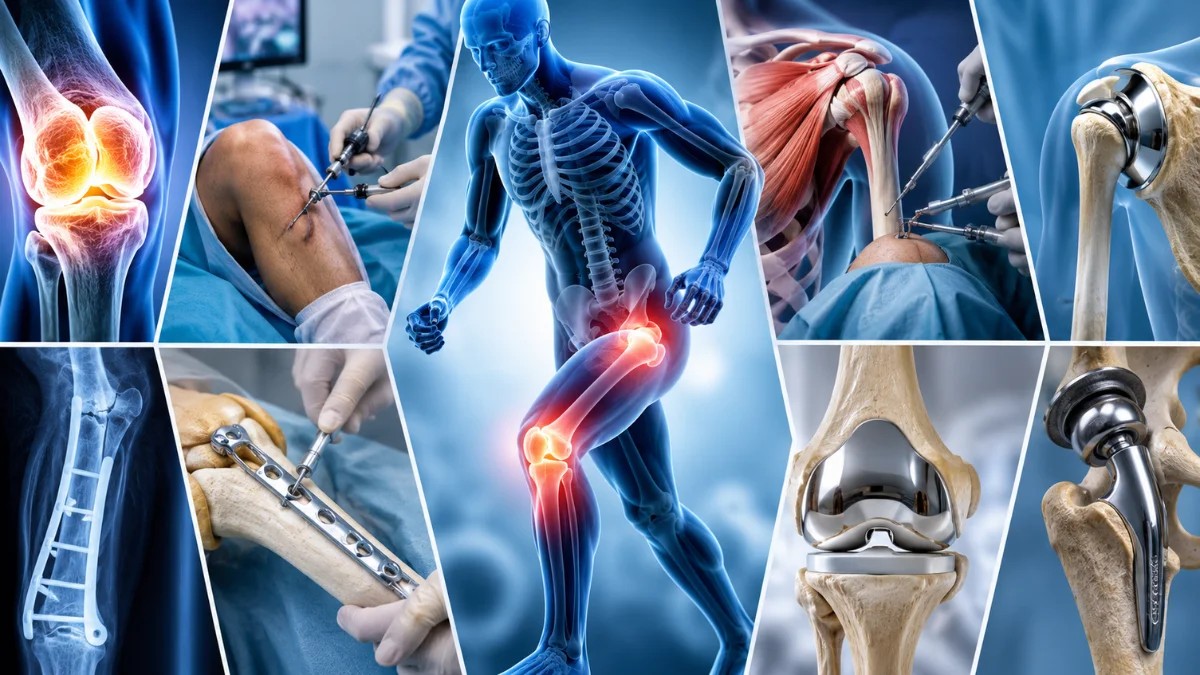
When an orthopedic surgeon mentions surgery, one of the first questions patients have is: “What kind of operation do I actually need?”
Orthopedic surgery is not a single procedure. A displaced fracture may require fixation, an unstable knee after an ACL tear may need ligament reconstruction, a damaged shoulder tendon may require repair, while advanced arthritis can eventually lead to knee, hip, or shoulder replacement.
At Advanced Bone & Joint Clinic, led by Dr. Ramakant Kumar, treatment planning considers the diagnosis, extent of damage, pain, movement, joint stability, daily limitations, imaging findings, activity requirements, overall health, and response to previous treatment.
Here is how the major types of orthopedic surgery differ and the problems they are designed to address.
Which Orthopedic Problem May Lead to Which Type of Surgery?
Symptoms can provide clues about which structure needs examination, although they cannot determine the procedure by themselves.
| Problem or symptom | What may need evaluation |
| Broken bone with displacement or deformity | Fracture fixation |
| Knee repeatedly giving way after injury | ACL or another ligament injury |
| Knee locking or catching | Meniscus or another mechanical problem |
| Severe knee arthritis affecting walking | Partial or total knee replacement |
| Advanced hip arthritis with groin pain and stiffness | Hip replacement |
| Shoulder weakness following an injury | Rotator cuff injury |
| Repeated shoulder dislocation or instability | Labrum and stabilizing structures |
| Severe shoulder joint damage | Shoulder replacement |
An orthopedic examination, supported by appropriate imaging when required, helps establish what is actually causing the symptoms.
Does Every Bone or Joint Problem Need Surgery?
No. Many orthopedic problems can initially be treated without an operation.
Depending on the condition, treatment may include physiotherapy, strengthening, activity modification, medicines, bracing, weight management, or selected injections.
Surgery is generally considered when structural damage, instability, mechanical restriction, severe arthritis, or a significant injury is unlikely to improve sufficiently with conservative treatment.
How Does an Orthopedic Surgeon Choose the Procedure?
Two people with pain in the same joint may have completely different conditions.
For example, knee pain following a twisting sports injury could involve the ACL or meniscus. Gradually worsening knee pain with stiffness and loss of joint space may point toward osteoarthritis.
Assessment may consider:
- The bone, ligament, tendon, cartilage, or joint surface involved
- Extent of structural damage
- Stability and range of motion
- Previous treatments and their results
- X-ray, MRI, CT, or other relevant findings
- Associated injuries
- Occupation and activity requirements
- General health and surgical fitness
These details help connect imaging findings with the patient’s actual symptoms and functional limitations.
1. Fracture Surgery: When Does a Broken Bone Need Fixation?
Many stable fractures can heal with a cast, splint, brace, or other immobilization. Surgical fixation may become necessary when broken bone fragments are significantly displaced, the fracture is unstable, an important joint surface is involved, the injury is open, or satisfactory alignment cannot be maintained.
Depending on the fracture pattern and location, fixation may involve plates, screws, rods, nails, wires, or other implants.
Fractures that commonly need careful surgical assessment include:
- Significantly displaced fractures
- Unstable fracture patterns
- Open fractures
- Certain fractures extending into a joint
- Multiple or complex bone injuries
- Fractures that lose alignment during treatment
- Selected cases where healing is delayed
Fixation stabilizes the injured area while biological bone healing continues. Movement and weight-bearing are advanced according to the bone involved and evidence of healing.
2. Knee Arthroscopy and Meniscus Surgery
Knee arthroscopy uses a small camera and specialized instruments inserted through small incisions to treat selected problems within the knee.
It can be useful for certain meniscus, cartilage, loose-body, or other mechanical conditions.
What happens with a meniscus tear?
Some meniscus tears can be managed through rehabilitation. Others may produce persistent locking, catching, or mechanical symptoms that require arthroscopic treatment.
When the tear pattern and tissue permit, meniscal repair may preserve more of the natural cushioning tissue. Other tears may require a different arthroscopic approach.
Age, tear location, tissue quality, activity requirements, associated ligament injuries, and arthritis all influence treatment planning.
3. ACL Reconstruction and Knee Ligament Surgery
The ACL is an important stabilizing ligament inside the knee. It is frequently injured during pivoting, sudden direction changes, awkward landings, and sports activities.
An ACL tear may cause:
- Repeated knee giving way
- Instability while turning
- Swelling following injury
- Difficulty returning to pivoting sports
- Loss of confidence during sudden movements
When instability significantly interferes with activity, ACL reconstruction may be considered. The damaged ligament is usually reconstructed using a tissue graft.
Rehabilitation then focuses on rebuilding knee movement, strength, balance, coordination, and functional control.
4. Knee Replacement Surgery: Partial or Total?
Knee replacement may be considered when arthritis has caused substantial joint damage and persistent pain or stiffness is limiting everyday activities.
Patients may struggle with walking, stairs, standing, getting up from a chair, or sleeping comfortably.
Total Knee Replacement
Total knee replacement is generally used when arthritis extensively affects the knee. Damaged joint surfaces are prepared and covered with prosthetic components designed to restore a functional joint surface.
It may be considered when there is:
- Persistent pain during routine activities
- Significant stiffness
- Reduced walking ability
- Rest or night pain
- Progressive deformity
- Advanced arthritis with inadequate relief from conservative treatment
Recovery is progressive: walking usually improves before strength and endurance fully return, and rehabilitation commonly continues for several weeks to months.
Partial Knee Replacement
When arthritis is confined to a suitable compartment and the remainder of the knee is reasonably preserved, partial knee replacement may be an option.
Only the affected compartment is resurfaced.
Suitability depends on the pattern of arthritis, ligament function, alignment, movement, and condition of the remaining joint.
5. Robotic Knee Replacement: What Does the Robot Actually Do?
Robotic knee replacement does not mean a robot independently performs the operation.
Robotic-assisted systems provide technology that can support surgical planning and execution. Depending on the system, they may help assess anatomy, plan bone preparation, evaluate alignment, and assist implant positioning.
The orthopedic surgeon remains in control throughout surgery.
For patients considering robotic knee replacement, the useful question is not simply whether robotic technology is available, but whether it offers a meaningful role in their particular surgical plan.
6. Hip Replacement Surgery
Advanced hip disease may cause pain in the groin, thigh, buttock, or sometimes around the knee.
As joint damage progresses, patients may find it difficult to:
- Walk comfortably
- Climb stairs
- Put on shoes or socks
- Enter or exit a car
- Stand for longer periods
- Sleep comfortably
Hip replacement may be considered when substantial joint damage causes persistent pain and loss of mobility despite appropriate conservative care.
During total hip replacement, damaged parts of the ball-and-socket joint are replaced with prosthetic components.
Many patients begin walking with appropriate support early in recovery, but strength, balance, confidence, and return to routine activities improve progressively over the following weeks and months.
Read more: 4 Types of Fractures: These Symptoms Can Reveal Bigger Problems
7. Shoulder Arthroscopy and Rotator Cuff Surgery
Shoulder arthroscopy allows selected conditions within and around the shoulder to be treated through small incisions.
Depending on the diagnosis, it may be used for certain:
- Rotator cuff tears
- Labral injuries
- Shoulder instability problems
- Other internal shoulder conditions
When may a rotator cuff tear require repair?
The rotator cuff contributes to shoulder movement and stability. Tears may occur after an injury or develop gradually as tendon tissue changes.
Symptoms can include:
- Night pain
- Shoulder weakness
- Difficulty raising the arm
- Trouble reaching overhead
- Reduced ability to lift objects
When repair is appropriate, the torn tendon may be reattached to the bone arthroscopically. Recovery is deliberately gradual because the repaired tendon needs time to heal before heavier strengthening and unrestricted activity can resume.
8. Shoulder Replacement Surgery
Shoulder replacement addresses severe damage to the joint surfaces rather than an isolated soft-tissue problem.
Depending on the condition, procedures may include conventional total shoulder replacement or reverse shoulder replacement.
Reverse shoulder replacement changes the mechanics of the shoulder and can be considered in selected complex cases, including certain situations involving severe joint damage together with major rotator cuff dysfunction.
Recovery usually progresses from protecting the operated shoulder and restoring movement toward strengthening and functional use over several months.
9. Other Orthopedic and Sports Injury Surgeries
Orthopedic surgery also includes procedures involving the ankle, wrist, elbow, foot, and other musculoskeletal structures.
These can include:
- Tendon repair
- Ligament reconstruction
- Ankle or wrist fracture fixation
- Surgery for recurrent joint instability
- Selected cartilage procedures
- Repair or reconstruction following sports injuries
These procedures address different structural problems and therefore have different rehabilitation requirements.
Arthroscopy vs Open Surgery vs Joint Replacement
These terms describe different surgical approaches or treatment goals.
Arthroscopy
A camera and narrow instruments are inserted through small incisions to treat selected internal joint or soft-tissue problems.
Open Surgery
A larger surgical exposure provides direct access when required for procedures such as complex fracture fixation, tendon repair, or reconstruction.
Joint Replacement
Severely damaged joint surfaces are resurfaced or replaced using prosthetic components. Knee, hip, and shoulder replacements fall into this category.
The surgical approach is selected according to the structure that needs to be repaired, stabilized, reconstructed, or replaced.
What Tests May Be Needed Before Orthopedic Surgery?
Investigations depend on the suspected condition and planned procedure.
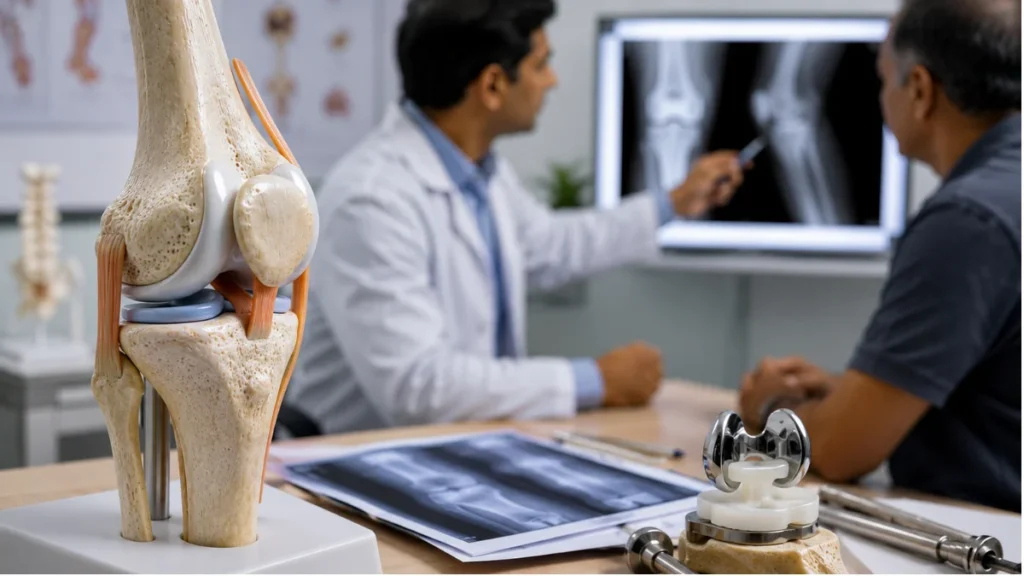
X-rays are commonly used to assess fractures, alignment, and arthritis. MRI can provide detailed information about ligaments, menisci, tendons, cartilage, and other soft tissues. CT may be useful for selected complex fractures or detailed bone assessment.
Before an operation, some patients may also require:
- Blood tests
- Blood sugar assessment
- ECG
- Review of current medicines
- Anaesthesia evaluation
- Additional medical fitness tests when indicated
Testing is individualized rather than identical for every orthopedic patient.
What Are the Risks of Orthopedic Surgery?
The risks differ according to the procedure and the patient’s health.
Possible complications can include infection, bleeding, blood clots, stiffness, wound problems, persistent pain, nerve or blood vessel injury, delayed bone or soft-tissue healing, implant-related problems, or occasionally the need for further surgery.
Uncontrolled diabetes, smoking, obesity, poor nutrition, active infection, and certain medical conditions may increase surgical risk. Addressing modifiable health factors before elective surgery can therefore be an important part of preparation.
What Does Recovery After Orthopedic Surgery Involve?
Recovery usually moves through stages.
Early care focuses on controlling pain and swelling, protecting the operated area, wound care, and safe movement. Rehabilitation then works on mobility, muscle strength, balance, stability, and functional independence.
Later, activities such as work, driving, exercise, sports, and heavier physical tasks are reintroduced according to healing and clinical progress.
Recovery should be judged by the operation performed and the patient’s progress rather than another person’s timeline.
Warning Signs After Orthopedic Surgery
Contact the treating medical team promptly if you develop:
- Increasing redness or discharge around the wound
- Fever accompanied by worsening pain
- Sudden or excessive swelling
- New numbness or weakness
- Unexpected inability to bear weight
- Significant calf pain or swelling
- New shortness of breath
- Severe pain after a fall
These symptoms do not always mean that a serious complication has occurred, but they deserve timely medical assessment.
When Should You Seek an Orthopedic Consultation?
Consider an orthopedic evaluation when:
- Pain continues despite appropriate treatment
- Joint movement is progressively decreasing
- A knee or another joint repeatedly locks or gives way
- You have sustained a significant bone or joint injury
- Swelling repeatedly returns
- Walking, work, sleep, or sports are becoming difficult
- Weakness is increasing
- Arthritis is reducing independence in everyday activities
Early evaluation can also help identify conditions that may still be manageable with non-surgical treatment before they cause greater functional limitation.
Frequently Asked Questions
1. What are the most common types of orthopedic surgery?
Common procedures include fracture fixation, arthroscopy, ACL reconstruction, meniscus surgery, rotator cuff repair, knee replacement, hip replacement, shoulder replacement, and selected tendon or ligament reconstruction procedures.
2. Does every fracture require surgery?
No. Many stable fractures can heal with appropriate immobilization. Surgery becomes more likely when a fracture is significantly displaced, unstable, open, involves certain joint surfaces, or cannot maintain satisfactory alignment.
3. What is the difference between arthroscopy and joint replacement?
Arthroscopy uses a small camera and specialized instruments to treat selected internal joint problems. Joint replacement addresses severely damaged joint surfaces using prosthetic components.
4. Which orthopedic surgeries are used for sports injuries?
Depending on the injury, treatment may include ACL reconstruction, meniscus repair, rotator cuff repair, tendon repair, ligament reconstruction, or fracture fixation.
5. How long does recovery take after orthopedic surgery?
It varies widely. Recovery from some procedures may be measured in weeks, while ligament reconstruction, tendon repair, complex fracture fixation, and joint replacement can require rehabilitation over several months.
6. How do I know whether I really need orthopedic surgery?
The decision considers the diagnosis, structural damage, pain, instability, movement, functional limitations, examination findings, imaging results, response to previous treatment, and expected consequences of leaving the problem untreated.
Final Takeaway
From fracture fixation and ligament reconstruction to arthroscopy and joint replacement, orthopedic procedures are designed to solve very different problems.
The important question is not simply “Which surgery is best?” It is “What structure is causing my symptoms, how serious is the damage, and what treatment gives me a reasonable path back to function?”
If persistent bone or joint pain, instability, stiffness, an injury, or arthritis is interfering with your mobility or everyday life, you can schedule an evaluation at Advanced Bone & Joint Clinic with an experienced orthopedic surgeon in Patna. The purpose of the consultation is to establish the cause first and then discuss appropriate non-surgical or surgical options based on your condition.