

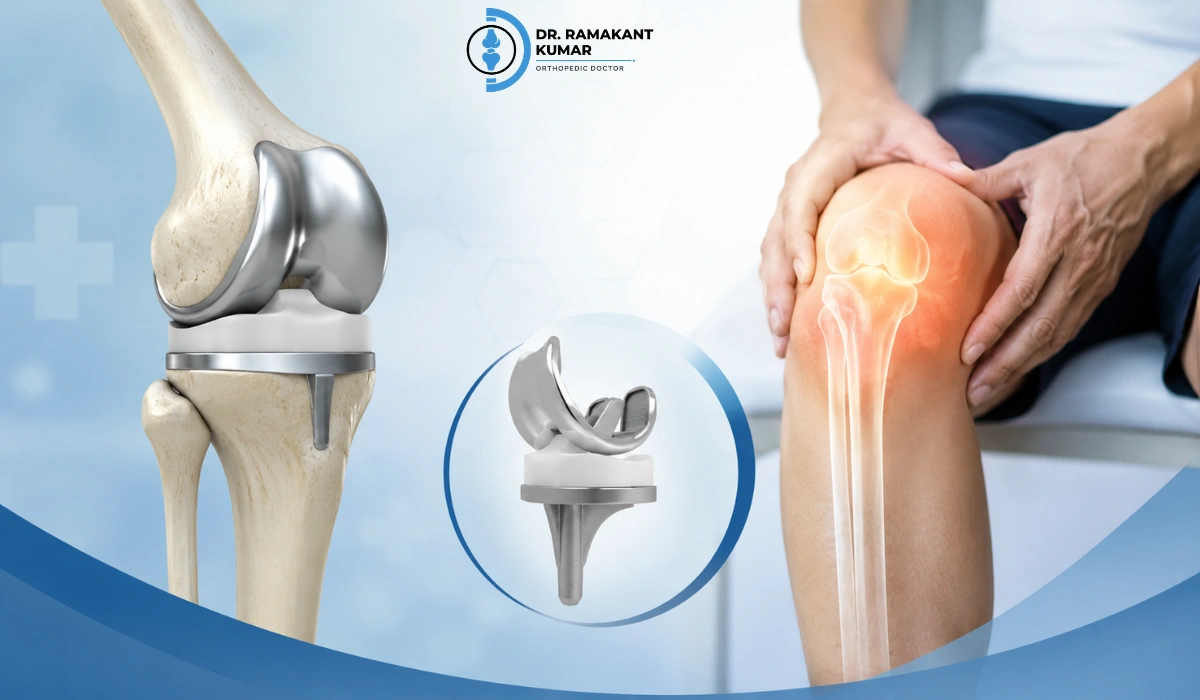
Persistent knee or hip pain can gradually affect the way you walk, sleep, work, and manage everyday activities. You may start avoiding stairs, walking shorter distances, or depending on support for tasks that once felt easy. When this continues despite treatment, it is natural to wonder whether joint replacement is the next step.
However, pain alone does not mean you need surgery.
As an orthopedic surgeon, I look at the complete picture before recommending joint replacement surgery. The decision depends on the extent of joint damage, severity of pain and stiffness, loss of movement, effect on daily activities, imaging findings, overall health, and response to previous treatment.
For some patients, non-surgical treatment can continue to provide meaningful relief. For others with advanced joint damage and significant functional limitation, replacement may become a reasonable option.
When Should Joint Replacement Be Considered?
There is no single symptom that confirms you need a replacement. Surgeons usually look for a combination of persistent symptoms, structural joint damage, and increasing difficulty with routine activities.
You should consider an orthopedic evaluation if you have:
- Pain while walking or standing
- Difficulty climbing stairs
- Trouble getting up from a chair
- Pain that disturbs sleep
- Increasing stiffness
- Reduced joint movement
- Progressive bowing or deformity
- Dependence on a walking stick or support
- Reduced walking distance
- Difficulty managing work or household activities
- Symptoms that continue despite appropriate treatment
An X-ray is important, but it should not decide surgery by itself.
Two people may have similar arthritis on an X-ray but experience very different levels of pain and disability. That is why symptoms, physical examination, joint stability, movement, muscle strength, alignment, imaging findings, and quality of life must be considered together.
Which Conditions Commonly Lead to Joint Replacement?
Read More: From Fractures to Joint Replacement: Which Orthopedic Surgery Treats What?
Osteoarthritis
Osteoarthritis is one of the most common reasons for knee and hip replacement. As the cartilage covering the ends of the bones wears down, the joint can become painful, stiff, swollen, and difficult to move.
Early or moderate arthritis can often be managed without surgery. Replacement is usually considered when the disease becomes advanced and significantly affects mobility or daily function.
Rheumatoid and Other Inflammatory Arthritis
Inflammatory arthritis can gradually damage cartilage and bone. Modern medicines help control these conditions in many patients, but severe joint destruction may still occur.
If the joint becomes persistently painful, stiff, deformed, or functionally limited despite appropriate medical treatment, replacement may be considered.
Avascular Necrosis
Avascular necrosis occurs when the blood supply to part of a bone is reduced. It commonly affects the hip.
If the head of the thigh bone weakens or collapses, the joint may lose its normal shape and develop severe damage. In advanced cases, hip replacement may be required.
Post-Traumatic Arthritis
A major fracture or joint injury can damage cartilage or change normal alignment. Even after the original injury heals, arthritis may develop years later, causing increasing pain, stiffness, and loss of movement.
Should You Try Other Treatments Before Surgery?
Usually, yes.
The purpose of non-surgical treatment is to control symptoms and maintain useful function for as long as it continues to help.
Depending on your condition, treatment may include:
- Physiotherapy
- Muscle strengthening
- Activity modification
- Weight management when appropriate
- Pain-relieving medicines
- Anti-inflammatory medicines when medically suitable
- Walking aids
- Selected braces
- Appropriate joint injections
These treatments cannot rebuild cartilage lost through advanced arthritis, but they may still provide useful symptom relief.
The important question is whether they are continuing to help.
If severe pain is still affecting walking, sleep, work, or independence despite appropriate treatment, it may be time to discuss replacement.
Also Read: 4 Types of Fractures: These Symptoms Can Reveal Bigger Problems
What Type of Joint Replacement Might You Need?
Joint replacement is not one standard operation. The procedure depends on the joint involved and how much of it has been damaged.
Total Knee Replacement
Total knee replacement is generally considered when arthritis has extensively damaged the knee.
During surgery, damaged joint surfaces are prepared and covered with prosthetic components. The goal is to create a more stable, better-aligned joint that can move with less pain.
It may be appropriate when persistent pain, stiffness, deformity, or reduced walking ability is significantly affecting everyday life.
Partial Knee Replacement
If arthritis is limited to one suitable compartment of the knee, the entire joint may not need replacing.
Partial knee replacement resurfaces only the damaged area while preserving more of the natural knee.
However, suitability depends on ligament stability, alignment, movement, and the condition of the remaining joint, not simply where pain is felt.
Robotic Knee Replacement
Patients often ask whether robotic knee replacement is better.
The robot does not operate independently.
Robotic-assisted systems can help the surgeon with planning and certain stages of the procedure, such as bone preparation, alignment assessment, and implant positioning, depending on the system being used.
The surgeon remains in control throughout surgery.
Technology may be useful, but diagnosis, surgical planning, implant selection, surgeon experience, and rehabilitation remain equally important.
Total Hip Replacement
Hip arthritis often causes deep groin pain, although discomfort may also spread into the thigh or around the knee.
Patients may struggle with walking, stairs, putting on shoes, getting into a car, or sleeping comfortably.
During total hip replacement, the damaged ball-and-socket surfaces are replaced with prosthetic components.
What Does an Orthopedic Surgeon Check Before Recommending Surgery?
Before recommending replacement, it is important to confirm that the joint itself is actually causing the symptoms.
Hip pain can sometimes come from the lower back. Knee pain may occasionally be influenced by hip problems, muscle weakness, ligament injuries, or another condition.
An orthopedic assessment usually considers:
- Exact location and pattern of pain
- Range of movement
- Muscle strength
- Joint stability
- Swelling and tenderness
- Limb alignment
- Walking pattern
- Functional limitations
- Previous treatment and response
X-rays are commonly used to assess arthritis, joint-space narrowing, deformity, and bone changes. MRI or CT may be useful in selected situations but is not necessary for every patient.
Your general health also matters. Diabetes, heart or lung disease, smoking, obesity, active infection, medications, and other medical conditions can influence surgical risk.
You May Like: Considering Joint Replacement Surgery in Patna? What to Know Before You Decide
What Can Joint Replacement Realistically Improve?
The main goal of joint replacement is to reduce significant pain and restore useful function.
After recovery, many patients hope to walk more comfortably, manage stairs more easily, sleep with less pain, and become more independent.
These are realistic goals, but an artificial joint is not identical to a young, healthy natural joint.
Some patients may continue to experience mild stiffness, weakness, altered sensation, or occasional discomfort.
Recovery can also take longer when muscle weakness or limited mobility was already present before surgery.
The goal should be meaningful improvement in pain and mobility, not the expectation of a completely “new” joint.
What Are the Risks of Joint Replacement?
Joint replacement is a major operation, and complications are possible.
Potential risks include:
- Infection
- Blood clots
- Pulmonary embolism
- Bleeding or wound problems
- Joint stiffness
- Persistent pain
- Nerve or blood vessel injury
- Fracture around the implant
- Implant loosening or wear
- Hip dislocation in selected cases
- Need for revision surgery later
Your individual risk depends partly on your overall health.
Poorly controlled diabetes, smoking, active infection, and certain medical conditions may increase surgical or recovery risks. Improving these factors before elective surgery can be an important part of preparation.
What Is Recovery Like After Joint Replacement?
Recovery happens gradually.
During the first few days, treatment usually focuses on pain control, swelling reduction, wound care, blood-clot prevention, and safe movement. Many patients begin walking with a walker or another support relatively early.
Over the following weeks, rehabilitation focuses on improving movement, increasing walking distance, strengthening muscles, and reducing dependence on support.
Strength and endurance generally take longer to return than basic walking.
Return to work depends on the type of job. Desk-based work may allow an earlier return than work involving lifting, climbing, prolonged standing, or physical labour.
Knee and hip replacement recovery are also different, so comparing your progress with another patient is rarely helpful.
When Should You Seek Medical Attention After Surgery?
Some pain, swelling, and stiffness are expected after surgery. However, certain symptoms require prompt assessment.
Contact your medical team if you develop increasing wound redness or discharge, fever with worsening pain, severe calf pain or swelling, new numbness or weakness, unexpected inability to bear weight, or severe pain after a fall.
Sudden chest pain or shortness of breath requires urgent medical attention.
Related Article: Your X-Ray Looks Normal, So Why Does the Joint Still Hurt?
Questions to Ask Before Choosing Joint Replacement
Before deciding on surgery, make sure you understand:
- What exactly is damaged in the joint?
- How advanced is the arthritis?
- What may happen if surgery is delayed?
- Are useful non-surgical options still available?
- Is partial or total replacement more suitable?
- Is robotic-assisted surgery relevant?
- What improvement can realistically be expected?
- What are your individual risks?
- When can you return to walking, work, and driving?
- What rehabilitation will be required?
Considering Joint Replacement Surgery in Patna?
If you are considering joint replacement surgery in Patna, avoid making the decision based only on an X-ray report, package price, or availability of a specific technology.
Patients searching for a top joint replacement surgeon doctor in Patna should consider orthopedic training, experience with the proposed procedure, hospital facilities, rehabilitation planning, follow-up support, and how clearly the surgeon explains alternatives, risks, and expected outcomes.
The purpose of replacement is not simply to change a damaged joint. It is to improve pain, mobility, and independence enough to make surgery and recovery worthwhile.
Final Takeaway
Joint replacement can be an effective option when advanced knee or hip damage is causing persistent pain and reducing mobility or independence. The decision should not be based on one symptom or one X-ray.
What matters most is whether the joint is truly causing your symptoms, how advanced the damage is, whether non-surgical treatment still helps, and what improvement surgery can realistically provide.
If knee or hip pain is interfering with walking, sleep, work, or independence, an evaluation with leading orthopedic doctors in Patna can help determine whether joint replacement is appropriate and what you can realistically expect from surgery and recovery.