
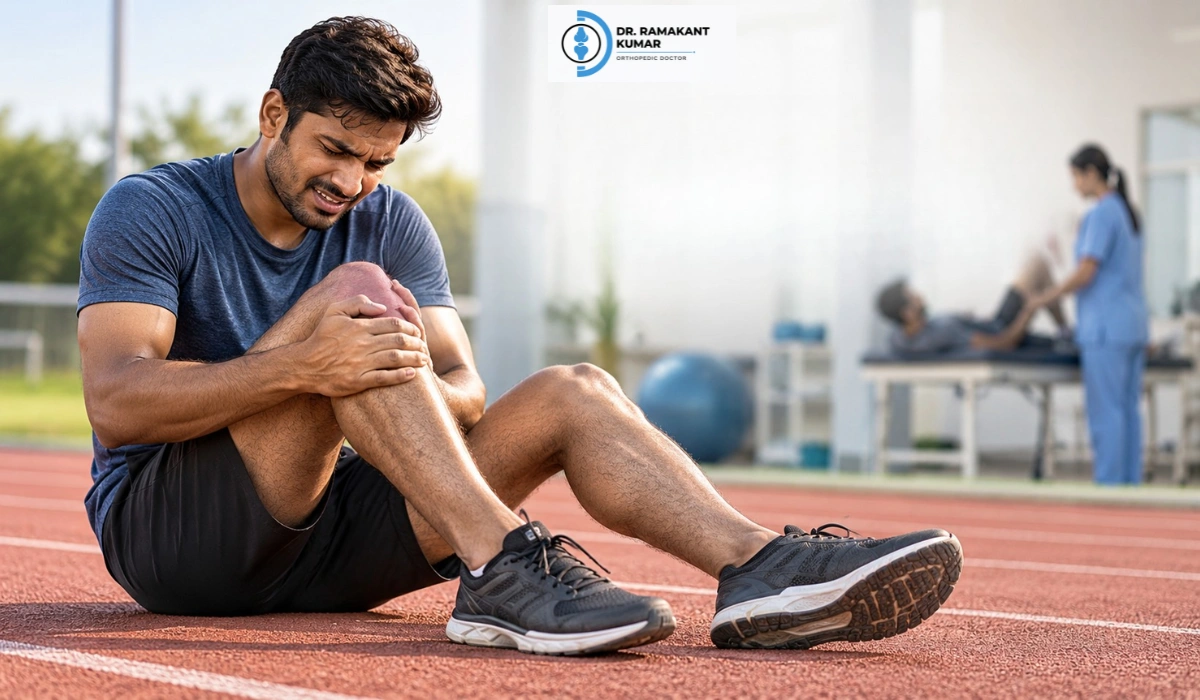
Sports injuries can happen during running, gym training, cricket, football, badminton, cycling, or even routine exercise. Sometimes the pain is only temporary muscle soreness. At other times, it can be a sign of a ligament tear, tendon injury, fracture, or joint problem that needs proper evaluation.
The difficult part for most patients is knowing when an injury is minor and when it deserves medical attention.
One useful way to judge a sports injury is to look beyond pain alone. Swelling, weakness, instability, loss of movement, and difficulty putting weight on the injured part can often tell us more about the seriousness of the problem.
Contents
- 1. What Are the Warning Signs That a Sports Injury May Be More Serious?
- 2. What Are the Most Common Sports Injuries?
- 3. What Should You Do Immediately After a Sports Injury?
- 4. How Is a Sports Injury Diagnosed?
- 5. When Might Surgery Be Needed?
- 6. Why Do Sports Injuries Keep Coming Back?
- 7. How Do You Know When You’re Ready to Return to Sports?
- 8. How Can You Reduce the Risk of Another Sports Injury?
- 9. When Should You Consult an Orthopedic Doctor?
- 10. Final Takeaway
- 11. Frequently Asked Questions
What Are the Warning Signs That a Sports Injury May Be More Serious?
Mild soreness usually settles gradually, especially when it follows a new workout or increased activity. A more concerning sports injury often affects how normally you can move, walk, lift, or use the joint.
Some symptoms should make you more cautious:
- Severe or increasing pain
- Significant swelling or bruising
- Inability to bear weight normally
- A joint that feels weak, loose, or unable to support movement properly
- Marked weakness or loss of movement
- Repeated locking or catching
- Numbness or persistent tingling
- A pop or crack followed by swelling or loss of function
- Visible deformity
A popping sound does not always mean something has torn, but the symptoms that follow matter. For example, a twisting knee injury followed by rapid swelling and repeated giving way is more concerning than a painless click.
You should seek urgent care if the injured limb looks deformed, becomes unusually cold or discoloured, loses sensation, or cannot be moved after a significant injury.
Read More: Is Joint Replacement the Right Choice for You? Signs, Options, Risks and Recovery
What Are the Most Common Sports Injuries?
Sports injuries can affect bones, muscles, ligaments, tendons, cartilage, and joints. The type of injury often depends on the movement that caused it.
A sprain affects a ligament, while a strain affects a muscle or tendon. Ankle sprains are common after awkward landings, while muscle strains often happen during sprinting, jumping, or sudden acceleration.
Knee injuries are also common, especially in sports that involve pivoting or rapid changes in direction. ACL injuries may cause a pop, swelling, and a feeling that the knee is unstable. Meniscus injuries can cause pain, catching, locking, or swelling after a twisting movement.
Shoulder injuries are often seen in overhead sports, weight training, or contact activities. Problems may involve the rotator cuff, labrum, or structures that keep the shoulder stable.
Fractures usually follow a fall, collision, or direct impact, while stress fractures develop more gradually due to repeated loading. A runner who increases training distance too quickly, for example, may develop very localised bone pain that worsens with activity.
What Should You Do Immediately After a Sports Injury?
If you feel sudden pain during sport, the safest first step is to stop. Continuing to run, jump, lift, or “test” the injured area repeatedly can make the problem worse.
For many acute sprains and strains, early care may include relative rest, protection of the injured area, cold application for pain and swelling, compression when suitable, and elevation of an injured limb.
What you should avoid is equally important. Aggressive massage, forceful stretching, or repeatedly trying the painful movement during the early stage can irritate the injured tissue.
Pain relief can sometimes make the injury feel better, but that does not mean it is healed. Even if the pain has eased, do not return to sport while you are still limping, moving differently, or experiencing weakness or poor joint stability.
Also Read: From Fractures to Joint Replacement: Which Orthopedic Surgery Treats What?
How Is a Sports Injury Diagnosed?
The correct sports injury treatment starts with identifying what has actually been injured.
The way the injury happened gives important clues. A sudden twisting injury suggests a different set of possibilities than pain that gradually develops after several weeks of heavy training.
During an orthopedic assessment, we usually look at movement, strength, swelling, tenderness, stability, and how well you can bear weight or use the injured part.
Imaging is used when it adds useful information. X-rays are mainly helpful for suspected fractures, dislocations, or other bone injuries. MRI may be needed for selected ligament, meniscus, tendon, cartilage, or muscle injuries. Ultrasound can be useful for certain tendon and soft-tissue problems.
Not every sports injury needs an MRI. In many cases, the clinical examination helps decide whether advanced imaging is actually necessary.
When Might Surgery Be Needed?
A scan showing a tear does not automatically mean you need an operation.
Surgery may be considered when there is significant structural damage that is unlikely to recover well with conservative treatment alone. This can include selected unstable fractures, major tendon injuries, recurrent shoulder dislocation, persistent knee instability, or certain meniscus injuries with ongoing locking or mechanical symptoms.
The important point is that the treatment decision should be based on your symptoms and function, not just the wording of an MRI report.
You May Like: 4 Types of Fractures: These Symptoms Can Reveal Bigger Problems
Why Do Sports Injuries Keep Coming Back?
One of the most common situations is a patient who says, “It felt better, but the pain came back as soon as I started playing again.”
This usually happens because pain improves faster than strength, balance, coordination, and tissue tolerance.
Repeated sports injuries can be linked to:
- Returning too early
- Incomplete rehabilitation
- Persistent weakness
- Poor balance or movement control
- Joint instability
- Sudden increase in training load
- Incorrect technique
- Training through repeated pain
Rest may settle symptoms, but it does not automatically prepare the body for full-speed sporting activity.
How Do You Know When You’re Ready to Return to Sports?
There is no fixed recovery timeline that works for every injury.
A mild strain may improve relatively quickly, while a ligament reconstruction, tendon repair, or fracture may require several months.
A safer return depends on function rather than simply counting weeks. Before resuming full sport, you should generally have good movement, strength, stability, balance, and the ability to perform sport-specific actions without significant symptoms returning.
Being able to walk without pain is not the same as being ready to sprint, jump, pivot, tackle, or throw.
Return to sport is usually better when it happens gradually, starting with controlled rehabilitation and progressing toward sport-specific drills before full participation.
Read This: Considering Joint Replacement Surgery in Patna? What to Know Before You Decide
How Can You Reduce the Risk of Another Sports Injury?
Injury prevention is not only about warming up. It also depends on how well your body is prepared for the demands of your sport.
Gradually increase training load instead of making sudden jumps in intensity or duration. Build strength that matches your sport, work on balance and movement control, use suitable footwear, and allow enough recovery between demanding sessions.
Most importantly, finish rehabilitation properly. If the same ankle keeps spraining or the same knee keeps giving way, there may be an underlying issue that has not been addressed.
When Should You Consult an Orthopedic Doctor?
You should consider an orthopedic evaluation when the injury is affecting normal movement or is not improving as expected.
Medical assessment is especially useful if:
- Pain is severe or worsening
- Swelling remains significant
- You cannot bear weight normally
- The joint keeps giving way
- Your knee locks or catches
- Shoulder strength is clearly reduced
- You suspect a fracture or dislocation
- Symptoms return whenever you restart sport
- Pain continues despite rest and rehabilitation
Seeing an orthopedic doctor does not automatically mean surgery. In many cases, the main benefit is getting the correct diagnosis and a more targeted recovery plan.
If a sports injury is affecting your movement, stability, strength, or ability to return to your usual activity, an appointment with a leading orthopedic doctor in Patna can help determine whether you need imaging, physiotherapy, bracing, rehabilitation, or further treatment.
Related Article: Before Joint Replacement: 12 Important Questions to Ask Your Orthopaedic Surgeon at the First Consultation
Final Takeaway
Sports injuries should not be judged only by pain. Swelling, weakness, instability, restricted movement, locking, and difficulty bearing weight are equally important.
Most sports injuries recover well when the problem is identified correctly and treated with the right balance of rest, rehabilitation, and gradual return to activity. The key is to avoid rushing back before your body is ready and to seek medical attention when symptoms suggest something more than a minor injury.
Frequently Asked Questions
A sprain involves a ligament, while a strain involves a muscle or tendon. Both can cause pain and swelling. If there is major weakness, instability, inability to bear weight, or loss of movement, medical assessment may be needed.
Cold application can help with pain and swelling after many acute injuries. Heat is usually not the first choice immediately after a newly swollen injury.
It depends on the injury. Mild strains may improve within days or weeks, while major ligament injuries, tendon injuries, fractures, or surgery can require several months of rehabilitation.
No. Many can be treated without surgery. Treatment depends on instability, tear pattern, symptoms, activity level, and response to rehabilitation.
MRI is useful when a ligament, meniscus, tendon, cartilage, or other soft-tissue injury is suspected and the result is likely to influence treatment.
Not always. Pain relief is only one part of recovery. Strength, movement, balance, stability, and sport-specific function should also return.