
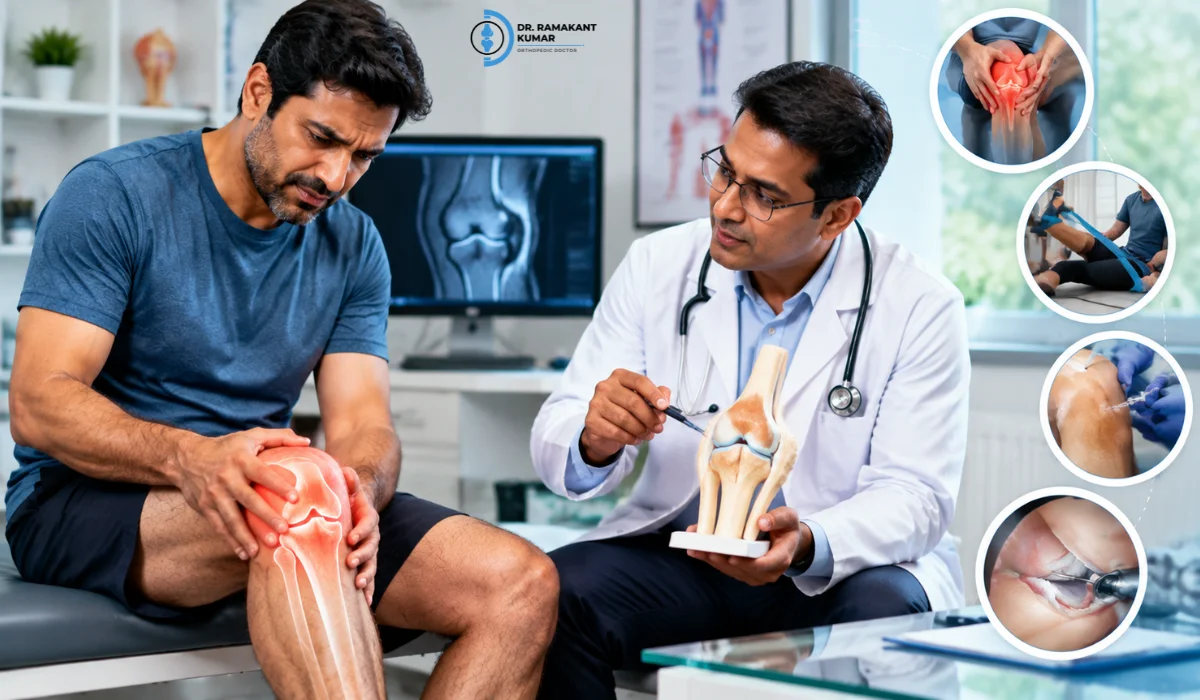
Knee pain can affect your ability to walk, exercise, work, or participate in sports. While some knee problems improve with rest, physiotherapy, and strengthening exercises, others continue because of damage inside the joint.
As an orthopedic surgeon, the approach to knee pain evaluation is not based only on the intensity of pain or an MRI report. A proper diagnosis requires understanding how the injury happened, what symptoms you are experiencing, findings during physical examination, and whether imaging results match the actual problem.
An orthopedic surgeon may suggest knee arthroscopy surgery when examination and imaging confirm a treatable condition inside the knee joint where surgery can help improve pain, movement, or stability. The goal is not simply to perform surgery but to restore function, stability, and quality of life whenever surgery is the appropriate option.
In clinical practice, many patients ask if knee pain alone is enough to justify surgery. The answer is no. Surgery is considered only after evaluating the specific cause of pain, joint condition, functional limitations, and response to non-surgical treatments. The right treatment depends on identifying the exact reason behind the pain.
Contents
- 0.1. What Is Knee Arthroscopy Surgery?
- 0.2. Why Is Knee Arthroscopy Surgery Recommended?
- 0.3. Which Knee Problems Can Be Treated With Arthroscopy?
- 0.4. Does Every Knee Problem Require Arthroscopy?
- 0.5. Signs You Should Get Your Knee Evaluated
- 0.6. When Is Knee Arthroscopy Not Usually the First Option?
- 0.7. How Does an Orthopedic Surgeon Decide If You Need Arthroscopy?
- 1. An Orthopedic Expert’s Advice Before Choosing Knee Arthroscopy
What Is Knee Arthroscopy Surgery?
In clinical practice, one of the most common misunderstandings about knee arthroscopy is that it is a solution for every type of knee pain. Arthroscopy is a targeted procedure designed for specific internal joint problems.
A patient with a meniscus tear causing repeated locking may benefit from arthroscopic treatment, while another patient with knee pain caused mainly by weakness or arthritis may require a completely different approach.
Read More: Sports Injuries: Warning Signs and When to See a Doctor
Why Is Knee Arthroscopy Surgery Recommended?
Before recommending a knee arthroscopy operation, an orthopedic surgeon evaluates whether the patient’s symptoms match a treatable problem inside the knee.
For example:
- A patient whose knee repeatedly locks after a twisting injury may have a meniscus problem that requires further evaluation.
- A sports person experiencing repeated knee instability after an ACL injury may need assessment for ligament reconstruction.
- A patient with mild pain but no locking or instability may improve with rehabilitation instead of surgery.
This difference is important because the same MRI finding can have different meanings for different patients.
Which Knee Problems Can Be Treated With Arthroscopy?
Knee arthroscopy is mainly used for specific conditions where there is damage inside the joint. The decision depends on the type of injury, severity of symptoms, age, activity requirements, and overall knee condition.
Meniscus Tear
The meniscus works as a cushion between the thigh bone and shin bone. It helps absorb pressure and provides stability during movement.
A meniscus tear can happen due to sports injuries, sudden twisting movements, accidents, or age-related changes.
Some small tears improve with rehabilitation, but others may continue causing symptoms that affect daily life.
Common signs of a problematic meniscus tear include:
- Knee locking or catching sensation
- Pain during twisting movements
- Repeated swelling
- Difficulty fully bending or straightening the knee
- Pain while walking, squatting, or exercising
A knee arthroscopy operation may help repair or treat selected meniscus injuries when symptoms and examination findings support the diagnosis.
ACL Injury
The anterior cruciate ligament (ACL) plays an important role in maintaining knee stability, especially during running, jumping, and sudden changes in direction.
ACL injuries commonly occur during sports activities, but they can also happen because of accidents or falls.
Symptoms may include:
- Feeling that the knee is unstable
- Knee giving way during activity
- Difficulty returning to sports
- Swelling after injury
For active individuals or patients with significant instability, arthroscopic ACL reconstruction may be considered to restore knee stability.
Cartilage Damage
Cartilage allows smooth movement between the bones of the knee joint. When cartilage is damaged, it may lead to pain, swelling, and reduced movement.
In selected cases, arthroscopy helps assess the cartilage condition and allows appropriate treatment based on the damage present.
Loose Bodies Inside the Knee
Sometimes small pieces of cartilage or bone can become loose inside the knee joint. These fragments may interfere with movement and cause sudden locking or catching.
Arthroscopy can help identify and remove these loose pieces when they are responsible for symptoms.
Also Read: Is Joint Replacement the Right Choice for You? Signs, Options, Risks and Recovery
Does Every Knee Problem Require Arthroscopy?
No.
One of the most important factors patients need to know is that treatment decisions should be based on the complete clinical picture, not just one finding. An abnormal finding on an MRI does not always mean surgery is required.
For example, some people may have a meniscus tear visible on imaging but experience only mild symptoms that improve with physiotherapy and strengthening exercises.
On the other hand, a patient with repeated locking, instability, or significant movement problems may require further surgical evaluation.
The decision should always be based on the complete picture, including symptoms, physical examination, imaging, and lifestyle needs.
Signs You Should Get Your Knee Evaluated
Not every knee pain requires surgery, but certain symptoms should not be ignored because they may indicate an internal joint problem.
If knee symptoms continue or interfere with your daily activities, an orthopedic evaluation can help determine the underlying cause. If these symptoms persist or begin affecting your daily activities, an orthopedic consultation can help determine the underlying cause and appropriate treatment approach:
- Repeated knee locking or catching
- Persistent swelling after activity or injury
- Difficulty fully straightening or bending the knee
- Feeling that the knee is unstable
- Pain that continues despite physiotherapy
- Difficulty with stairs, walking, or sports activities
- Symptoms returning whenever you increase activity
These symptoms do not confirm that you need surgery, but they indicate that the exact cause should be identified.
You May Like: From Fractures to Joint Replacement: Which Orthopedic Surgery Treats What?
When Is Knee Arthroscopy Not Usually the First Option?
Knee arthroscopy is not the right solution for every type of knee pain.
Some patients improve with non-surgical treatment, especially when symptoms are related to muscle weakness, overuse, mild irritation, or conditions that respond well to rehabilitation.
Non-surgical knee pain treatment may include:
- Physiotherapy and strengthening exercises
- Activity modification
- Weight management when required
- Pain management under medical guidance
- Movement and flexibility training
The goal is always to treat the actual cause of pain rather than treating only the symptom.
How Does an Orthopedic Surgeon Decide If You Need Arthroscopy?
The decision for knee arthroscopy surgery involves clinical reasoning rather than depending on a single test.
During evaluation, an orthopedic surgeon considers:
- How the injury occurred
- The location and pattern of pain
- Whether the knee locks, clicks, or gives way
- Changes in movement and strength
- Impact on daily activities and sports
- Response to previous treatments
For example, locking symptoms often suggest a mechanical issue inside the joint, while instability after injury may indicate ligament involvement. Identifying the structure responsible for symptoms helps guide the correct treatment plan.
MRI and other investigations provide valuable information, but they are interpreted along with the patient’s symptoms and examination findings.
Read This: 4 Types of Fractures: These Symptoms Can Reveal Bigger Problems
An Orthopedic Expert’s Advice Before Choosing Knee Arthroscopy
Before deciding on surgery, patients should ask:
1. What is causing my knee pain?
A proper evaluation of the underlying condition helps guide the most effective and personalized treatment plan.
2. Does the MRI finding explain my symptoms?
Not every abnormality seen on imaging is the reason for pain.
3. What improvement can I realistically expect?
Understanding expected outcomes helps patients make informed decisions.
4. What will recovery involve?
Rehabilitation is an important part of successful recovery after arthroscopy.
5. Are there other treatment options?
Depending on the condition, physiotherapy, strengthening exercises, and other non-surgical treatments may be appropriate.
What Happens During a Knee Arthroscopy Operation?
During knee arthroscopy, small openings are made around the knee joint. A camera is inserted through one opening to examine the internal structures.
If treatment is needed, small instruments are used through additional openings to repair or treat the damaged area.
Depending on the condition, the surgeon may:
- Repair a damaged meniscus
- Remove loose fragments
- Treat selected cartilage problems
- Perform ligament reconstruction procedures
The procedure and recovery depend on the exact problem being treated.
Many arthroscopic procedures may allow patients to return home the same day, depending on the surgery and overall health condition.
Related Article: Considering Joint Replacement Surgery in Patna? What to Know Before You Decide
Recovery After Knee Arthroscopy Surgery
Many patients believe recovery depends mainly on the size of the surgical cuts. However, in orthopedic practice, recovery is influenced more by what was treated inside the knee rather than the incision size.
A simple arthroscopic procedure and an ACL reconstruction are completely different situations. Their rehabilitation requirements, recovery timelines, and return-to-activity goals are not the same.
The recovery process generally focuses on:
- Reducing swelling and discomfort
- Restoring knee movement
- Improving muscle strength
- Regaining stability and balance
- Gradually returning to normal activities
General Recovery Timeline After Knee Arthroscopy
Recovery time varies depending on the procedure performed, the patient’s overall health, and how well rehabilitation progresses. The recovery period after knee arthroscopy depends on the procedure performed and the patient’s rehabilitation progress. However, the following timeline explains the typical stages of recovery patients may experience.
First Few Days After Surgery
During the initial recovery period, mild pain, swelling, and stiffness are common. Patients are usually advised to keep the leg elevated, manage swelling, and begin gentle movements as recommended.
The focus during this stage is:
- Controlling swelling
- Protecting the knee
- Starting basic mobility exercises
- Preventing stiffness
1 to 3 Weeks After Surgery
Many patients gradually improve their walking ability during this phase. Physiotherapy usually becomes an important part of recovery to restore knee movement and begin strengthening exercises.
Goals include:
- Improving knee bending and straightening
- Reducing stiffness
- Increasing muscle activation
- Improving walking pattern
4 to 8 Weeks After Surgery
Patients often continue progressing with strengthening and functional exercises. Depending on the type of procedure, many people can gradually return to routine daily activities.
However, activities involving running, jumping, or sudden twisting movements may still require restrictions.
3 to 6 Months After Surgery
For procedures such as meniscus repair or ACL reconstruction, rehabilitation may continue for several months. The focus shifts toward improving strength, coordination, stability, and confidence during activity.
Return to sports is usually considered only when:
- Knee strength has improved adequately
- Stability has returned
- Movement control is restored
- The patient can perform activity-specific movements safely
Patients should avoid returning to sports only because pain has reduced. The knee also needs adequate strength, balance, and control to handle higher levels of activity safely.
The recovery timeline is different for every patient. Following the rehabilitation plan and regular follow-up with the orthopedic team plays an important role in achieving a successful outcome.
When Should You Consult a Knee Specialist in Patna?
Persistent knee pain, repeated swelling, locking, instability, or difficulty performing normal activities should not be ignored.
A detailed orthopedic evaluation can help determine whether you need:
- Knee arthroscopy surgery
- Physiotherapy and rehabilitation
- Medication-based management
- Another treatment approach
If knee problems are affecting your mobility, work, exercise, or sports activities, consult the best orthopedic doctor in Patna for proper evaluation and guidance based on your specific knee condition.
Dr. Ramakant Kumar – Orthopedic Surgeon in Patna
Dr. Ramakant Kumar is a leading Orthopedic Surgeon in Patna, Bihar, specializing in knee surgery, hip surgery, joint replacement, arthroscopy, sports injury treatment, and complex bone and joint conditions. With 12+ years of experience in orthopedic care, he focuses on accurate diagnosis, evidence-based treatment planning, and helping patients choose the right approach between surgical and non-surgical options.
His expertise includes advanced knee replacement, hip replacement, knee arthroscopy, ligament injury management, and joint reconstruction procedures. He has received international training in hip and knee surgery from reputed centers, including National University Hospital, Singapore, and Seoul, South Korea, with a focus on modern joint preservation and replacement techniques.
At Advanced Bone & Joint Clinic, the treatment approach focuses on understanding the actual cause of pain, explaining available options clearly, and creating personalized care plans that help patients improve mobility, reduce pain, and return safely to their daily activities.
Frequently Asked Questions
The procedure is performed under anesthesia, so pain is not felt during surgery. Mild pain, swelling, and stiffness may occur afterward and usually improve during recovery.
No. Some tears improve with rehabilitation, while surgery may be considered for tears causing locking, instability, or persistent symptoms.
Recovery depends on the procedure. Simple procedures may recover faster, while ACL reconstruction or meniscus repair may require several months.
Yes. Many knee conditions improve with physiotherapy, strengthening, and other non-surgical treatments.
Both have different roles. The right choice depends on the cause of knee pain and the condition of the knee joint.
No. Returning to sports requires adequate strength, stability, and movement control to reduce the risk of reinjury.