

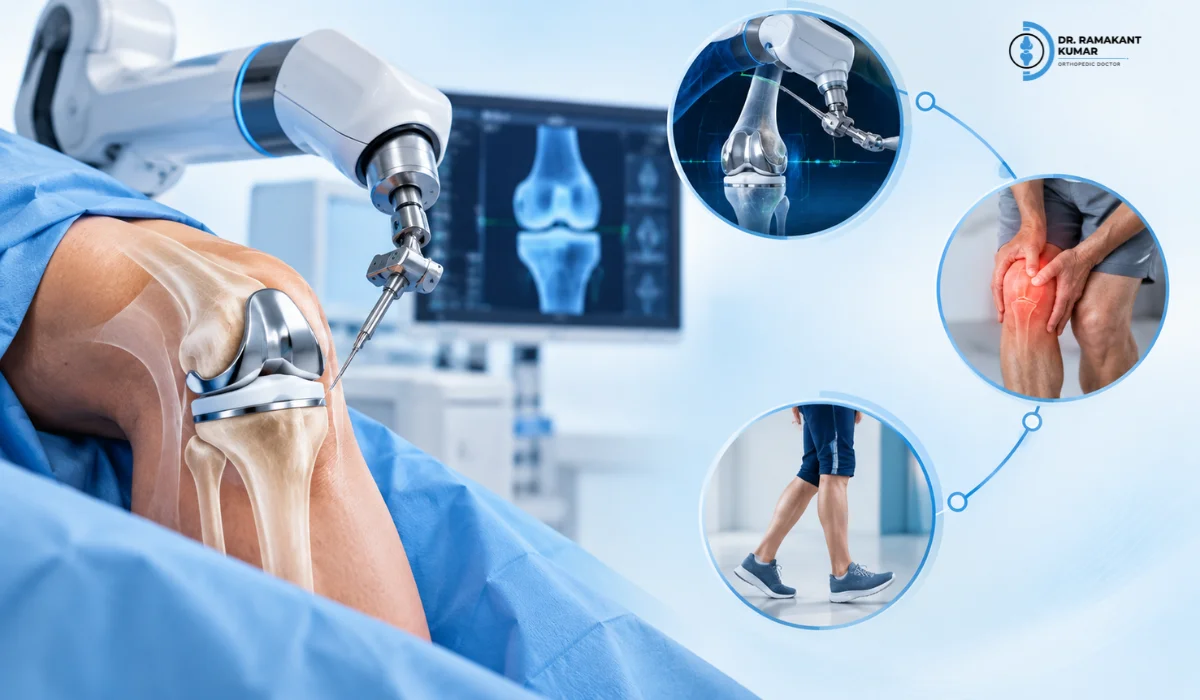
Robotic knee replacement is a surgeon-controlled knee replacement procedure supported by computer-assisted planning and robotic guidance. It can help with surgical planning, bone preparation, knee alignment, and implant positioning. It may be considered for selected patients who already need knee replacement because of significant joint damage and symptoms. Robotic assistance can improve the precision of implant alignment, but it does not guarantee faster recovery, complete pain relief, or better results for every patient. PubMed
Contents
- 1. What Is Robotic Knee Replacement?
- 2. How Does the Robotic System Actually Help?
- 3. Who May Need a Robotic Full Knee Replacement?
- 4. What Can You Expect Before and During Surgery?
- 5. What Are the Potential Benefits?
- 6. How Does Recovery Progress After Robotic Knee Replacement?
- 7. Robotic Knee Replacement Surgery Cost in India
- 8. Robotic Knee Replacement Surgery in Patna
- 9. About Advanced Bone & Joint Clinic
- 10. Final Takeaway
What Is Robotic Knee Replacement?
Severe knee arthritis can gradually affect simple parts of everyday life. Walking, climbing stairs, getting up from a chair, exercising, or standing for long periods may become increasingly difficult. When the joint is significantly damaged and appropriate treatment is no longer providing sufficient relief or function, knee replacement may be considered.
Robotic knee replacement adds computer-assisted planning and robotic technology to an established knee replacement procedure. The purpose is to provide the surgeon with detailed information about the patient’s individual knee and assist with specific parts of the operation.
The orthopedic surgeon remains fully in control of the procedure, while robotic technology provides assistance with surgical planning and precision. The orthopedic surgeon remains responsible for evaluating the patient, planning the procedure, making clinical decisions, and carrying out the operation.
Research has found that robotic-assisted total knee replacement can improve the accuracy and consistency of implant alignment compared with conventional techniques. However, greater technical precision does not automatically mean that every patient will experience better pain relief or function. PubMed
Read This: Knee Arthroscopy Surgery: When Is Surgery Needed for Knee Pain?
How Does the Robotic System Actually Help?
A simple way to understand the technology is to think of it as an advanced surgical navigation and measurement system. It gives the surgeon additional information during planning and surgery, while the surgeon remains in control.
Before surgery, the knee is assessed through clinical examination and appropriate imaging. The information is used to understand the patient’s anatomy, joint damage, alignment, and surgical requirements.
During the procedure, robotic assistance may help with:
- Patient-specific surgical planning
- Assessment of knee alignment
- Guidance during bone preparation
- Implant positioning
- Assessment of knee balance
- Intraoperative measurements and guidance
This can be particularly useful because knees do not all have the same anatomy or pattern of arthritis. Modern robotic systems are also being studied and developed around more individualized alignment strategies, although the long-term clinical advantages of these approaches continue to be evaluated. PubMed
The important point is simple: the robot assists the surgeon; it does not replace the surgeon.
Who May Need a Robotic Full Knee Replacement?
The first question is whether a patient needs a total knee replacement. Robotic assistance is considered only after that decision.
A robotic full knee replacement may be discussed when advanced arthritis or other substantial joint damage is causing persistent pain and meaningful limitations in daily activities.
Patients may experience:
- Persistent knee pain
- Significant stiffness
- Difficulty walking or climbing stairs
- Progressive limitation of daily activities
- Pain affecting sleep or quality of life
- Advanced joint damage on appropriate imaging
An X-ray showing arthritis does not automatically mean that knee replacement is necessary. Symptoms, examination findings, imaging, mobility, general health, previous treatment, and the effect of the condition on everyday life need to be considered together.
This is why robotic technology should not be the starting point of the decision. The condition comes first; the technology comes second.
Also Read: Sports Injuries: Warning Signs and When to See a Doctor
What Can You Expect Before and During Surgery?
The treatment journey begins with an orthopedic assessment. The surgical team first determines whether knee replacement is appropriate and then considers whether robotic assistance is suitable for the planned procedure.
If robotic surgery is selected, the process generally involves:
Clinical assessment → imaging and planning → computer-assisted surgical mapping → robotic guidance during surgery → implant positioning → postoperative rehabilitation
During surgery, the robotic system can provide the surgeon with information about the planned position and alignment of the knee. The surgeon uses this information together with direct surgical assessment to perform the replacement.
Patients sometimes search for a robotic knee replacement video before surgery. Educational videos can help explain the general process, but they cannot show exactly what will happen in your operation because surgical planning depends on your individual anatomy and condition.
What Are the Potential Benefits?
The clearest benefit supported by current evidence is that robotic assistance can help surgeons achieve more precise and consistent implant alignment during knee replacement. A 2025 systematic review and meta-analysis of 21 randomized controlled trials involving 2,692 patients found fewer mechanical alignment outliers with robotic-assisted surgery, although it did not find significant differences in several commonly used functional scores. The review also found longer operating times with robotic procedures. PubMed
Potential advantages include:
- Detailed surgical planning
- Assistance with implant alignment
- Controlled bone preparation
- Intraoperative measurements
- Ability to account for individual anatomical differences
Robotic technology can support surgical precision, but it does not guarantee a specific result. Factors such as the surgeon’s expertise, patient selection, implant choice, overall health, postoperative care, and rehabilitation can all influence the outcome.
You May Like: Is Joint Replacement the Right Choice for You? Signs, Options, Risks and Recovery
How Does Recovery Progress After Robotic Knee Replacement?
Recovery still follows the basic principles of knee replacement rehabilitation. Robotic assistance does not remove the need for physiotherapy.
Initially, the focus is on pain and swelling management, knee movement, safe walking, and beginning rehabilitation. Over the following weeks and months, the emphasis shifts toward improving strength, flexibility, balance, endurance, and confidence with movement.
Recovery varies according to your:
- Preoperative mobility and muscle strength
- General health
- Age and physical condition
- Surgical complexity
- Pain management
- Rehabilitation progress
For detailed information about walking, pain relief and exercise after surgery, see Robotic Knee Replacement Recovery Time, Walking, Pain Relief, and Exercise Tips.
Robotic Knee Replacement Surgery Cost in India
The robotic knee replacement surgery cost in India varies considerably. There is no single price that applies to every patient.
The final cost can depend on the hospital, robotic platform, implant, professional charges, investigations, hospital stay, medicines, and rehabilitation.
Patients should ask what is included in a treatment estimate rather than comparing only the advertised surgery price.
For patients researching total versus partial replacement and the factors involved in choosing an approach, see Best Robotic Knee Replacement in Patna – Total & Partial Knee Surgery Options.
Robotic Knee Replacement Surgery in Patna
For patients considering robotic knee replacement surgery in Patna, the technology is only one part of the treatment. Accurate diagnosis, careful surgical planning, appropriate implant selection, postoperative care, and rehabilitation all play an important role in recovery.
A joint replacement surgeon in Patna can evaluate the severity of the knee problem, determine whether replacement is necessary, and assess if robotic assistance is suitable for the patient’s anatomy and planned procedure.
Advanced Bone & Joint Clinic provides robotic-assisted knee replacement as part of its broader knee and joint replacement services in Patna.
About Advanced Bone & Joint Clinic
At Advanced Bone & Joint Clinic, under the clinical guidance of Dr. Ramakant Kumar,, provides orthopedic care for knee and hip conditions, joint replacement, arthroscopy, ACL injuries, sports injuries, ligament problems, and complex orthopedic conditions.
Dr. Ramakant Kumar has 12+ years of orthopedic experience and holds MBBS (Gold Medalist), MS Orthopaedics from AIIMS New Delhi, and DNB Orthopaedics. His published profile also documents advanced fellowship training in hip and knee surgery from National University Hospital, Singapore, and South Korea.
The clinic’s approach is to assess the patient’s condition first and then select an appropriate treatment strategy. For robotic knee replacement, the key consideration is whether robotic assistance is suitable for the planned procedure and the patient’s specific needs, rather than choosing surgery simply because robotic technology is available.
To better understand the potential role of robotic assistance in knee replacement, explore Is Robotic Surgery Better for Knee Surgery? Patient Guide.
Final Takeaway
Robotic-assisted knee replacement combines conventional surgical techniques with computer-based planning and robotic technology to support the surgeon throughout the procedure. Its clearest role is to support the surgeon with detailed planning, alignment assessment, and controlled execution.
Robotic technology supports the surgeon’s expertise, but its use depends on the patient’s individual condition and is not required for every knee replacement procedure. The right approach depends on the patient’s joint condition, symptoms, anatomy, surgical requirements, and overall health.
If ongoing knee pain or advanced arthritis is limiting your movement, an orthopedic assessment can help determine whether knee replacement or robotic assistance may be suitable for your condition.
If you are considering robotic knee replacement in Patna, consult the best orthopedic surgeons in Patna for an individualized assessment and a treatment plan based on your specific knee condition and functional needs.
It is a surgeon-controlled knee replacement procedure supported by computer-assisted planning and robotic guidance. The technology assists with selected surgical steps but does not independently perform the operation.
Patients with advanced joint damage and symptoms who are suitable for total knee replacement may also be candidates for robotic-assisted surgery. Whether robotic assistance is appropriate is determined by the patient’s individual knee condition and the planned surgical approach.
Robotic assistance may help the surgeon achieve more precise and consistent positioning of the knee implant. However, greater alignment accuracy does not guarantee better clinical results for every patient. PubMed
Not necessarily. Recovery depends on several factors, including preoperative mobility, general health, surgical complexity, pain management, and rehabilitation.
There is no universal cost. Hospital, city, implant, robotic platform, professional fees, investigations, hospitalization, and rehabilitation can all affect the final amount.
At Advanced Bone & Joint Clinic, where Dr. Ramakant Kumar leads the orthopedic care team, Dr. Ramakant Kumar, provides robotic-assisted knee replacement in Patna. An individual orthopedic assessment is essential to determine whether this approach is suitable for the patient’s specific condition and treatment needs. Dr. Ramakant Kumar