

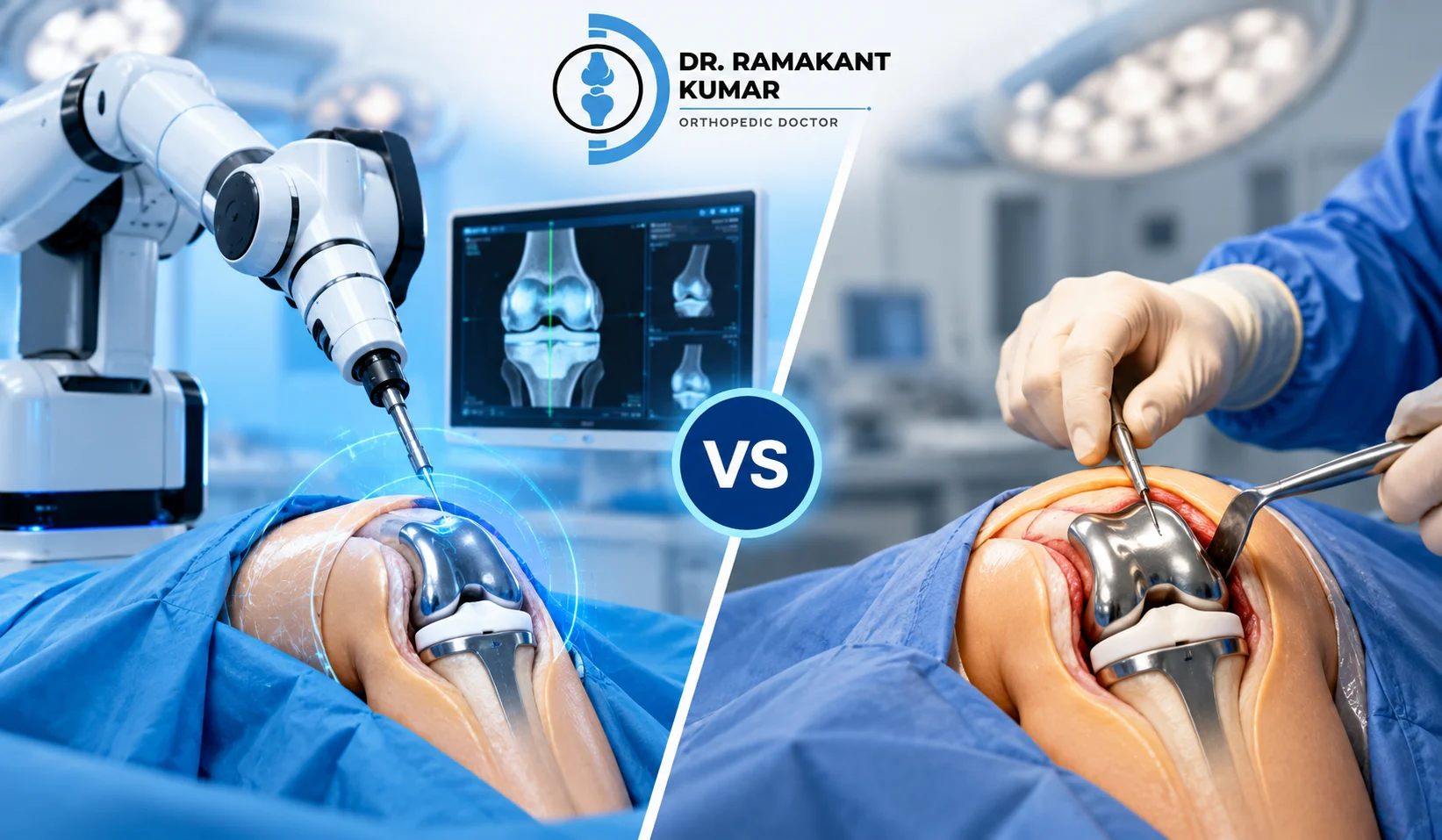
If severe knee pain makes walking, climbing stairs, or getting out of a chair difficult, knee replacement surgery may help when other treatments are no longer effective. However, patients often wonder whether robotic knee replacement offers better results than traditional surgery.
The main difference is surgical guidance. Robotic-assisted knee replacement uses computer technology to help the surgeon plan and position an artificial knee, while traditional surgery uses established instruments and alignment techniques.
Both procedures can reduce arthritis-related pain and improve mobility. Robotic technology may improve surgical precision, but it does not guarantee faster recovery, less pain, or a longer-lasting implant.
Understanding these differences can help patients make an informed treatment decision.
Contents
- 1. When Is Knee Replacement Surgery Necessary?
- 2. How Do Robotic and Traditional Knee Replacement Surgeries Work?
- 3. Robotic vs Traditional Knee Replacement: Key Differences
- 4. What Potential Advantages Does Robotic Knee Replacement Offer?
- 5. What Are the Risks of Both Knee Replacement Techniques?
- 6. Robotic vs Traditional Knee Replacement Recovery Time
- 7. Conclusion
- 8. Dr. Ramakant Kumar – Orthopedic Surgeon in Patna
- 9. Frequently Asked Questions
When Is Knee Replacement Surgery Necessary?
Knee replacement is usually considered when advanced arthritis or significant joint damage causes persistent pain, stiffness, and difficulty performing everyday activities.
Osteoarthritis is a common reason for surgery. It develops when the protective cartilage covering the knee’s joint surfaces gradually deteriorates. This can lead to painful movement, swelling, reduced flexibility, and difficulty bearing weight.
An orthopedic surgeon may consider knee replacement when:
- Knee pain regularly interferes with walking, climbing stairs, or sleeping.
- Limited knee movement can make it difficult to bend the joint or straighten the leg fully.
- Appropriate non-surgical treatments no longer provide sufficient relief.
- Joint deformity or restricted movement affects daily independence.
Before recommending surgery, the orthopedic specialist evaluates symptoms, medical history, knee movement, X-rays, and previous treatments.
A diagnosis of knee arthritis does not by itself mean that surgery is necessary. The decision depends on how severely the condition affects daily life, rather than X-ray findings alone.
Read More: World Arthritis Day 2026: What Your Joint Pain May Be Telling You About Your Bone and Joint Health
How Do Robotic and Traditional Knee Replacement Surgeries Work?
Both procedures remove damaged joint surfaces and replace them with artificial components, generally made from metal and medical-grade plastic.
The primary distinction lies in how bone preparation is planned and how the knee implant is positioned during the procedure.
Traditional Knee Replacement Surgery
Traditional Knee Replacement Surgery uses conventional surgical instruments, anatomical landmarks, and alignment guides.
The affected joint surfaces are carefully prepared by removing damaged cartilage and a measured amount of underlying bone before the artificial components are fitted. Knee movement, ligament balance, and joint stability are then assessed.
This technique has been used for decades and has well-established long-term outcomes.
Robotic Knee Replacement Surgery
Robotic Knee Replacement Surgery uses computer-assisted technology to support surgical planning and guide selected steps.
Depending on the robotic system, a CT scan or digital mapping during surgery helps create a plan based on the patient’s knee anatomy. The technology may assist with bone preparation, implant alignment, and joint balancing.
Robotic technology assists with selected surgical steps, while the orthopedic surgeon remains in control of the procedure and makes the necessary clinical decisions.
Both approaches may use similar artificial knee implants. Robotic assistance primarily changes how the implant is planned and positioned, not necessarily the implant itself.
Robotic vs Traditional Knee Replacement: Key Differences
| Comparison | Robotic Knee Replacement | Traditional Knee Replacement |
| Surgical planning | Computer-assisted planning | Conventional planning |
| Bone preparation | Robot-guided assistance | Conventional instruments |
| Implant alignment | May provide greater positioning accuracy | Established alignment techniques |
| Joint balancing | Some systems offer real-time measurements | Surgeon uses conventional assessment methods |
| Pain relief | Can provide substantial relief | Can provide substantial relief |
| Recovery | Faster recovery is not guaranteed | Depends on individual recovery |
| Surgery duration | May take longer | Often shorter in comparative studies |
| Implant lifespan | Longer survival is not proven | Established long-term outcomes |
| Cost | May involve additional technology expenses | Often comparatively less expensive |
Robotic assistance also does not automatically mean a smaller incision. Incision size and tissue handling depend on the patient’s anatomy, the surgical approach, and the technology used.
Also Read: Robotic Knee Replacement: How Does It Work, Who Needs It and What Can You Expect?
What Potential Advantages Does Robotic Knee Replacement Offer?
The main potential benefit of robotic-assisted surgery is improved accuracy during selected surgical steps.
Computer-assisted planning helps the surgeon assess the patient’s knee anatomy, determine implant positioning, and guide bone preparation. Some systems also provide measurements that help evaluate ligament tension and joint stability.
This can improve consistency in achieving the planned surgical alignment.
However, accuracy is only one factor influencing a successful knee replacement.
Does Robotic Surgery Provide Better Pain Relief and Knee Function?
Both robotic and traditional knee replacement can substantially reduce pain caused by advanced arthritis and improve mobility.
Some studies have reported modest benefits in selected pain or early recovery measures following robotic surgery. However, research has not consistently shown clinically meaningful improvements in long-term knee function, pain relief, or patient satisfaction compared with traditional techniques.
Overall health, knee condition, surgical care, and rehabilitation also influence outcomes.
Read More: From Fractures to Joint Replacement: Which Orthopedic Surgery Treats What?
Does a Robotic Knee Replacement Last Longer?
Many modern knee replacements continue functioning for 15–20 years or longer, although individual outcomes vary.
Greater positioning accuracy may be beneficial, but existing research has not established that robotic assistance consistently extends implant lifespan.
Long-term results depend on implant design, positioning, bone quality, body weight, physical activity, and complications.
Patients should therefore avoid choosing a technique solely on the assumption that robotic implants last longer.
What Are the Risks of Both Knee Replacement Techniques?
Robotic and traditional knee replacement share many of the same surgical risks.
Possible complications include infection, blood clots, persistent pain, stiffness, nerve or blood vessel injury, implant loosening, and the possibility of revision surgery.
The requirements can vary between robotic systems, with some involving additional imaging, tracking components, or specialized surgical equipment. They may also take longer to perform.
Traditional surgery does not require robotic equipment but still demands careful alignment and joint-balancing techniques.
Neither approach eliminates surgical risks. Patients with diabetes, cardiovascular disease, previous blood clots, or other medical conditions should discuss their individual risks before surgery.
You May Like: Knee Arthroscopy Surgery: When Is Surgery Needed for Knee Pain?
Robotic vs Traditional Knee Replacement Recovery Time
Knee replacement recovery can vary from one person to another, influenced by factors such as general health, pre-surgery mobility, muscle condition, pain control, and commitment to rehabilitation.
Both techniques generally require similar recovery planning. Some patients recover more quickly than others, regardless of the surgical technology used.
Typical Knee Replacement Recovery Timeline
| Recovery period | What patients may expect |
| First 1–3 days | Pain management, assisted walking, and gentle exercises |
| Weeks 1–2 | Wound care, swelling control, walking support, and physiotherapy |
| Weeks 3–6 | Gradual improvement in walking, bending, and everyday activities |
| Weeks 6–12 | Greater strength, balance, and independence |
| 3–6 months and beyond | Continued functional improvement; complete recovery may take a year or longer |
These timelines are general estimates, not guaranteed milestones.
When Can Patients Walk, Climb Stairs, or Return to Work?
Many patients begin walking with a walker or crutches on the day of surgery or shortly afterward, depending on their condition.
Stair climbing may begin under supervision before hospital discharge. Initially, using handrails and taking one step at a time is often recommended.
Desk-based work may resume after approximately four to six weeks for some patients. Physically demanding work generally requires more time.
Driving should resume only when the patient can safely control the vehicle, is no longer affected by sedating pain medicines, and has received appropriate medical clearance.
During early recovery, a raised Western-style toilet may be easier and safer than deep squatting or using an Indian-style toilet. Patients should avoid forcing uncomfortable knee movements and follow their surgeon’s activity recommendations.
Read This: Sports Injuries: Warning Signs and When to See a Doctor
Why Is Physiotherapy Important?
Physiotherapy helps restore knee movement, strengthen supporting muscles, improve balance, and rebuild confidence while walking.
Rehabilitation generally begins with gentle exercises and progresses toward strengthening and everyday activities.
Whether surgery is robotic or traditional, consistent rehabilitation remains important for regaining mobility and independence.
Warning Signs After Knee Replacement Surgery
Patients should contact their treating team if they notice increasing wound redness, unusual discharge, persistent fever, worsening pain, or new calf swelling.
Sudden chest pain, difficulty breathing, or fainting requires emergency medical attention because these symptoms may indicate a serious complication.
Should You Choose Robotic or Conventional Knee Replacement?
Neither technique is automatically the better choice for every patient.
The decision depends on arthritis severity, knee alignment, bone quality, medical history, surgeon experience, available technology, and the patient’s expectations.
Robotic assistance may offer advantages when additional digital planning or alignment guidance is useful. Traditional surgery remains an established option capable of achieving good outcomes.
Cost is another consideration. Robotic procedures may involve additional equipment or imaging charges. Patients in Patna and other parts of Bihar should request a complete treatment estimate covering surgery, implants, hospital stay, medicines, rehabilitation, and follow-up care.
Before deciding, patients should ask their surgeon:
- Why is this technique suitable for my knee condition?
- What benefits, limitations, and complications should I understand?
- How Long Is Recovery, and What Does Rehabilitation Involve?
A decision based on individual clinical needs is more meaningful than choosing a procedure simply because it uses newer technology.
Related Article: Is Joint Replacement the Right Choice for You? Signs, Options, Risks and Recovery
Conclusion
Robotic and traditional knee replacement surgeries aim to reduce severe knee pain and improve movement. Robotic assistance offers additional planning and surgical guidance, while traditional surgery remains an established technique with documented long-term results.
Neither approach guarantees better outcomes for every patient. If persistent knee pain or difficulty walking is affecting daily life, consulting an orthopedic doctor in Patna can help identify the underlying problem and determine suitable treatment options. At Advanced Bone & Joint Clinic, treatment decisions begin with a careful assessment of the patient’s individual knee condition.
Dr. Ramakant Kumar – Orthopedic Surgeon in Patna
Dr. Ramakant Kumar is an orthopedic surgeon based in Patna, Bihar, with more than 12 years of experience in the management of knee, hip, and other bone and joint conditions. His clinical areas include knee and hip surgery, joint replacement, arthroscopy, sports-related injuries, ligament problems, and complex orthopedic conditions. His approach begins with a detailed assessment of the patient’s condition, followed by evidence-informed treatment planning and a discussion of both surgical and non-surgical options where appropriate.
His surgical expertise covers procedures such as knee and hip replacement, knee arthroscopy, ligament injury management, and joint reconstruction. He has also undertaken international training in hip and knee surgery at reputed institutions, including National University Hospital in Singapore and centers in Seoul, South Korea. This training has contributed to his focus on contemporary approaches to joint preservation and replacement.
At Advanced Bone & Joint Clinic, the emphasis is on identifying the underlying reason for pain or restricted movement before selecting a treatment pathway. Patients are guided through their available options so that the proposed care plan reflects their diagnosis, functional needs, and recovery requirements.
Frequently Asked Questions
Robotic surgery can improve the accuracy of certain surgical measurements, but it has not consistently demonstrated better long-term pain relief or knee function. Both procedures may be effective for appropriately selected patients.
Not necessarily. Some studies suggest modest early pain-related benefits, but results vary. Pain management, rehabilitation, and individual health influence postoperative discomfort.
Not always. The size and placement of the incision vary according to the surgical technique and the patient’s individual knee anatomy. Robotic assistance does not automatically make the operation minimally invasive.
Many modern knee implants function for 15–20 years or longer. However, current evidence does not establish that robotic assistance consistently increases implant longevity.
It can be more expensive because of specialized equipment, imaging, or technology-related costs. The final expense depends on the hospital, implant, surgical plan, and included services.
There is no fixed ideal age. The need for surgery is assessed by considering the patient’s symptoms, degree of joint damage, overall health, response to non-surgical care, and impact on daily activities.