

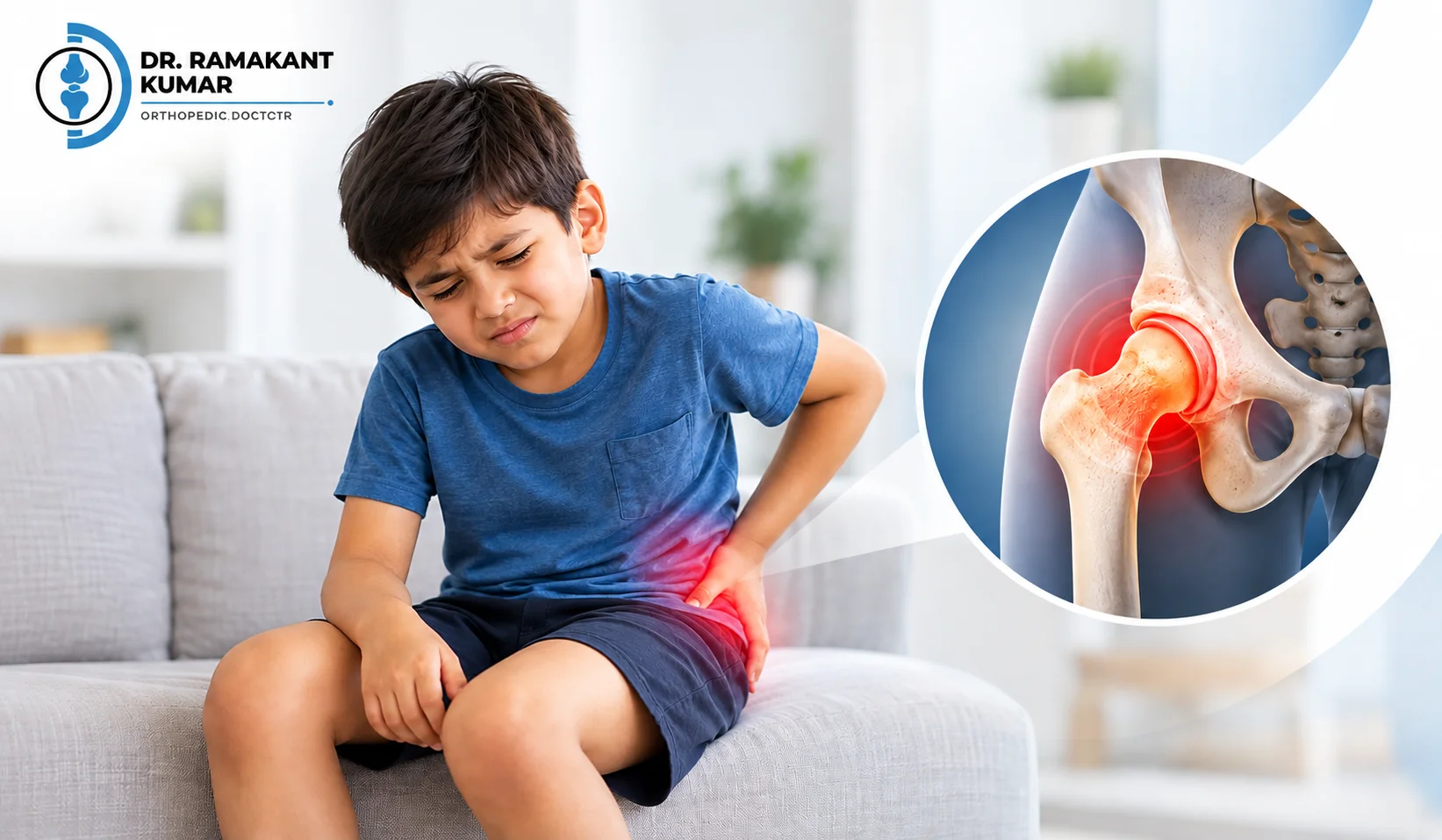
A child who suddenly starts limping, stops participating in games, or complains about pain near the hip can leave parents unsure about what to do next. The discomfort may be temporary, but childhood hip symptoms can also be linked to an injury, inflammation, a developing joint problem, or an infection.
Another difficulty is that children may not accurately identify where the problem begins. A hip condition can sometimes be experienced as pain in the thigh or knee. For this reason, the child’s walking pattern, age, recent illness, injury history, and overall behaviour are important when assessing unexplained leg pain.
Is Hip Pain in a Child Something to Worry About?
Not every episode of hip discomfort means there is a serious condition. A child who is otherwise well and gradually returns to normal movement may simply need observation and appropriate care.
The situation is different when symptoms persist, repeatedly return, or interfere with everyday movement. A noticeable limp, difficulty putting weight on a leg, reduced hip movement, or worsening discomfort deserves medical attention.
Parents should pay particular attention when a child:
- Starts walking differently
- Avoids putting weight on one leg
- Stops running or playing normally
- Complains repeatedly about the hip, thigh, or knee
- Has difficulty moving one hip
- Develops symptoms that are becoming more noticeable
A sudden inability to walk or bear weight should be assessed promptly.
Read More: Robotic vs Traditional Knee Replacement: Key Differences, Benefits, Risks, and Recovery Explained
What Could Be Causing the Pain?
The possible explanation changes with the child’s age and the circumstances in which the symptoms appeared.
One relatively common childhood problem is transient synovitis, sometimes referred to as an irritable hip. It can develop after a viral illness and may cause a child to limp or complain of discomfort around the hip, thigh, or knee. Many children recover with appropriate conservative care, but similar symptoms can occasionally occur with more serious conditions.
Other possibilities include:
- An injury from sport, play, or a fall
- Developmental dysplasia of the hip (DDH)
- Perthes disease
- Slipped capital femoral epiphysis (SCFE)
- Inflammatory conditions
- Infection affecting a bone or joint
Age can provide useful context. Perthes disease is primarily encountered during childhood, whereas SCFE is more relevant during adolescence.
Symptoms alone, however, cannot establish which condition is present.
Why Does a Hip Problem Sometimes Feel Like Knee Pain?
It is understandable for parents to focus on the knee when that is where their child reports discomfort. However, the location of pain does not always identify where the problem actually begins.
A condition affecting the hip can sometimes cause symptoms around the thigh or knee. This may lead a child to appear as though they have a knee problem even when the hip requires closer assessment. This is separate from procedures such as robotic hip replacement, which are used in selected cases of significant hip joint damage and are not a routine treatment for childhood hip pain.
Hip assessment becomes particularly important when knee discomfort is accompanied by:
- A noticeable limp
- Difficulty running or playing
- Limited hip movement
- Unexplained difficulty walking
- Repeated symptoms without a clear knee injury
Examining both the hip and knee can help identify the actual source of the symptoms and guide appropriate treatment.
Also Read: Robotic Knee Replacement: How Does It Work, Who Needs It and What Can You Expect?
Childhood Hip Conditions Parents Should Know
Transient Synovitis
This condition involves temporary irritation of the tissues lining the hip joint. It is commonly seen in younger children and can follow a recent viral infection.
A child may suddenly start limping or become reluctant to walk. Pain can be felt around the groin, hip, thigh, or knee.
Many children improve over several days, with symptoms usually settling within a relatively short period. If the child develops fever, becomes more uncomfortable, or fails to improve, reassessment is important.
Developmental Dysplasia of the Hip
DDH describes a hip joint that has not developed normally or is not sufficiently stable.
It is particularly important during infancy because early recognition can influence treatment. Some babies have few obvious signs that parents can identify themselves, which is why appropriate screening and clinical examination matter.
Management depends on the child’s age and the severity of the hip abnormality. Some infants can be treated with a brace, while others may require different interventions.
Perthes Disease
Perthes disease affects the developing ball of the hip joint. It may begin gradually, sometimes with little more than a change in the child’s walking pattern.
Possible features include:
- A recurring or persistent limp
- Hip or groin discomfort
- Thigh pain
- Knee pain without an obvious knee injury
- Reduced hip movement
- Difficulty with running or sports
Management depends on the child’s age, the stage of the condition, movement of the hip, and the extent of joint involvement. Some children can be managed with activity changes, rehabilitation, and monitoring, while others may require surgery.
Slipped Capital Femoral Epiphysis
SCFE is mainly seen in adolescents. In this condition, the growth plate near the upper end of the thigh bone becomes unstable.
The presentation is not always obvious. A teenager may report knee or thigh pain and develop a limp rather than clearly describing hip pain.
Because continued weight-bearing can allow the displacement to progress, suspected SCFE should be evaluated promptly.
You May Like: Knee Arthroscopy Surgery: When Is Surgery Needed for Knee Pain?
Could Sports Be Responsible?
Sports and physical activity can contribute to hip discomfort through falls, repetitive loading, sudden increases in training, or direct injury.
However, continuing pain should not automatically be dismissed as a simple muscle problem. If a child continues to limp, repeatedly develops pain during activity, or cannot return to usual activities, an assessment may be appropriate.
A child should not be encouraged to ignore significant pain simply to continue participating in sport.
Is It Just Growing Pains?
Not necessarily.
The term “growing pains” should not be used as a catch-all explanation for persistent hip or leg symptoms. A continuing limp, restricted movement, worsening discomfort, fever, or difficulty bearing weight needs proper assessment.
This becomes particularly important when the symptoms affect school, sleep, walking, sports, or normal play.
When Does Hip Pain Require Urgent Attention?
Some symptoms should be treated as warning signs rather than monitored casually.
Prompt medical assessment is appropriate when a child:
- Suddenly cannot walk or refuses to stand
- Has severe pain accompanied by fever
- Looks significantly unwell or unusually sleepy
- Has a hot or swollen joint
- Develops severe pain after a major injury
- Experiences rapidly increasing pain or loss of movement
A joint infection such as septic arthritis requires urgent treatment because delay can damage the joint.
A child does not necessarily need to have a fever for a serious condition to be present, so overall appearance and examination remain important.
Read This: Sports Injuries: Warning Signs and When to See a Doctor
How Will a Doctor Find the Cause?
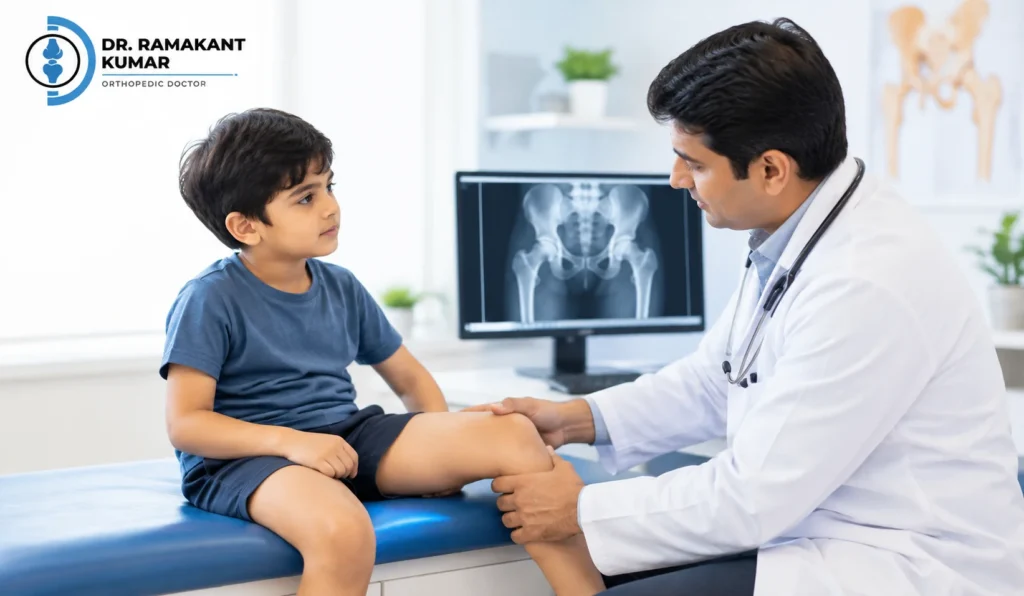
The assessment normally starts with questions and a physical examination rather than immediately ordering every available scan.
The doctor may ask about the onset of symptoms, recent infections, injuries, sports participation, changes in activity, and whether the child can walk normally.
The child’s gait and movement may then be assessed. Both hips and knees may be examined because the painful area is not always the source of the problem.
Will My Child Need an X-Ray or MRI?
Not necessarily.
The investigation depends on what the history and examination suggest.
An X-ray can provide information about bones and may help identify conditions such as Perthes disease, DDH, SCFE, or an injury. Ultrasound can be useful when fluid around the hip is suspected. Blood tests may be considered when infection or inflammation is a concern. MRI can provide more detailed information when other investigations do not adequately explain the symptoms.
The appropriate test is the one that answers a relevant clinical question; more imaging does not automatically mean better diagnosis.
Related Article: Is Joint Replacement the Right Choice for You? Signs, Options, Risks and Recovery
What Treatment Might Be Needed?
There is no universal treatment for childhood hip pain. Management should match the condition responsible for the symptoms.
Depending on the diagnosis, care may involve:
- Monitoring with planned follow-up
- Temporarily reducing strenuous activity
- Appropriate pain relief
- Physiotherapy or rehabilitation
- Limiting weight-bearing for a period
- Bracing in selected conditions
- Surgery when clinically necessary
Many children can be treated without surgery. However, certain structural problems and infections require more specific intervention.
Parents should understand what the diagnosis is, why a particular treatment has been suggested, and what alternatives may be reasonable.
How Quickly Should a Child Recover?
Recovery varies considerably between conditions.
A child with transient synovitis may start feeling better within days, whereas conditions such as Perthes disease or developmental hip problems may need longer observation and treatment.
Instead of expecting every child to recover within the same timeframe, parents can look for practical changes such as:
- Walking becoming easier
- Less noticeable limping
- Better hip movement
- Fewer pain episodes
- Gradual return to normal activities
If the child is moving in the opposite direction and symptoms are becoming worse, reassessment is appropriate.
Read More: From Fractures to Joint Replacement: Which Orthopedic Surgery Treats What?
What Should Parents Avoid Doing?
Until the cause is clear, avoid making the child repeatedly test the painful leg through running, jumping, or stretching.
Massage and exercise are not automatically appropriate for every hip condition. Some problems benefit from movement, whereas others require temporary restriction.
Parents should also avoid giving medication based solely on what worked for another child. Medication decisions should take the child’s age, weight, medical history, and clinical situation into account.
Does Hip Pain Mean a Child Will Need Hip Replacement?
Usually, no.
Hip replacement is not a standard treatment for childhood hip pain. Most pediatric hip conditions are managed according to their specific cause, with efforts directed toward maintaining function and protecting the developing joint.
In rare circumstances, extensive and irreversible damage may make reconstruction or, in selected cases, joint replacement part of a specialist discussion. Such decisions require consideration of the child’s age, diagnosis, joint condition, expected activity, and future treatment needs.
Therefore, parents should not assume that persistent childhood hip pain automatically leads to hip replacement.
Also Read: 4 Types of Fractures: These Symptoms Can Reveal Bigger Problems
When Should Parents See an Orthopedic Doctor in Patna?
An assessment may be appropriate when a child’s hip, thigh, or unexplained knee symptoms continue or begin affecting normal activities.
An orthopedic doctor in Patna can evaluate the child’s history, walking pattern, joint movement, and relevant investigations before discussing the next step.
Consider arranging an assessment when:
- The limp does not settle or keeps returning
- Pain interferes with normal activities
- Hip movement seems reduced
- Knee or thigh pain has no clear explanation
- The child avoids normal physical activity
- Symptoms are not following an expected improvement
Severe pain, fever, appearing significantly unwell, or sudden inability to bear weight requires prompt medical attention rather than a routine appointment.
About Dr. Ramakant Kumar
Dr. Ramakant Kumar is an orthopedic surgeon in Patna with more than 12 years of experience in evaluating and managing bone and joint conditions. His clinical areas include hip and knee problems, joint replacement, arthroscopy, sports injuries, ligament conditions, fractures, and other orthopedic disorders.
He completed his MS in Orthopaedics from AIIMS New Delhi and has undertaken additional training in hip and knee surgery at reputed centres, including National University Hospital, Singapore, and centres in Seoul, South Korea.
His approach involves identifying the underlying cause of pain or movement difficulty before deciding whether observation, rehabilitation, non-surgical treatment, or surgery is appropriate.
You May Like: Considering Joint Replacement Surgery in Patna? What to Know Before You Decide
Final Takeaway
A child’s hip pain may come from a temporary condition, injury, developmental problem, inflammation, or infection. The location described by the child does not always reveal where the problem originates.
What matters is the overall picture: how the child walks, whether movement is restricted, whether symptoms are improving, and whether warning signs such as fever or inability to bear weight are present.
Most childhood hip problems do not require joint replacement. The appropriate treatment depends on the underlying diagnosis, the child’s age and development, and the effect of the condition on everyday function.
If persistent hip, thigh, or unexplained knee symptoms are affecting your child’s normal activities, an orthopedic assessment can help clarify the cause and determine the appropriate next step.