


Before undergoing knee replacement, many patients want to know one important thing: How long can they expect their artificial knee to function effectively?
It is a reasonable question. Knee replacement is a major decision, and patients want to know whether the implant can continue functioning for decades or whether another operation might eventually be necessary.
The expected lifespan of a knee replacement can differ considerably from one patient to another. Modern knee replacement implants can remain functional for many years, and long-term studies show that a substantial proportion continue to work well two decades or more after surgery. However, implant longevity depends on several factors, including age, activity level, body weight, implant design, surgical technique, alignment, infection risk, and the condition of the knee over time.
Quick Answer: How Long Does a Knee Replacement Last?
Many contemporary total knee implants function well for 15 to 20 years or more, with a considerable number continuing to perform effectively for longer periods.
However, this should not be interpreted as a guaranteed lifespan. A large systematic review of national joint-registry data estimated that approximately 82% of total knee replacements were still functioning without revision at 25 years.
Another analysis using data from the UK National Joint Registry reported all-cause survivorship of approximately 96.7% at 10 years and 95.4% at 15 years for total knee replacements.
Different studies use different patient groups, implants, follow-up periods, and definitions of failure. Individual results can therefore vary.
The important point is that a knee replacement does not automatically “expire” after a fixed number of years.
Read More: Hip Pain in Children: When Is It Serious and What Treatment Options Are Available?
What Does “Knee Replacement Lasting” Actually Mean?
When doctors discuss implant longevity, they are often referring to implant survivorship.
In simple terms, this means the knee replacement remains in place without requiring revision surgery.
That is different from saying the knee will feel exactly the same for 20 or 25 years. A patient may have an implant that remains in place while their muscle strength, mobility, activity level, or general health changes over time.
Does a Long-Lasting Implant Mean the Knee Will Feel the Same for Years?
Not necessarily.
Implant survivorship generally describes whether the replacement remains in place without revision. It does not mean that pain, movement, strength, or activity level will remain unchanged throughout that period.
Ageing, changes in muscle strength, body weight, other health conditions, and activity levels can affect how the knee feels and functions. A knee replacement can remain structurally successful while a person’s overall physical function changes for other reasons.
This distinction is important when patients think about what “lasting” actually means.
What Happens During Knee Replacement?
During total knee replacement, damaged joint surfaces are replaced with artificial components designed to restore the function of the knee joint.
The implant generally includes metal components and a durable plastic bearing surface. The exact design and fixation method depend on factors such as the patient’s anatomy, bone quality, diagnosis, and surgical plan.
The goal is not simply to insert an implant. Appropriate component positioning, knee balancing, implant selection, and postoperative care all contribute to the overall result.
Also Read: Robotic vs Traditional Knee Replacement: Key Differences, Benefits, Risks, and Recovery Explained
What Factors Can Influence the Lifespan of a Knee Replacement?
There is no single factor that determines implant longevity. Several patient, surgical, and implant-related factors can influence long-term survival.
1. Age and Activity Level
Younger patients may place more cumulative demands on an implant because they potentially have more years of activity ahead.
This does not mean younger patients should avoid knee replacement when it is clinically appropriate. It means that long-term implant considerations can be particularly important when surgery is performed at a younger age.
Long-term research has found that age and other patient factors can be associated with differences in implant survival, although individual outcomes vary.
2. Body Weight
Body weight can influence the mechanical load placed on the knee during everyday activities.
Maintaining a healthy weight can support overall joint health, although it cannot guarantee that a knee implant will remain functional for a specific length of time. Patients should discuss realistic and appropriate weight-management goals with their healthcare team.
3. Implant Position and Alignment
The position and alignment of the components are important aspects of knee replacement surgery.
Appropriate positioning for the patient’s anatomy can help create a balanced and functional knee. Long-term implant survival is influenced by multiple factors involving the patient, operation, and implant.
This is one reason careful surgical planning and accurate execution matter.
4. Implant Design and Fixation
Different knee replacement systems and fixation methods have been studied over time.
Evidence from the UK National Joint Registry analysis found similar 10- and 15-year survivorship for cemented and uncemented total knee replacements in the data examined.
The choice should therefore not be reduced to asking which implant “lasts the longest.” Implant selection should take the patient’s anatomy, bone quality, age, activity, diagnosis, and surgical plan into account.
5. Infection and Other Complications
An implant can develop problems for reasons unrelated to ordinary wear.
Infection around a knee replacement, instability, fracture near the implant, loosening, or other mechanical or biological problems can sometimes require additional treatment or revision surgery.
This is why persistent pain, increasing swelling, instability, or a significant change in knee function after recovery should be evaluated rather than automatically considered part of normal ageing.
You May Like: World Arthritis Day 2026: What Your Joint Pain May Be Telling You About Your Bone and Joint Health
Does Exercise Wear Out a Knee Replacement?
Not necessarily.
Regular, appropriate physical activity can be an important part of maintaining muscle strength, mobility, and overall health after knee replacement.
Rather than asking only whether exercise is possible, it is more important to consider which activities are appropriate for the replaced knee but “Which activities are appropriate for my knee and stage of recovery?”
Low-impact activities are commonly incorporated into long-term rehabilitation and fitness plans. Activities involving substantial impact or repeated loading can put additional stress on the replacement joint, so their suitability should be considered on an individual basis.
Patients should follow their surgeon’s and rehabilitation team’s recommendations rather than assuming that every activity is either completely safe or completely prohibited.
Is Revision Necessary After 10 Years of Knee Replacement?
No.
There is no universal rule that a knee replacement must be replaced after 10 years.
Many implants continue functioning well beyond that point. Registry evidence has reported high survivorship at 10 and 15 years, while long-term research has also documented substantial survival at 25 years.
Revision surgery is generally considered because there is a specific clinical reason, not simply because the implant has reached a particular age.
Read This: Robotic Knee Replacement: How Does It Work, Who Needs It and What Can You Expect?
What Happens If a Knee Replacement Eventually Wears Out?
If a knee replacement develops significant wear, loosening, instability, infection, or another problem, the first step is to determine what is actually causing the symptoms.
Assessment may include a physical examination and appropriate imaging or laboratory tests. Not every painful knee replacement requires another operation.
Treatment depends on the underlying problem. If revision surgery is necessary, some or all of the existing components may need to be removed, replaced, or reconstructed depending on the condition of the implant and surrounding bone.
Revision knee replacement is generally more complex than the original procedure, which is why new or worsening symptoms should be properly evaluated rather than assumed to represent normal implant ageing.
What Is Revision Knee Replacement?
Revision knee replacement is a procedure performed when an existing knee replacement requires correction, replacement, or reconstruction.
Possible reasons include:
- Infection
- Implant loosening
- Significant wear
- Instability
- Fracture around the implant
- Persistent problems associated with the replacement
- Other mechanical or biological complications
Not every patient with pain after knee replacement needs revision surgery. The underlying cause needs to be established first.
Related Article: Knee Arthroscopy Surgery: When Is Surgery Needed for Knee Pain?
What Symptoms Could Suggest a Problem With an Old Knee Replacement?
A knee replacement that has been functioning well for years does not normally require replacement simply because it has reached a certain age.
However, a new or progressively worsening change deserves assessment.
Possible warning signs include:
- Increasing knee pain
- New or persistent swelling
- Repeated episodes of instability
- Increasing difficulty walking
- Reduced function after a period of good recovery
- Pain associated with particular movements
- New symptoms following an injury
These symptoms do not prove that the implant has failed. They indicate that the knee may need clinical evaluation.
Does Age Affect How Long a Knee Replacement Lasts?
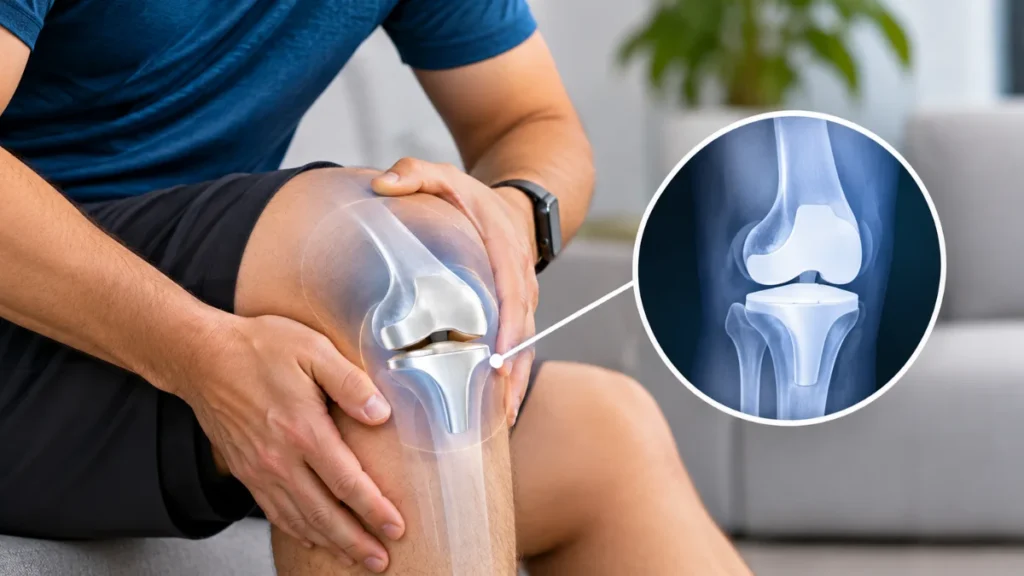
Age can influence implant survivorship, partly because younger patients may have a longer period during which the implant is exposed to activity and mechanical loading.
However, age alone should not determine whether knee replacement is appropriate.
A patient’s overall health, severity of joint damage, symptoms, functional limitations, activity requirements, and response to other treatments all matter when discussing surgery.
Long-term studies have demonstrated that implant survival can vary across age groups and patient populations, so an individual’s expected outcome should not be predicted from age alone.
Read This: Sports Injuries: Warning Signs and When to See a Doctor
What Can Patients Do to Support Long-Term Knee Function?
After recovery, the focus should be on maintaining a healthy and functional lifestyle rather than trying to “protect” the implant by avoiding all activity.
Helpful long-term habits may include:
- Maintaining appropriate muscle strength
- Staying physically active within recommended limits
- Managing body weight where appropriate
- Following rehabilitation guidance
- Addressing injuries promptly
- Attending follow-up appointments when advised
- Seeking assessment if new or worsening symptoms appear
Good long-term care is about maintaining overall knee function, not simply counting the years since surgery.
Does Robotic Knee Replacement Make the Implant Last Longer?
Robotic assistance can provide additional planning and guidance during knee replacement, including support for component positioning and bone preparation.
However, it would be misleading to say that robotic assistance guarantees a longer-lasting implant.
Long-term results depend on multiple factors, including the patient’s condition, implant selection, surgical execution, postoperative care, rehabilitation, and individual circumstances.
The decision about robotic or conventional techniques should therefore be based on the patient’s specific situation rather than the assumption that newer technology automatically means greater implant longevity.
Also Read: Is Joint Replacement the Right Choice for You? Signs, Options, Risks and Recovery
What Should You Ask Before Knee Replacement?
If you are considering surgery, asking the right questions can be more useful than focusing only on the implant’s advertised lifespan.
Consider discussing:
- Why is knee replacement being recommended in my case?
- What type of knee replacement is being considered?
- Why is this implant appropriate for my anatomy and condition?
- What level of activity can I realistically expect after recovery?
- What rehabilitation will I need?
- What complications should I understand before surgery?
- What could cause revision surgery in the future?
- How will my progress be monitored after the operation?
These questions shift the discussion from simply asking “How long will my implant last?” to understanding the factors that influence the long-term outcome.
When Should You Consult an Orthopedic Doctor in Patna?
Patients considering knee replacement in Patna should look beyond the implant’s brand or expected lifespan. A proper evaluation should consider the severity of joint damage, symptoms, mobility, age, activity level, medical history, and previous treatments.
An orthopedic doctor in Patna can help determine whether knee replacement is appropriate and discuss the factors that may influence the expected long-term result.
For patients researching joint replacement options, a joint replacement surgeon in Patna can also explain implant selection, surgical planning, rehabilitation, and the possibility of revision based on the individual’s condition.
You May Like: From Fractures to Joint Replacement: Which Orthopedic Surgery Treats What?
About Dr. Ramakant Kumar
Dr. Ramakant Kumar is an orthopedic surgeon in Patna with more than 12 years of experience in evaluating and managing bone and joint conditions. His clinical areas include knee and hip problems, joint replacement, arthroscopy, sports injuries, ligament conditions, fractures, and other orthopedic disorders.
He completed his MS in Orthopaedics from AIIMS New Delhi and has received additional training in hip and knee surgery at reputed centres, including National University Hospital, Singapore, and centres in Seoul, South Korea.
His approach focuses on understanding the underlying joint problem and the patient’s functional needs before discussing whether surgical or non-surgical management is appropriate.
Final Takeaway
A knee replacement does not come with a fixed expiry date.
Many modern implants provide long-term service, and research shows that a substantial proportion remain functional 20–25 years after surgery. However, longevity varies between individuals, so a specific number of years should never be treated as a guarantee.
The long-term result depends on more than the implant itself. Patient factors, activity, body weight, implant choice, surgical positioning, postoperative rehabilitation, and complications can all influence how the knee performs over time.
For someone considering knee replacement, the better question is not simply “How long will my implant last?” but “What factors can influence my long-term outcome, and what is appropriate for my knee?”
An individualized orthopedic evaluation can help answer that question based on the patient’s condition, goals, and long-term needs.
Read This: 4 Types of Fractures: These Symptoms Can Reveal Bigger Problems
Medical References
- PubMed: How long does a knee replacement last? A systematic review and meta-analysis
- PubMed: The impact of the National Joint Registry on knee replacement longevity estimates
- PubMed: 20-year survival analysis of total knee replacement